
4. Legal Battles, Private-Public Partnerships, and Community Gardens Today
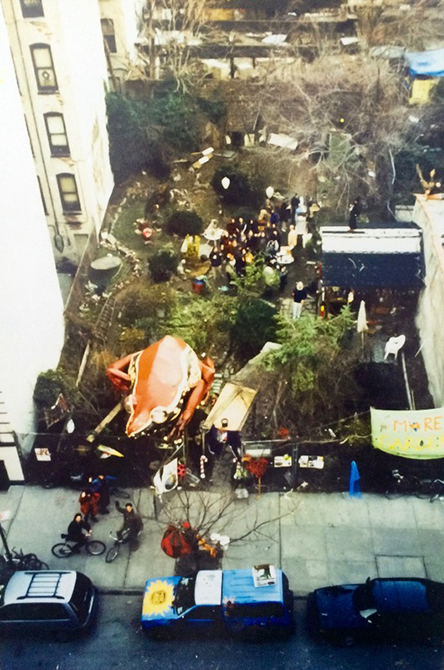
By 1999, the tense arguments over the rights and ownership to the community gardens peaked, culminating in the Esperanza Garden Occupation. Threatened with demolition, protestors gathered for a 24-hour encampment to protect the space, building barricades and camping out in the garden. They slept in the Coqui, a large, frog-shaped tree house and a symbol of Puerto Rico.
Along with Esperanza, Mayor Giuliani had chosen 113 other community gardens, which had previously been under GreenThumb’s jurisdiction, to auction off to the highest bidder. Two non-profit public-private partnership groups, The New York Restoration Project and The Trust for Public Land came in to save the day, purchasing the lands from Giuliani's auction for $4.2 million, with a significant contribution from New York actress Bette Midler. Under the auction conditions, two the non-profit groups agreed to maintain the lots as community gardens and be responsible for the maintenance and upkeep of the gardens.
But this didn’t stop the continued destruction at the hands of private development interests. In February of 2000, the gardeners and activists of Esperanza received word a bulldozer would be coming. That very morning, state Attorney General Eliot Spitzer was filing papers calling for an injunction barring the destruction of more gardens until further review. Protesters locked themselves to the fence and to the Coqui at Esperanza, but despite their best efforts, the bulldozer demolished the majority of the garden before Spitzer’s injunction could go through that afternoon. The judge, Judge Richard Huttner, was so upset that the police and the bulldozer hadn’t waited for his decision that he granted a temporary restraining order on the development of GreenThumb land, protecting over 200 community gardeners. Spitzer declared that Mayor Giuliani had “subverted the legal process” in pushing ahead with the bulldozing while the injunction was in deliberation.
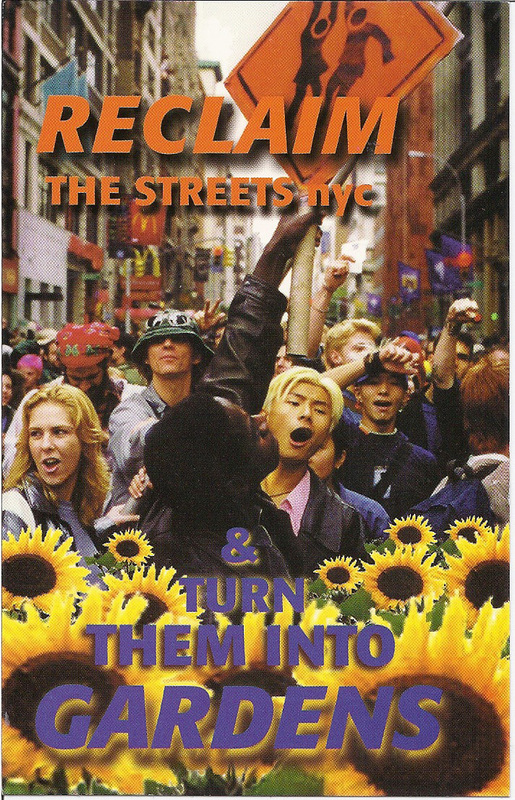
Finally, after three years of ongoing legal battles, an agreement was signed in 2002 between Mayor Michael Bloomberg and State Attorney General Eliot Spitzer, securing the future of city-owned community gardens. The agreement called for a lift on the previous restraining order, allowing the City to immediately build affordable housing on 38 gardens while protecting 400 others from future development. In a news conference at City Hall, Mayor Bloomberg stated, “Our hope is that this satisfies everybody to the extent that they can be satisfied.”
Today, there are nearly 600 community gardens in New York City, with 39 of them concentrated in the Lower East Side and East Village, the neighborhood where it all started. According to a 2010 Greenthumb Community Survey, approximately 80% of community gardens in NYC grow food; 65.6% of community gardens compost, and 43% of community gardens partner with at least one local school, cites the survey. In September in 2010, the agreement between Mayor Bloomberg and Attorney General Spitzer from 2002, which had preserved nearly 400 gardens, was updated. These new rules stated that new gardens will be allowed and will receive the same protections as existing ones. While very few gardens have been created since 1999, the City, local organizations, and private-public partnerships, like The Trust for Public Land and The New York Restoration Project, have worked productively together throughout the majority of the 21st century to ensure the long term viability of community gardens. Although public, open, green-space in New York remains vulnerable to commercial interests still today, the gardens have become integral to New York City’s urban landscape. Having emerged out of governmental neglect and “seed-bomb” activism, the gardens are now sites of pride for both the communities and the City at large.