
1. Progressive Era School Gardens & the Department of Parks
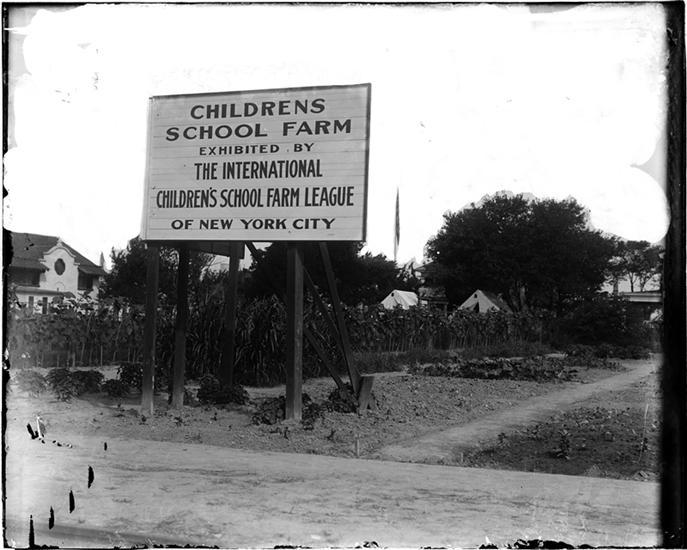
At the turn of the twentieth century, school gardening in cities began as a nationwide initiative not only to create gardens for children, but also to foster a range of health benefits and skills that this education could provide. This movement peaked between 1900 and 1920, and was the product of one tract of Progressive Era urban reform. Reformers pulled from a unique list of ideals and theories related to progressive education, which included the City Beautiful Movement and the small parks movement. Utilizing areas designated as municipal spaces, reformers instilled life lessons into urban immigrant children through educational nature endeavors and communal collaboration. Through the use of these selected public spaces, the program initially thrived, but ultimately the effort was phased out over time.
The idea of forming small neighborhood parks began in the mid-nineteenth century, when the city was searching for ways to counteract the effects of industrialization and urbanization. Officially, the Small Parks Act passed in 1887, which enabled the city to spend resources to plan and construct parks in rundown neighborhoods like “Hell’s Kitchen” or the Lower East Side. Open spaces were thought to provide a benefit to public health, respite from crowded urban living conditions, and the chance for citizens to experience nature. Piggybacking off of this idea was the school garden movement, which focused on these benefits, but aimed specifically at children in a more hands on approach.
One of the first school gardens began in New York City in 1902 by progressive reformer Frances Griscom Parsons. The “Children’s School Farm” was created on a plot of land which had been slated to become public parkland through Small Parks Act. Initially, this area was vacant and unimproved due to lack of funding. Being in the geographic region termed “Hell’s Kitchen,” this neighborhood was known as a place overrun with disease and foul living conditions. Crowded tenement life was commonplace for immigrant children, and through this program, Parsons was able to provide relief from these congested and deplorable settings. Her assertion was that the environment presented in this program would transform their behavior and guide them towards responsible citizenship.
Parsons initially believed that the Children’s School Farm was a temporary experiment, due in part to the fact that it was created with private funding and on land that was borrowed from the Department of Parks. Not having ownership of the land was reason for concern, but since the farm was such a great initial success, the department allowed the project to remain open. Parsons was hired to help maintain and run the property. It was officially opened under the name De Witt Clinton Park in 1905.
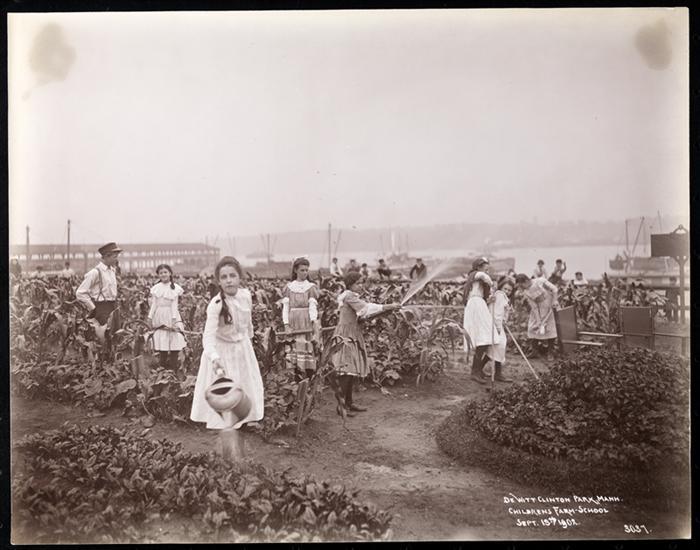
The school gardening movement reached its peak in the mid 1910s. When World War I began, the focus and outcomes from the program shifted to promote gardening as a way to supplement local food production. The federal government provided funding during this time period. During this period, the “United States School Garden Army” was formed to help with the War effort. Unfortunately, at the close of the war, the federal government cut funding to the program, which had a negative impact on children’s gardening programs. By 1920, the federal government had closed the Office of School and Home Gardening. Since New York City’s program was funded at the local level through the Department of Parks and the School Garden Association, this helped to keep the city’s gardens open. The war garden movement was further continued with “Victory Garden” projects during World War II, which began long after the end of the school garden movement.
Fannie Griscom Parsons passed away in 1923, and left her legacy to her son Henry, who continued work on the school farm and garden movement. Officially, the program was taken over by Edward Miller, Parson’s former assistant. By 1930, there were nine school farms operating in Manhattan. During the Great Depression, these farms were used to increase food production, in addition to the original educational incentives of promoting reprieve from urban life for youth. While the school farm movement continued as a whole, in 1932, Parson’s Children’s School Farm at DeWitt Clinton Park was destroyed during the expansion of Twelfth Avenue and the construction of the Miller Elevated Highway. Similarly, many school parks followed suit and were closed in subsequent years. The shift from education to food production had changed the initial project’s purpose, and the reliance on permanent public space was always an issue.
The Children’s School Farm represents a transition in the history of public parks. With the expansion of urban areas in the nineteenth century, projects like the Children’s School Farm and other school gardening movements shows us how people began to shape the use of public space. From the school gardening movement, we can see the importance that women and children played in determining and shaping the use of communal spaces in New York City. The country’s shift from a pastoral landscape to an urban civilization saw the creation of many new issues. As far as the issue of a city’s use of public space, this was one of the first battlegrounds, where through the help of progressive reformers, communities came together to shape vacant and unused city-owned lots into their own creations.