Teresa Reyes-Trujillo
Documenting Domesticity
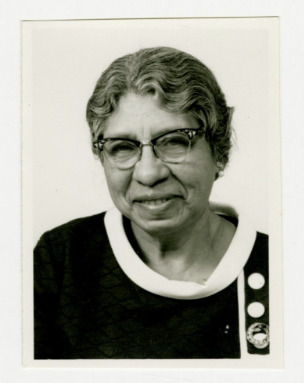
Teresa Reyes Trujillo was just three years old when she left her home in Silao, Mexico for a new life in the United States. In May 1910, she and her parents, Maximo and Marciano Reyes, boarded a train that would take them across Mexico to El Paso, Texas. The border crossing there was busy, but unencumbered by the kind of U.S. government inspection and approval process that immigrants encountered more than two thousand miles further north at Ellis Island. Technically, the family should have registered with immigration authorities in El Paso and gotten a “card manifest.” But the government didn’t track those crossing the border who planned to stay for less than six months. It’s possible the Reyes family intended to return to Mexico. What is clear is that there is no official record of their arrival. That oversight would reverberate for more than six decades.
In 1971, Trujillo decided to apply for legal permanent residency. Government policy allowed it, if she could prove she had lived continuously in the U.S. since before 1924. What initially may have seemed like a straightforward task became an immense challenge—one made vastly more difficult by something Trujillo wrote down in 1940 when, in her first known contact with immigration authorities, she filled out an Alien Registration Form. In it, she identified herself as a “House wife.” When she applied for legal status three decades later, she answered “NONE,” in response to a question about employment on a government form. And with that, Trujillo was in a bind. She had no record of her initial entry to the U.S., and she told government authorities that she had no employment history. That meant she had no pay stubs or tax forms, none of the documents associated with employment that might have proved that she’d lived in the U.S. for decades.
So how could Trujillo prove she’d been in the country since before 1924? How could a woman retroactively document domesticity? The pages in this A-file show the challenges—and contortions—of Trujillo’s attempt to make her domestic life visible enough to meet the demands of the government.
Not a Citizen? Registration Required
On September 18, 1940, Teresa Reyes Trujillo filled out this Alien Registration Form, the U.S. Immigration and Naturalization Service's Form AR-2, in order to comply with the Alien Registration Act. Enacted in 1940, the law required that anyone living in the United States who was not a citizen or national register with the government. To do so, Trujillo would have gone to her local post office, gotten fingerprinted, and answered a series of questions about her background. Trujillo's responses revealed details both matter-of-fact, such as her address in Pomona, California where she lived, and personal, like her nickname being “Daisy.” But two of Trujillo’s answers would prove most important over the years to come: she described her occupation as “House wife” and she said she planned to live in the U.S. permanently.
Having filled out the form, Trujillo was assigned an Alien Registration Number, 1866065, and for the next thirty-plus years all of her official work with the INS would be collected based on that number and compiled in what would become known, as of 1944, as an A-file.
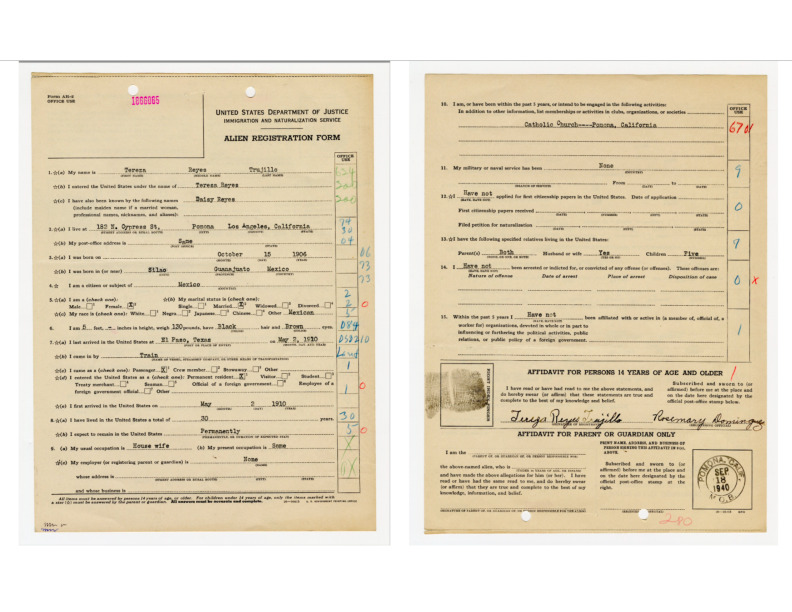
Alien Registration Form for Teresa Reyes Trujillo, 1940.
Mystery Letter
Trujillo first began the process of trying to get legal permanent residency in 1971, but her initial attempt was unsuccessful. Immigration authorities said she didn’t have enough proof that she had lived in the U.S. continuously since before 1924. Trujillo then embarked on an effort, over the course of the following year, to assemble evidence of her life in Pomona, California where she said she’d been living for decades.
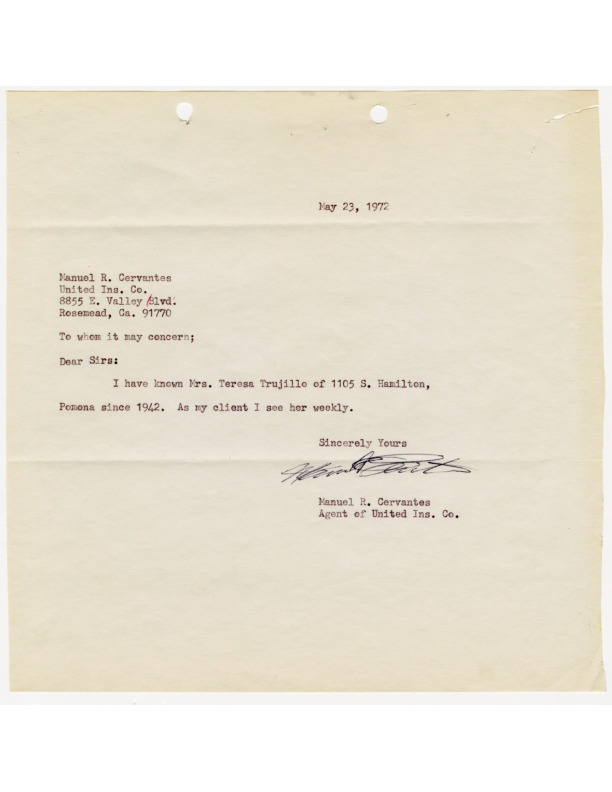
Among the papers she gave to the INS was this May 1972 letter from Manuel Cervantes. In it, Cervantes, a California insurance agent, says he’s seen Trujillo every week since 1942. He doesn’t explain the circumstances. Could Trujillo have worked for him off the books?
Cervantes describes Trujillo as his “client,” but it would be odd for an insurance agent to see a client with such frequency. Perhaps the real story is that Trujillo was, say, cleaning for Cervantes weekly, but he couldn’t say that outright since Trujillo had already told the INS she didn’t have a job. It’s a reasonable possibility. After all, domestic work was among the few career paths open to Mexican women at the time. Growing up in California, Mexican girls like Trujillo would have been prepped for and pushed toward domestic work, and if this manual for California teachers is any guide, that messaging would have begun from their earliest days in school.
Confirming Community
Trujillo lived the majority of her life in Pomona, a small agricultural town, where she attended school and would raise six children with her husband, Doroteo Trujillo. As Teresa Trujillo built a life there, the Catholic church seemed to play an important role. The church was the only organizational affiliation she listed on her Alien Registration Form in 1940, and now more than three decades later she leaned heavily on church records to make her case to the INS.
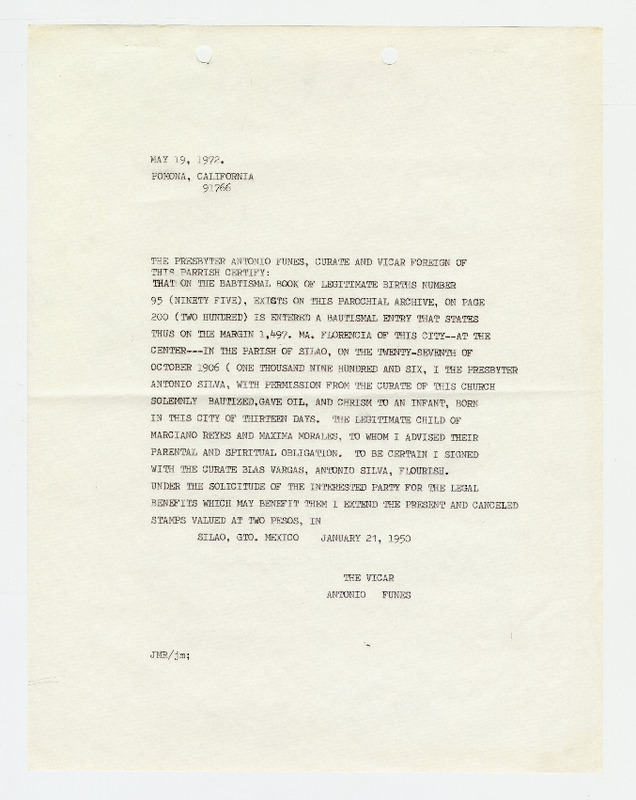
Letter from Vicar Antonio Funes of Silao confirming Teresa Trujillo's baptism at in his parish in October of 1906, 1972.
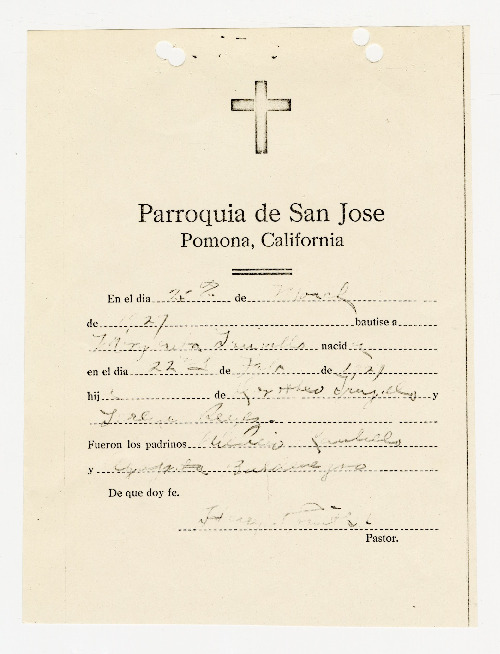
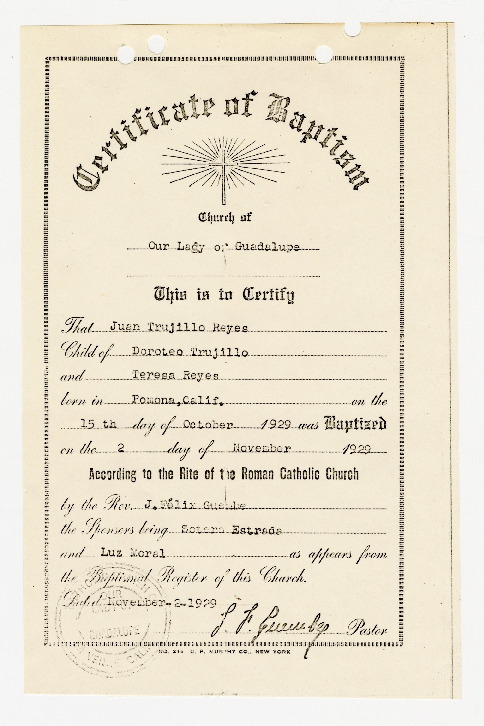
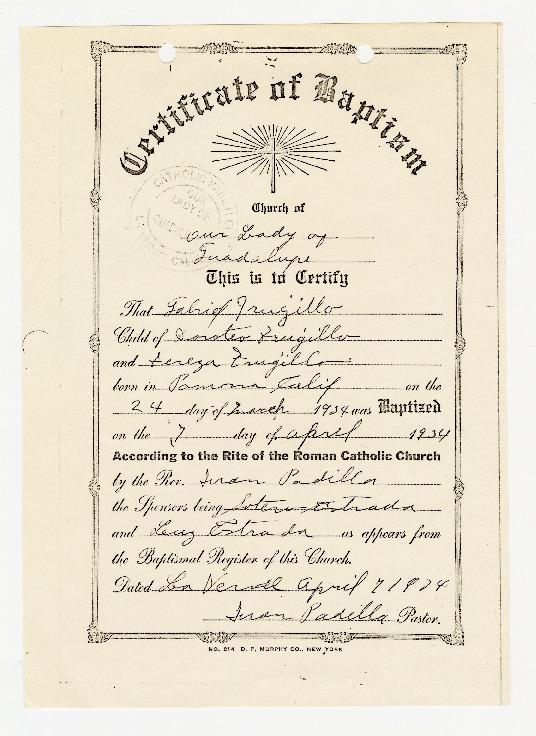
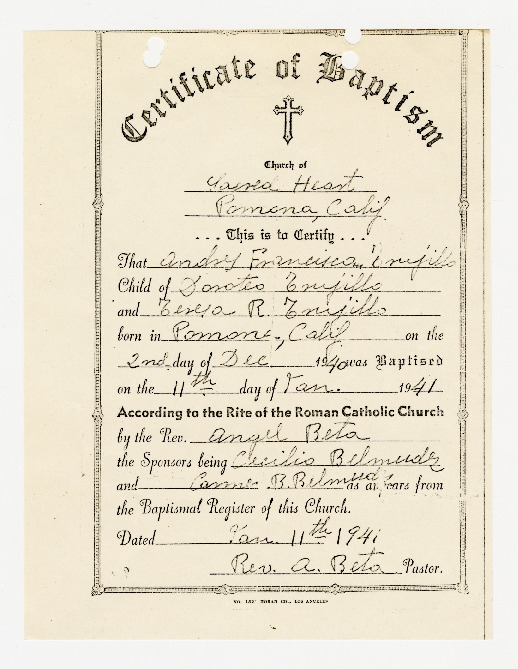
Church records served two purposes for Trujillo. The association with the church suggested her good moral character, which was important to immigration authorities. But as she tried to prove to the INS that she’d come to the U.S. as a child prior to 1924 and had resided there ever since, her Catholicism became even more important. Trujillo’s children had been baptized in California, and the church generated records for those rituals that placed her and her family in California.
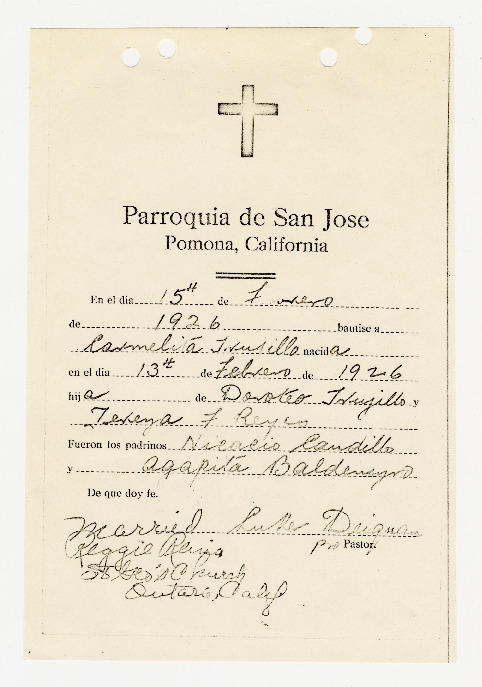
Baptismal certificate for Carmen Trujillo, Teresa's eldest daughter, 1926.