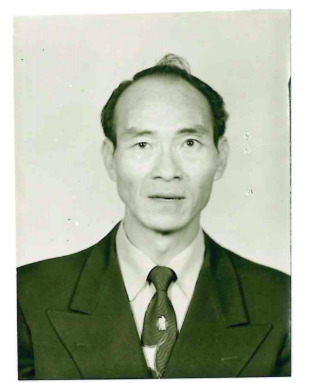
"George" Yuke Kee Lee
Confession of a Paper Son
Yuke Kee Lee, or “George” as he would later be known, was born in the Guangdong Province of China in 1906. It’s unclear exactly why Lee decided to leave Guangdong and come to the United States, but what is clear is that he found a way to circumvent Chinese Exclusion laws. In 1922, using the name Shing Yim, Lee traveled as a sailor aboard an American passenger ship, the S.S. President Taft, in order to meet with his uncle Lee Yun Cheong, who was already in the United States.
Between 1882 and 1943 when Chinese Exclusion laws were in effect, an estimated half of all Chinese immigrants entered the United States illegally. Like Lee, Chinese migrants found ways to bypass rules meant to keep them out. Many Chinese migrants would use fake documents to pose as the children or relatives of American-born Chinese because such relatives would have a rare legal path to the U.S. Those who used made-up relationships with an American would come to be known as “paper sons” or “paper daughters.”
When Lee arrived in the U.S. in 1922, he quickly found work as a barber in Sacramento. By the early twentieth century, Chinese Americans had been pushed out of economic sectors like agriculture. Cities, however, offered new opportunities in the service industry, most notably in restaurants and laundries, but also in barbershops. Although Lee may have been pushed by prejudice into the profession, it seems he found a tight-knit community among his colleagues.
The majority of the materials in Lee’s A-file relate to his pursuit of naturalization in 1957 and 1958. Lee’s A-file reveals that his journey from “registered alien” to permanent resident to naturalized citizen was shaped by the government’s stereotypes about Chinese immigrants. Lee would have to overcome presumptions regarding his criminality and moral character. If he was to obtain legal status, Lee had to produce sufficient evidence to the state that would disprove its negative perception of Chinese migrants.
Retroactive Records
By the 1950s, the Chinese Exclusion Act had been repealed, but the impact of it lingered. Paper sons and paper families still had to keep up the ruse of their false relationships or risk being caught up in INS or anti-Communist proceedings.
The government viewed paper families as a problem as well, but for different reasons. After several high profile court cases, it wanted to find a way to expose paper families without disrupting Chinese communities and inviting legal backlash. That’s why in 1956 the INS branch in San Francisco created the Chinese Confession Program, which offered Chinese immigrants who had come to the U.S. under false names the chance to confess and apply for legal status.
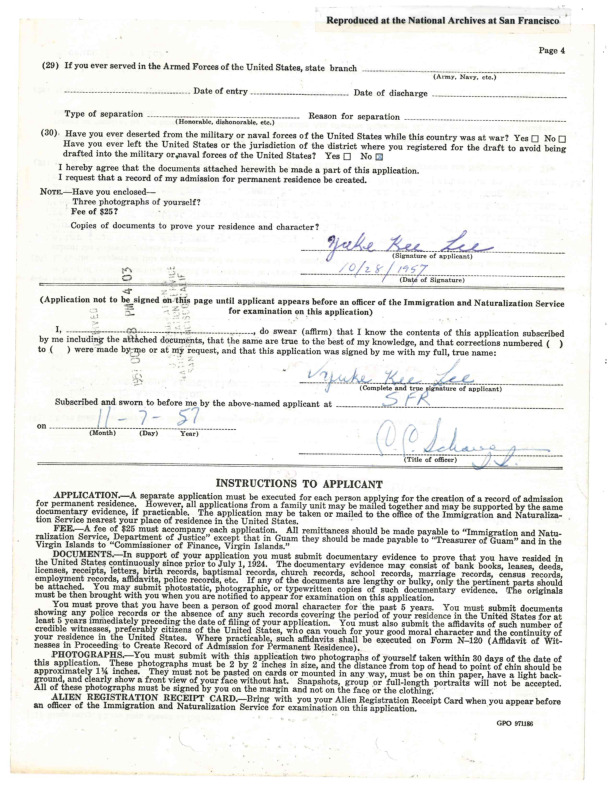
The program likely prompted Lee to try to legalize his status. Although some Chinese families became divided over whether an individual member should confess, Lee had no children or immediate family who could be implicated if he confessed. Despite this, his path to naturalization was not exactly smooth.
Although Lee had confessed to his use of an alias, he had still entered the U.S. before 1924, when records of admission became mandatory at immigration checkpoints. Because of this timing, there was no record of his entrance into the country, even under a false name. In order to rectify this and begin the naturalization process, he had to first retroactively create a record of admission.
Pictured right is the last page of Form N-105: Application to Create Record of Admission For Permanent Residence. This page of the form contains Lee’s signature (dated 10/28/1957) and the signature of the INS officer who approved his application (dated 11/7/1957).
The bottom of this page also contains detailed instructions for how to complete this form. Most importantly, it stipulates that the applicant “must submit documentary evidence” which proves that they have both “resided in the United States continuously since prior to July 1, 1924” and have been “a person of good moral character for the past 5 years.” The majority of Lee’s A-file is dedicated to providing such documentation.
Peril and Prejudice
In the late nineteenth century, decades of economic hardship, political instability, war, and natural disasters sparked new waves of migration out of Guangdong. While many envisioned migrating to the United States, the Chinese Exclusion Act of 1882, the first federal law to prohibit an ethnic group from entering the country, dimmed that hope. Yellow-peril imagery cast Chinese migrants as dangerous and backwards people. Nativists conflated the racial characteristics of immigrant populations with the impoverished conditions of higher density, higher crime, and vice districts. In San Francisco’s Chinatown, the rise of criminal organizations, called Tongs, and opium dens in late 19th century sparked a plethora of racist imagery and sentiment.
In 1943, Congress passed the Magnuson Act which repealed Chinese Exclusion after 61 years of restriction. However many of the paper sons and daughters who migrated during the period of exclusion were still left in the U.S., their identities unknown to the state. As the Cold War escalated and national security concerns increased, the state sought to eliminate paper immigration by documenting Chinese migrants.
However, the rise of McCarthyism had given a second wind to the idea that Chinese migrants posed a threat to white American ways of life. While some were now able to gain legal status, documentation hardly elevated their socio-political or economic status. Rather new criminal conflations of Chinese migrants with communist infiltrators added to their perceived inherent criminality.
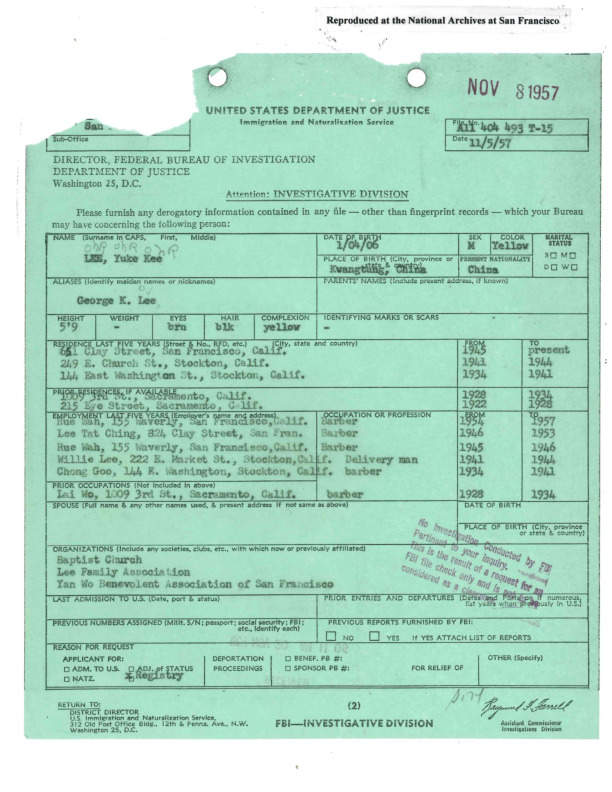
Form G-135 for "George" Yuke Kee Lee, 1957.
Pictured above is a copy of Form G-135. The INS would submit this form, known as the Agency Name Check, to the Federal Bureau of Investigation (FBI) to launch a background check. Applicants for legal status could be rejected if the FBI discovered they had engaged in criminal or suspicious activity.
In Lee’s Agency Name Check form, one sees that it required that migrants provide a detailed timeline of his addresses, employment history, and organization memberships.
Wrong Place, Wrong Time?
According to this letter from the Sacramento Police Department, which would have been produced by the background check, Lee was charged with vagrancy on August 25, 1937. Lee, who was living in Stockton at the time, received a 60-day suspended sentence on the condition he leave Sacramento. While the letter leaves out the details surrounding Lee’s arrest, a close read of the letter and connections to a local newspaper, the Sacramento Union, help fill in the picture.
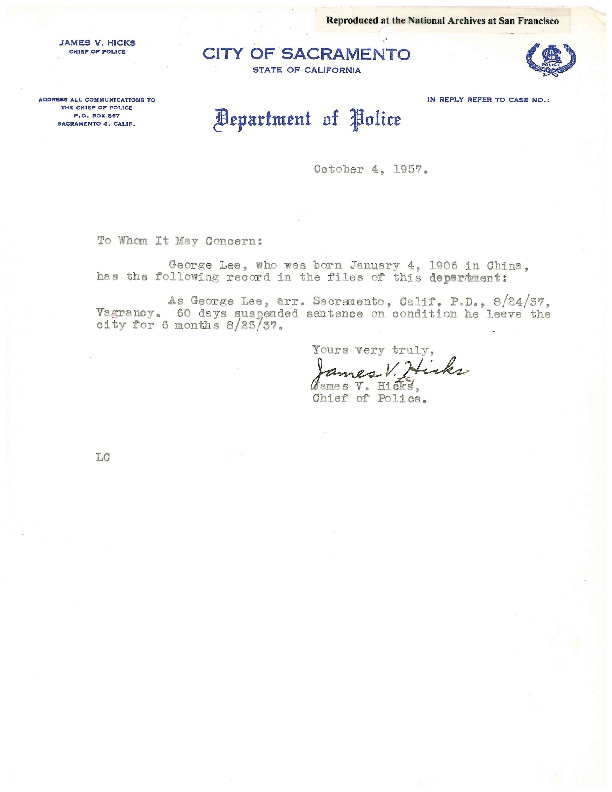
Letter from the Sacramento Police Department regarding "George" Yuke Kee Lee's police record. Submitted to the INS in response to Form G-135, 1957.
Character Study
Since the Nationality Act of 1790, immigrants have been asked to prove that they are people of good character worthy of being admitted to the U.S. While on the surface reasonable, this requirement has often been used to exclude various immigrant groups.
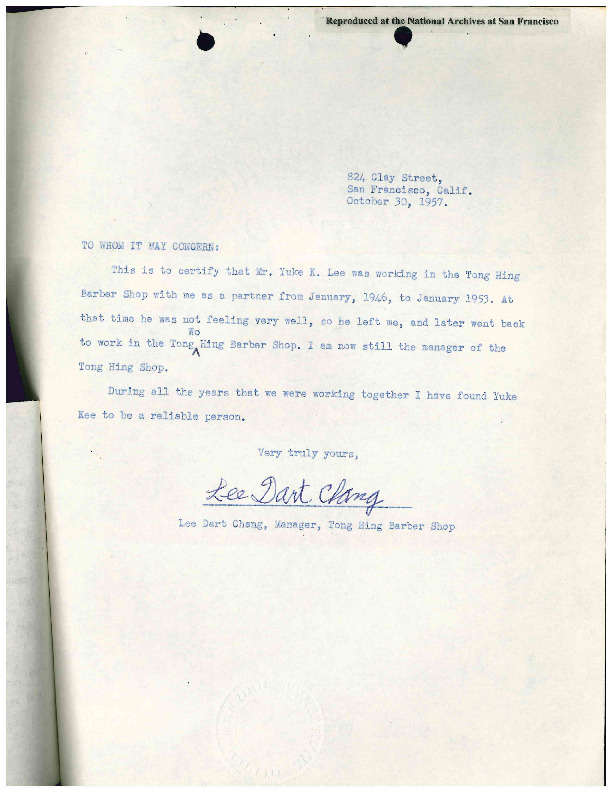
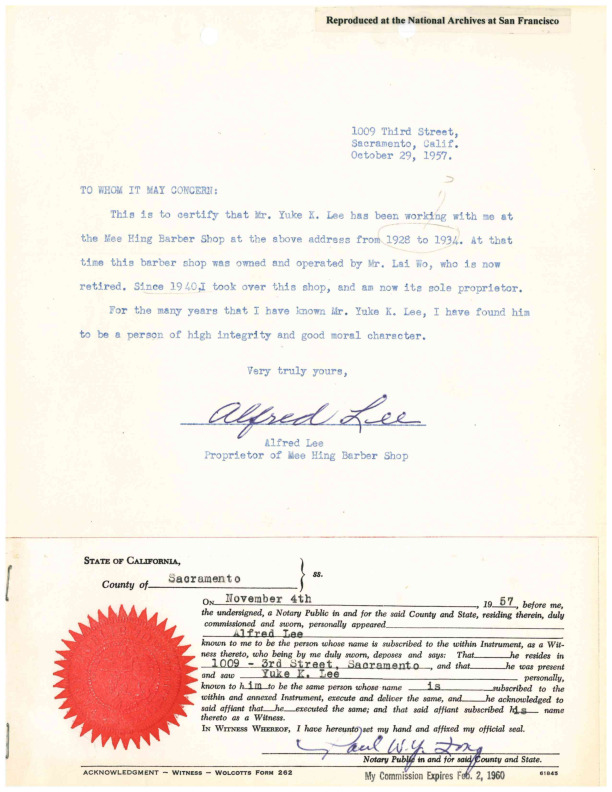
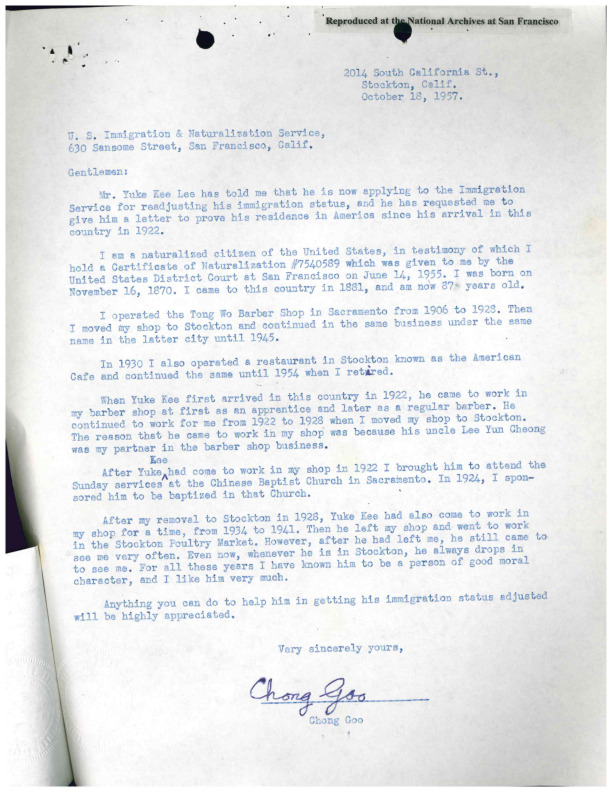
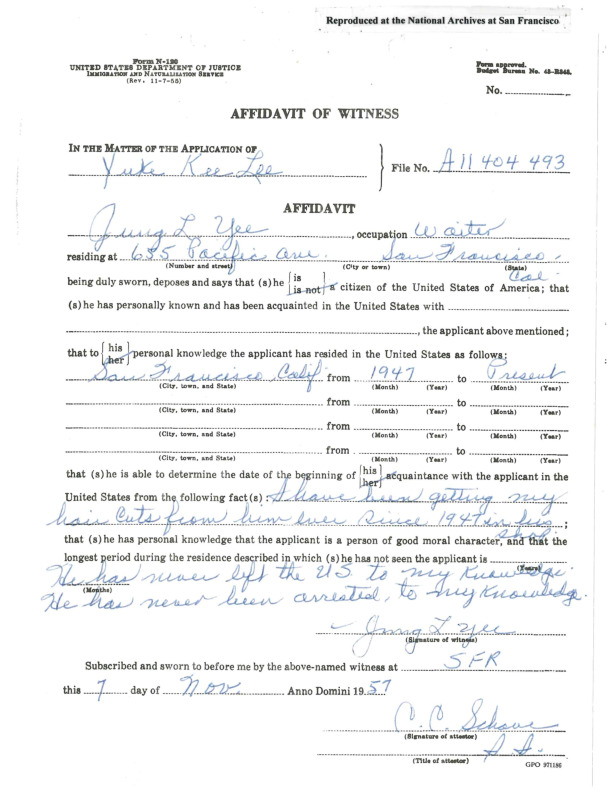
How migrants chose to prove their good moral character varied from person to person and depending on the historical context. While clean police reports were required and church records encouraged, by far the most common type of documents included for this purpose were affidavits from people who could attest to a migrant’s character. In Lee’s case, he relied heavily on affidavits from his colleagues.
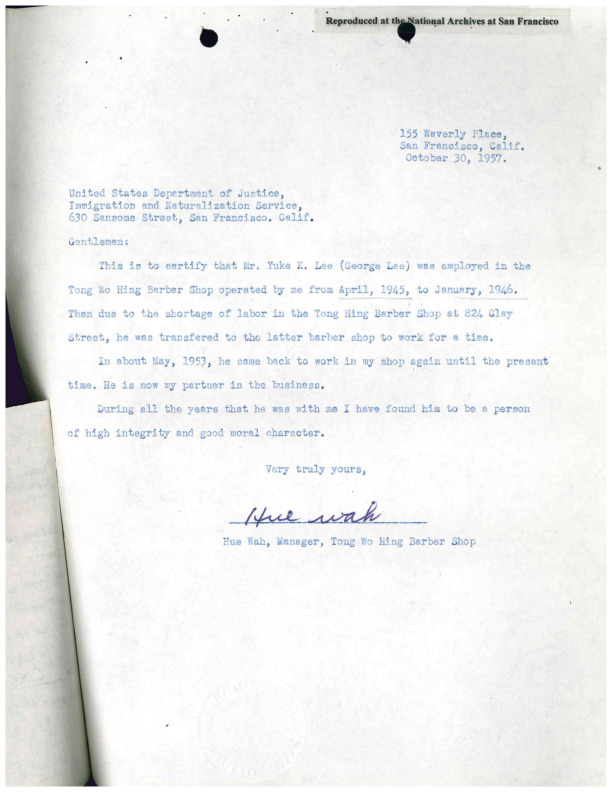
Affidavit of Hue Wah. Submitted on behalf of "George" Yuke Kee Lee, 1957.
Community in Chinatown
While not the intended purpose of the affidavits, these letters are often rich sources of information regarding the personal and community lives of migrants, especially when other sources provide little to go on. In Lee’s file, for instance, looking just at his naturalization forms would paint a rather sad picture of a man in his early fifties with no wife, no children, and no other family. However, the affidavits show us a version of Lee with a very active social life which revolved around his work.
There are six affidavits in total; one from his doctor, one from a client, and four from his colleagues. From their names and the addresses they provide, we can surmise that much of his social life was composed of other Chinese men who resided nearby in San Francisco’s Chinatown. That so many people were willing to go through the trouble of submitting affidavits for him shows us that these were not just surface-level relationships, but rather deep community ties.