Excerpt on Pauperism
Item
-
Title
-
Excerpt on Pauperism
-
Description
-
This item is an excerpt from a report to the New York State legislature, by a committee appointed to evaluate the state's charitable institutions, workhouses, and jails. In the mid-1800s, there was little meaningful distinction between being poor and being a criminal, and a wide variety of actions (including homelessness, drunkenness, or mental illness) could lead to incarceration in a state institution.
-
Creator
-
New York state legislature; Select Committee Appointed to Visit Charitable Institutions Supported by the State and all City and County Poor and Work Houses and Jails of the State of New York
-
Publisher
-
C. Van Benthuysen, printer to the legislature
-
Date
-
1857
-
Type
-
Print book
-
Format
-
PNG image
-
Language
-
English
-
Subject
-
pauperism, poverty, workhouse
-
Place
-
New York
-
Temporal Coverage
-
19th century
-
Rights Holder
-
U.S. National Library of Medicine
-
Rights
-
Public Domain
-
transcription
-
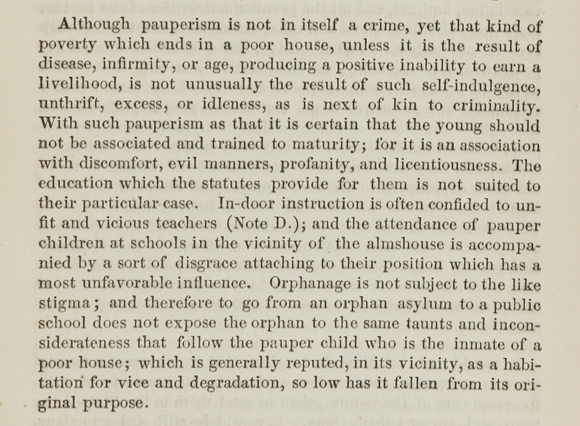
Although pauperism is not in itself a crime, yet that kind of poverty which ends in a poor house, unless it is the result of disease, infirmity, or age, producing a positive inability to earn a livelihood, is not unusually the result of such self-indulgence, unthrift, excess, or idleness, as is next of kin to criminality. With such pauperism as that it is certain that the long should not be associated and trained to maturity; for it is an association with discomfort, evil manners, profanity, and licentiousness. The education which the statues provide for them is not suited to their particular case. In door instruction is often confided to unfit and vicious teachers (Note D.); and the attendance of pauper children at schools in the vicinity of the almshouse is accompanied by a sort of disgrace attaching to their position which has a most unfavorable influence. Orphanage is not subject to the like stigma; and therefore to go from an orphan asylum to a public school does not expose the orphan to the same taunts and inconsiderateness that follow the pauper child who is the inmate of a poor house; which is generally reputed, in its vicinity, as a habitation for vice and degradation, so low has it fallen from its original purpose.