-
 The McCabe Lunacy Case -- Testimony of the Doctors as to the Insanity of Miss McCabe
 This article outlines the testimonies of Drs. Bradford & Burdick declaring Rose McCabe insane before the Court. These accounts did not always align with Rose McCabe's testimony, which raises questions as to whose testimonies should be believed.
-
 Emily Graham's Death
 This newspaper article tells the story of Emily Graham, who was institutionalized in an asylum on Blackwell's Island after police officers arrested her on charges of drunkenness. Her husband managed to locate her, allowing her to stay in the asylum for treatment; but she quickly deteriorated from substandard, abusive medical care and eventually died from her wounds.
-
 The Case of Jacob B. Stockvis
 This document details the jury findings in the inquest of the death of Jacob Stockvis after his stay in Blackwell's Island's workhouse. The workhouse system was designed to strike a balance between punishment and rehabilitation by identifying the culprits of minor crimes and assigning them short-term sentences where they could reform their ways.
-
 An Insane Hollander Killed
 This newspaper article describes a coroner's inquest into the case of Jacob Stockvis, a mentally ill man. Stockvis was arrested and imprisoned in the workhouse on Blackwell's Island on charges of drunkenness, all while his friends and family searched for him. Stockvis died due to his treatment in the workhouse shortly after being found.
-
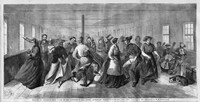 Dancing by Lunatics -- Ball Given to the Patients of the Insane Asylum on Blackwell's Island, New York
 Blackwell's Island was a grim place but there were lighthearted moments, as this newspaper clipping from 1865 shows. The image depicts asylum patients partaking of merriment.
-
 The M'Cabe Lunacy Case: Sister Stanislaus Before a Court in Her Own Defense
 McCabe wanted to prove her sanity and tell her side of the story. McCabe argued that she should never have been detained at the Bloomingdale Asylum or, subsequently, the New York City Lunatic Asylum. At the time this article was published, Rose McCabe had been relocated to the New York City Lunatic Asylum on Blackwell's Island (at her own request) as a result of the poor treatment she received at the Bloomingdale Asylum.
-
 "Bloomingdale Asylum for the Insane" -- 1872
 This idyllic image of the Bloomingdale Asylum's main building portrays patients leisurely strolling the grounds of the privately owned asylum. This particular image leaves one wondering whether life was truly as good as it seemed inside such an institution, and how this life may have differed from one lived at a publicly owned institution, such as the New York City Asylum of Blackwell's Island. Rose McCabe was one of the few individuals to find out.
-
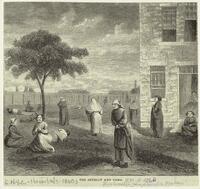 Retreat and Yard
 This etching depicts female asylum patients aimlessly wandering the grounds, with no attendants (doctors or nurses) in sight. Neglect of inmates and patients was all too common on Blackwell's Island, and a cause of death for many.
-
 Playing Mad Woman
 This newspaper article from The Sun recounts Nellie Bly's undercover expose of sordid conditions on Blackwell's Island. Bly's story is unusual because she feigned insanity and secured a quick release from the asylum, but her story is also remarkable for its results: bringing the conditions of Blackwell’s Island to the public’s attention and making those conditions a widespread public health concern, both of which led New York City to implement changes on Blackwell's Island.
-
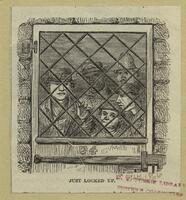 Workhouse on Blackwell's Island Just Locked Up
 This etching depicts five male inmates in the workhouse on Blackwell's Island, inside a single cell. Their differing expressions and unknown backgrounds raise questions as to how they found themselves together on Blackwell's Island.
-
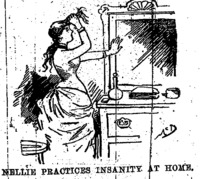 Nellie Practices Insanity at Home
 This image is an illustration from Nellie Bly's 1887 book, Ten Days in a Mad-House, detailing Bly's undercover work as an inmate at the female asylum on Blackwell's Island. Bly's book caused a stir, exposing the asylum’s wretched conditions to a public audience.
-
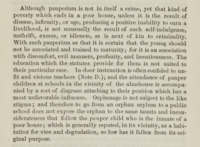 Excerpt on Pauperism
 This item is an excerpt from a report to the New York State legislature, by a committee appointed to evaluate the state's charitable institutions, workhouses, and jails. In the mid-1800s, there was little meaningful distinction between being poor and being a criminal, and a wide variety of actions (including homelessness, drunkenness, or mental illness) could lead to incarceration in a state institution.
