-
Title
-
The M'Cabe Lunacy Case: Sister Stanislaus Before a Court in Her Own Defense
-
Description
-
McCabe wanted to prove her sanity and tell her side of the story. McCabe argued that she should never have been detained at the Bloomingdale Asylum or, subsequently, the New York City Lunatic Asylum. At the time this article was published, Rose McCabe had been relocated to the New York City Lunatic Asylum on Blackwell's Island (at her own request) as a result of the poor treatment she received at the Bloomingdale Asylum.
-
Creator
-
New York Times
-
Publisher
-
ProQuest Historical Newspapers: The New York Times with Index
-
Date
-
September 04, 1872
-
Type
-
Newspaper Article
-
Format
-
PNG
-
Language
-
English
-
Identifier
-
ProQuest Document ID 93280031
-
ISSN 03624331
-
Subject
-
Lunacy
-
Statement
-
Defense
-
Supreme Court
-
Blackwell's Island
-
New York City Lunatic Asylum
-
Bloomingdale Asylum
-
Place
-
New York City
-
Temporal Coverage
-
19th Century
-
Rights Holder
-
New York Times Company
-
Rights
-
Public Domain
-
transcription
-
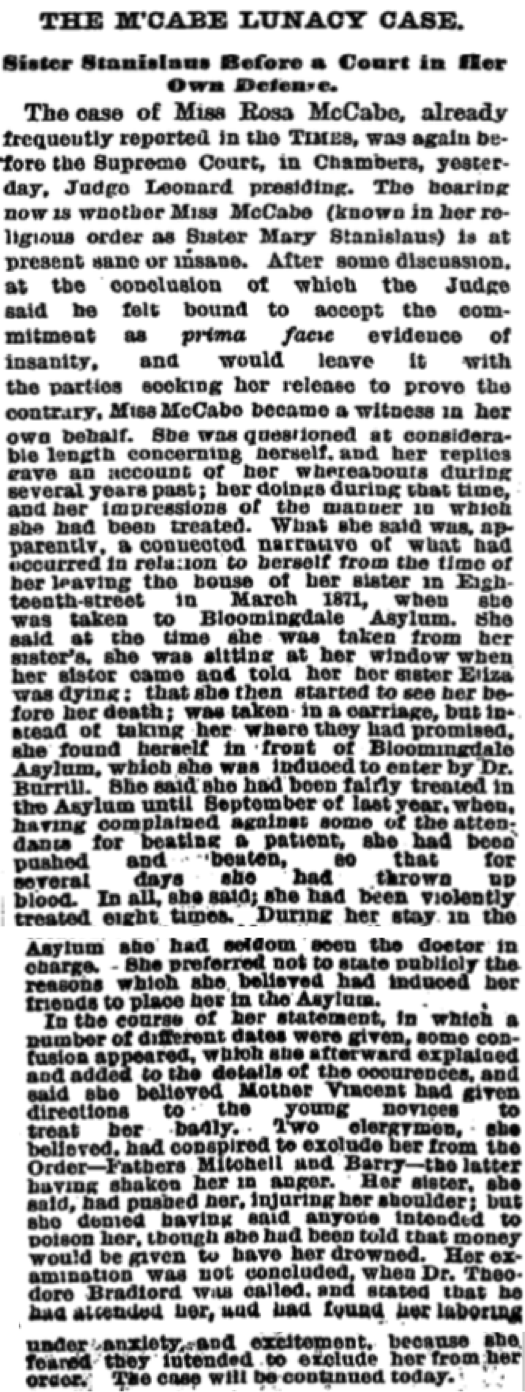
The M'Cabe Lunacy Case. Sister Stanislaus Before a Court in Her Own Defense.
The case of Miss Rosa McCabe, already frequently reported in the TIMES, was again before the Supreme Court, in Chambers, yesterday, Judge Leonard presiding. The hearing now is whether Miss McCabe (known in her religious order as Sister Mary Stanislaus) is at present sane or insane. After some discussion, as the conclusion of which the Judge said he felt bound to accept the commitment as prima facie evidence of insanity, and would leave it with the parties seeking her release to prove the contrary, Miss McCabe became a witness in her own behalf. She was questioned as considerable length concerning herself, and her replies gave an account of her whereabouts during several years past; her doings during that time, and her impressions of the manner in which she had been treated. What she said was, apparently, a connected narrative of what had occurred in relation to herself from the time of her leaving the house of her sister in Eighteenth-street in March 1871, when she was taken to Bloomingdale Asylum. She said at the time she was taken from her sister's, she was sitting at her window when her sister came and told her her sister Eliza was dying; that she then started to see her before her death; was taken in a carriage, but instead of taking her where they had promised, she found herself in front of Bloomingdale Asylum, which she was induced to enter by Dr. Burrill. She said she had been fairly treated in the Asylum until September of last year, when, having complained against some of the attendants for heating a patient, she had been punished and beaten, so that for several days she had thrown up blood. In all, she said; she had been violently treated eight times. During her stay in the Asylum she had seldom seen the doctor in charge. She preferred not to state publicly the reasons which she believed had induced her friends to place her in the asylum.
In the course of her statement, in which a number of different dates were given, some confusion appeared, which she afterward explained and added to the details of the occurrences, and she believed Mother Vinvent had given directions to the young novices to treat her badly. Two clergymen, she believed, had conspired to exclude her from the Order --Fathers Mitchell and Barry -- the latter having shaken her in anger. Her sister, she said, had pushed her, injuring her shoulder, but she denied having said anyone intended to poison her, though she had been told that money would be given to have her drowned. Her examination was not concluded when Dr. Theodore Bradford was called, and stated that he had attended her, and had found her laboring under anxiety and excitement, because she feared they intended to exclude her from her order. The case will be continued today.