
Lewis B. Parsons to Montgomery Blair, Thursday, February 19, 1863
Dublin Core
Title
Lewis B. Parsons to Montgomery Blair, Thursday, February 19, 1863
Subject
United States--History--Civil War, 1861-1865--Economic aspects
Cotton
United States--History--Civil War, 1861-1865--Confiscations and contributions
Description
Quartermaster Lewis B. Parsons wrote to share his observations of the cotton trade in occupied territory. Considering the widespread speculation in cotton among officers, he recommended that all cotton be declared the property of either the federal government or the producer, which Parsons believed would "puts an end to most of the existing evils."
Creator
Lewis B. Parsons
Source
Library of Congress, Rare Book and Special Collections Division
Date
1863-02-19
Contributor
AB, PP
Rights
Public Domain
Format
gif
Language
English
Manuscript Item Type Metadata
Text
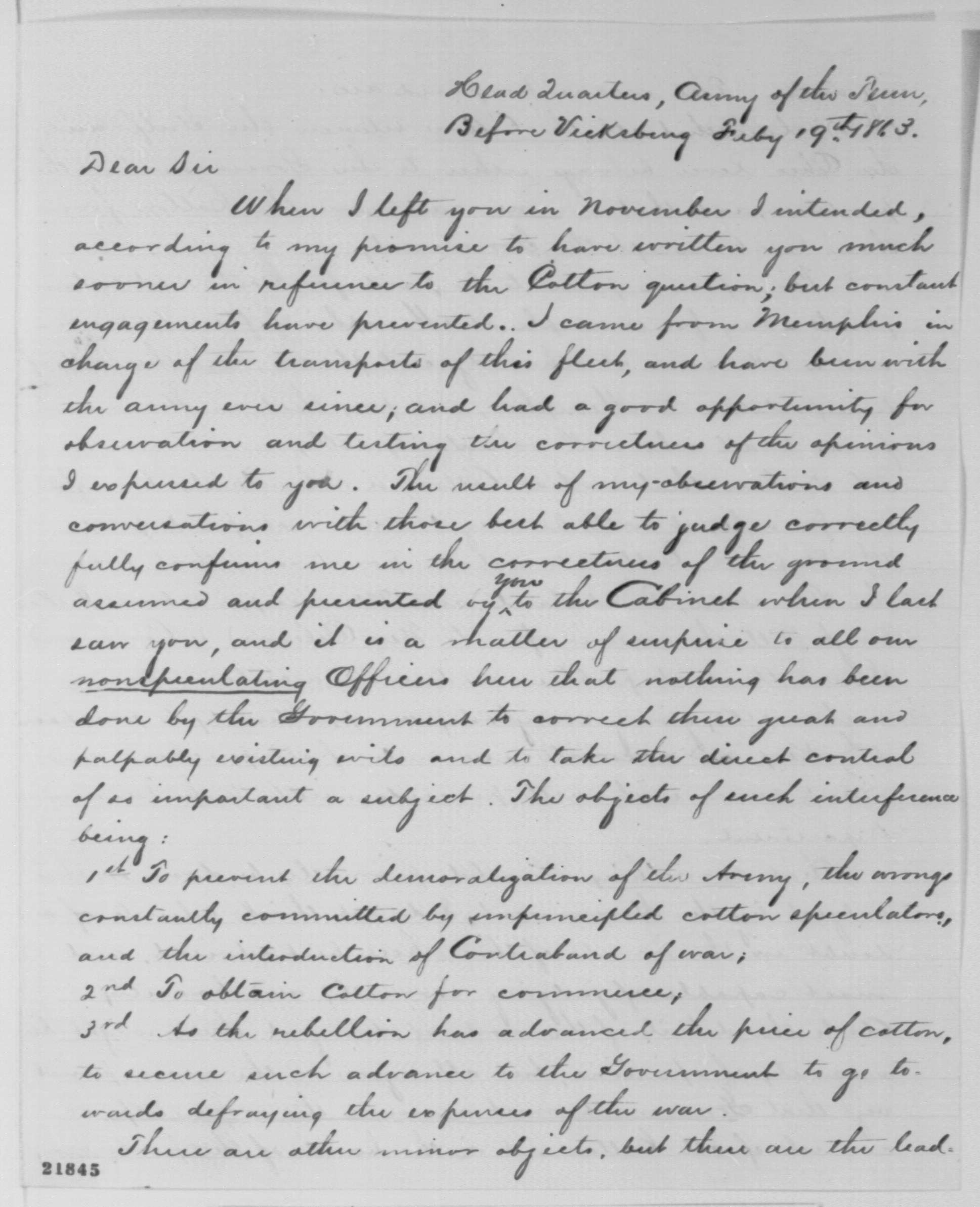
Head Quarters, Army of the Tenn,
Before Vicksburg Feby 19th 1863.
Dear Sir
When I left you in November I intended, according to my promise to have written you much sooner in reference to the Cotton question; but constant engagements have prevented. I came from Memphis in charge of the transports of this fleet, and have been with the army ever since; and had a good opportunity for observation and testing the correctness of the opinions I expressed to you. The result of my observations and conversations with those best able to judge correctly fully confirms me in the correctness of the ground assumed and presented by you to the Cabinet when I last saw you, and it is a matter of surprise to all our nonspeculating Officers here that nothing has been done by the Government to correct these great and palpably existing evils and to take the direct control of so important a subject. The objects of such interference being:
1st To prevent the demoralization of the Army, the wrongs constantly committed by unprincipled cotton speculators, and the introduction of Contraband of war;
2nd To obtain Cotton for commerce;
3rd As the rebellion has advanced the price of cotton, to secure such advance to the Government to go towards defraying the expenses of the war.
There are other minor objects, but these are the leading ones.-- The means proposed are:
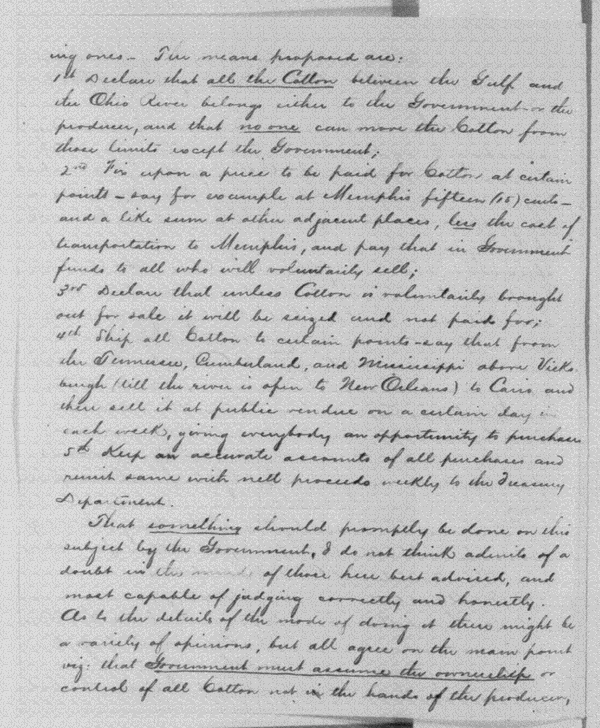
1st Declare that all the Cotton between the Gulf and the Ohio River belongs either to the Government or the producer, and that no one can move the Cotton from those limits except the Government;
2nd Fix upon a price to be paid for Cotton at certain points -- say for example at Memphis fifteen (15) cents -- and a like sum at other adjacent places, less the cost of transportation to Memphis, and pay that in Government funds to all who will voluntarily sell;
3rd Declare that unless Cotton is voluntarily brought out for sale it will be seized and not paid for;
4th Ship all Cotton to certain points -- say that from the Tennessee, Cumberland, and Mississippi above Vicksburgh (till the river is open to New Orleans) to Cairo and then sell it at public vendue on a certain day in each week, giving everybody an opportunity to purchase
5th Keep an accurate accounts of all purchases and remit same with nett proceeds weekly to the Treasury Department.
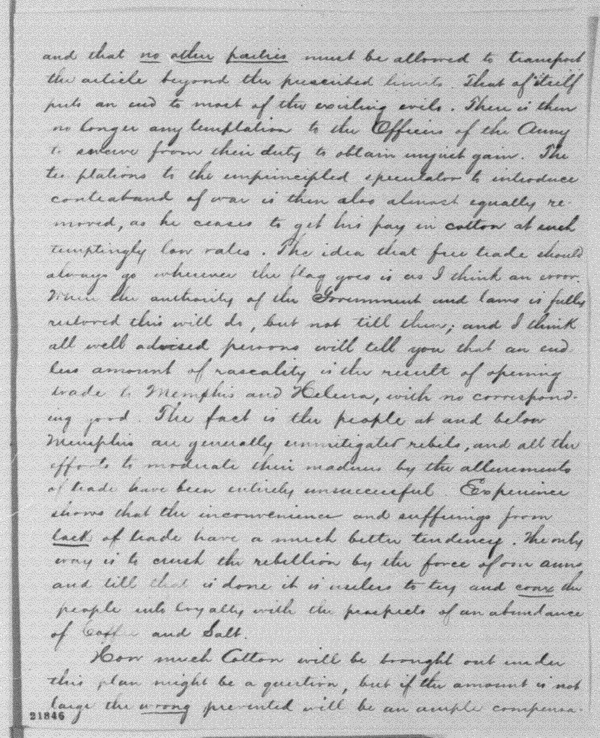
That something should promptly be done on this subject by the Government, I do not think admits of a doubt in the minds of those here best advised, and most capable of judging correctly and honestly. As to the details of the mode of doing it there might be a variety of opinions, but all agree on the main point viz: that Government must assume the ownership or control of all Cotton not in the hands of the producer, and that no other parties must be allowed to transport the article beyond the prescribed limits. That of itself puts an end to most of the existing evils. There is then no longer any temptation to the Officers of the Army to swerve from their duty to obtain unjust gain. The temptations to the unprincipled speculator to introduce contraband of war is then also almost equally removed, as he ceases to get his pay in cotton at such temptingly low rates. The idea that free trade should always go wherever the flag goes is as I think an error. When the authority of the Government and laws is fully restored this will do, but not till then; and I think all well advised persons will tell you that an endless amount of rascality is the result of opening trade to Memphis and Helena, with no corresponding good. The fact is the people at and below Memphis are generally unmitigated rebels, and all the efforts to moderate their madness by the allurements of trade have been entirely unsuccessful. Experience shows that the inconvenience and sufferings from lack of trade have a much better tendency. The only way is to crush the rebellion by the force of our arms and till that is done it is useless to try and coax the people into loyalty with the prospects of an abundance of Coffee and Salt.
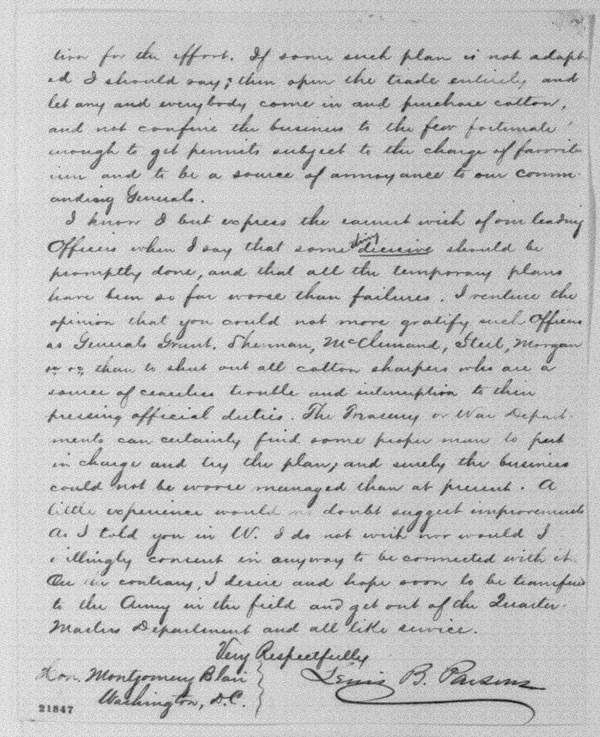
How much Cotton will be brought out under this plan might be a question, but if the amount is not large the wrong prevented will be an ample compensation for the effort. If some such plan is not adopted I should say; then open the trade entirely and let any and everybody come in and purchase cotton, and not confine the business to the few fortunate enough to get permits subject to the charge of favoritism and to be a source of annoyance to our commanding Generals.
I know I but express the earnest wish of our leading Officers when I say that something decisive should be promptly done, and that all the temporary plans have been so far worse than failures. I venture the opinion that you could not more gratify such Officers as Generals Grant, Sherman, McClernand, Steel, Morgan &c., &c., than to shut out all cotton sharpers who are a source of ceaseless trouble and interruption to their pressing official duties. The Treasury or War Departments can certainly find some proper man to put in charge and try the plan; and surely the business could not be worse managed than at present. A little experience would no doubt suggest improvements As I told you in W. I do not wish nor would I willingly consent in anyway to be connected with it. On the contrary, I desire and hope soon to be transfered to the Army in the field and get out of the Quarter-Masters Department and all like service.
Very Respectfully
Lewis B. Parsons
[ Endorsed on Envelope by Lincoln:]
Lewis B. Parsons on the Cotten question.
Before Vicksburg Feby 19th 1863.
Dear Sir
When I left you in November I intended, according to my promise to have written you much sooner in reference to the Cotton question; but constant engagements have prevented. I came from Memphis in charge of the transports of this fleet, and have been with the army ever since; and had a good opportunity for observation and testing the correctness of the opinions I expressed to you. The result of my observations and conversations with those best able to judge correctly fully confirms me in the correctness of the ground assumed and presented by you to the Cabinet when I last saw you, and it is a matter of surprise to all our nonspeculating Officers here that nothing has been done by the Government to correct these great and palpably existing evils and to take the direct control of so important a subject. The objects of such interference being:
1st To prevent the demoralization of the Army, the wrongs constantly committed by unprincipled cotton speculators, and the introduction of Contraband of war;
2nd To obtain Cotton for commerce;
3rd As the rebellion has advanced the price of cotton, to secure such advance to the Government to go towards defraying the expenses of the war.
There are other minor objects, but these are the leading ones.-- The means proposed are:
1st Declare that all the Cotton between the Gulf and the Ohio River belongs either to the Government or the producer, and that no one can move the Cotton from those limits except the Government;
2nd Fix upon a price to be paid for Cotton at certain points -- say for example at Memphis fifteen (15) cents -- and a like sum at other adjacent places, less the cost of transportation to Memphis, and pay that in Government funds to all who will voluntarily sell;
3rd Declare that unless Cotton is voluntarily brought out for sale it will be seized and not paid for;
4th Ship all Cotton to certain points -- say that from the Tennessee, Cumberland, and Mississippi above Vicksburgh (till the river is open to New Orleans) to Cairo and then sell it at public vendue on a certain day in each week, giving everybody an opportunity to purchase
5th Keep an accurate accounts of all purchases and remit same with nett proceeds weekly to the Treasury Department.
That something should promptly be done on this subject by the Government, I do not think admits of a doubt in the minds of those here best advised, and most capable of judging correctly and honestly. As to the details of the mode of doing it there might be a variety of opinions, but all agree on the main point viz: that Government must assume the ownership or control of all Cotton not in the hands of the producer, and that no other parties must be allowed to transport the article beyond the prescribed limits. That of itself puts an end to most of the existing evils. There is then no longer any temptation to the Officers of the Army to swerve from their duty to obtain unjust gain. The temptations to the unprincipled speculator to introduce contraband of war is then also almost equally removed, as he ceases to get his pay in cotton at such temptingly low rates. The idea that free trade should always go wherever the flag goes is as I think an error. When the authority of the Government and laws is fully restored this will do, but not till then; and I think all well advised persons will tell you that an endless amount of rascality is the result of opening trade to Memphis and Helena, with no corresponding good. The fact is the people at and below Memphis are generally unmitigated rebels, and all the efforts to moderate their madness by the allurements of trade have been entirely unsuccessful. Experience shows that the inconvenience and sufferings from lack of trade have a much better tendency. The only way is to crush the rebellion by the force of our arms and till that is done it is useless to try and coax the people into loyalty with the prospects of an abundance of Coffee and Salt.
How much Cotton will be brought out under this plan might be a question, but if the amount is not large the wrong prevented will be an ample compensation for the effort. If some such plan is not adopted I should say; then open the trade entirely and let any and everybody come in and purchase cotton, and not confine the business to the few fortunate enough to get permits subject to the charge of favoritism and to be a source of annoyance to our commanding Generals.
I know I but express the earnest wish of our leading Officers when I say that something decisive should be promptly done, and that all the temporary plans have been so far worse than failures. I venture the opinion that you could not more gratify such Officers as Generals Grant, Sherman, McClernand, Steel, Morgan &c., &c., than to shut out all cotton sharpers who are a source of ceaseless trouble and interruption to their pressing official duties. The Treasury or War Departments can certainly find some proper man to put in charge and try the plan; and surely the business could not be worse managed than at present. A little experience would no doubt suggest improvements As I told you in W. I do not wish nor would I willingly consent in anyway to be connected with it. On the contrary, I desire and hope soon to be transfered to the Army in the field and get out of the Quarter-Masters Department and all like service.
Very Respectfully
Lewis B. Parsons
[ Endorsed on Envelope by Lincoln:]
Lewis B. Parsons on the Cotten question.
Citation
Parsons, Lewis B. Lewis B. Parsons to Montgomery Blair, Thursday, February 19, 1863 (Cotton question). Letter. Library of Congress. http://memory.loc.gov/cgi-bin/ampage?collId=mal&fileName=mal1/218/2184500/malpage.db&recNum=0. Accessed December 11, 2016.
Files
Citation
Lewis B. Parsons, “Lewis B. Parsons to Montgomery Blair, Thursday, February 19, 1863,” Creating Digital History @ NYU, accessed September 17, 2026, https://aphnyu.org/creatingdigitalhistory/fall2016/items/show/58.
Embed
Copy the code below into your web page