
Nathaniel P. Banks to Abraham Lincoln, Friday, December 18, 1863
Dublin Core
Title
Nathaniel P. Banks to Abraham Lincoln, Friday, December 18, 1863
Subject
United States--History--Civil War, 1861-1865--Economic aspects
Cotton
United States--History--Civil War, 1861-1865--Confiscations and contributions
Description
Major General Nathaniel P. Banks wrote to Lincoln in late 1863 to urge caution in the cotton trade. Banks was adamant that no amount of profit could counterbalance the certain wrong of finding "the munitions of war furnshed [sic] to the Rebels."
Creator
Nathaniel P. Banks
Source
Library of Congress, Rare Book and Special Collections Division
Date
1863-12-18
Contributor
AB, PP
Rights
Public Domain
Format
jpeg/gif
Language
English
Manuscript Item Type Metadata
Text
New Orleans, 18. December 1863.
Sir:
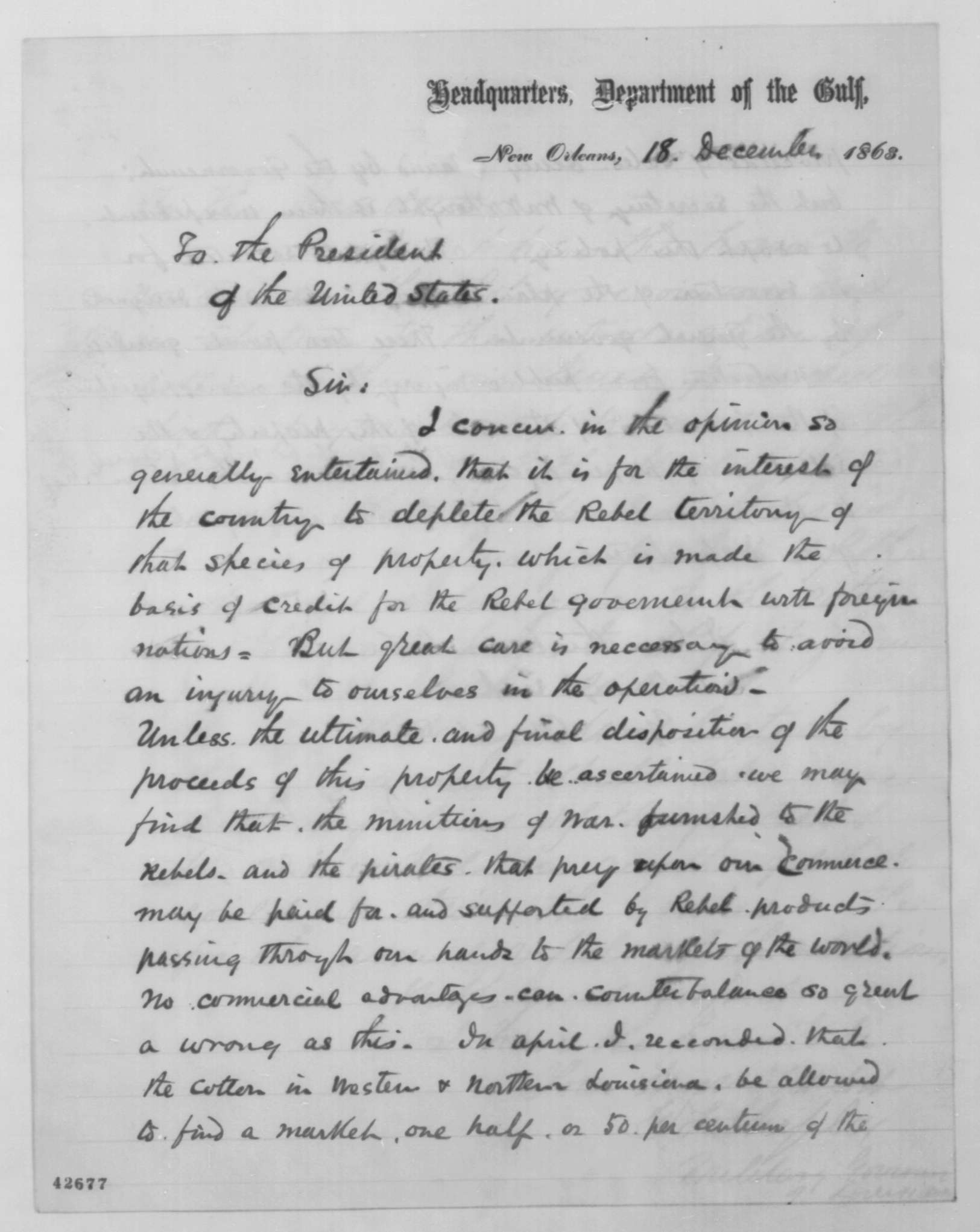
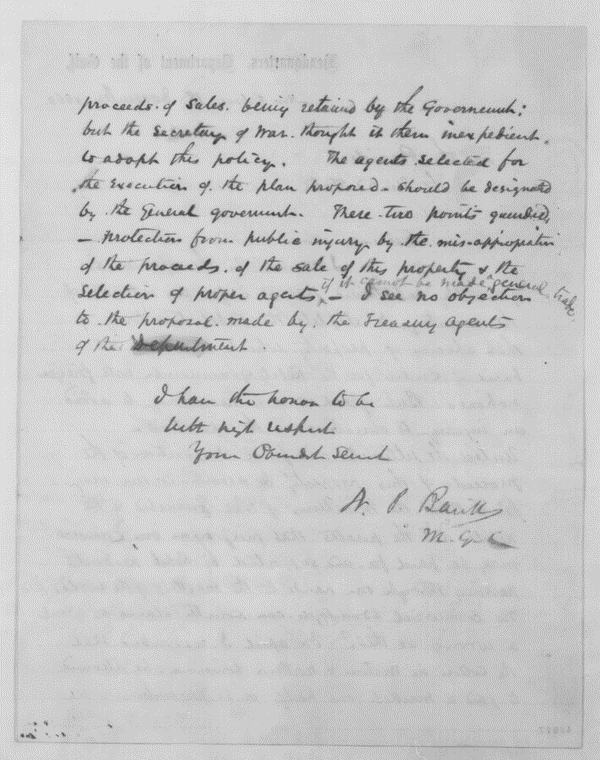
I concur in the opinion so generally entertained, that it is for the interest of the country to deplete the Rebel territory of that species of property, which is made the basis of credit for the Rebel govememt with foreign nations-- But great care is neccessary to avoid an injury to ourselves in the operation-- Unless the ultimate and final disposition of the proceeds of this property be ascertained we may find that the munitions of war furnshed to the Rebels -- and the pirates -- that prey upon our commerce -- may be paid for, and supported by Rebel products passing throgh our hands to the markets of the world. No commercial advantages -- can counterbalance so great a wrong as this-- In april I recconded that the cotton in western & northern Louisiana, be allowed to find a market, one half, or 50. per centum of the proceeds of sales, being retained by the Governemt: but the Secretary of War, thought it then inexpedient, to adopt this policy. The agents selected for the execution of the plan proposed -- should be designated by the General governemt-- These two points guarded, -- protection from public injury by the mis-appropiation of the proceeds, of the sale of this property & the selection of proper agents if it cannot be made a general trade.-- I see no objection to the proposal made by the Treasury Agents of the Department
I have the honor to be
With high respect
Your Obendt Servt
N. P. Banks
M. G. C
Sir:
I concur in the opinion so generally entertained, that it is for the interest of the country to deplete the Rebel territory of that species of property, which is made the basis of credit for the Rebel govememt with foreign nations-- But great care is neccessary to avoid an injury to ourselves in the operation-- Unless the ultimate and final disposition of the proceeds of this property be ascertained we may find that the munitions of war furnshed to the Rebels -- and the pirates -- that prey upon our commerce -- may be paid for, and supported by Rebel products passing throgh our hands to the markets of the world. No commercial advantages -- can counterbalance so great a wrong as this-- In april I recconded that the cotton in western & northern Louisiana, be allowed to find a market, one half, or 50. per centum of the proceeds of sales, being retained by the Governemt: but the Secretary of War, thought it then inexpedient, to adopt this policy. The agents selected for the execution of the plan proposed -- should be designated by the General governemt-- These two points guarded, -- protection from public injury by the mis-appropiation of the proceeds, of the sale of this property & the selection of proper agents if it cannot be made a general trade.-- I see no objection to the proposal made by the Treasury Agents of the Department
I have the honor to be
With high respect
Your Obendt Servt
N. P. Banks
M. G. C
Citation
Banks, Nathaniel P. Nathaniel P. Banks to Abraham Lincoln, Friday, December 18, 1863 (Cotton trade). Letter. Library of Congress. http://memory.loc.gov/cgi-bin/ampage?collId=mal&fileName=mal2/426/4267700/malpage.db&recNum=0. Accessed December 11, 2016.
Files
Citation
Nathaniel P. Banks, “Nathaniel P. Banks to Abraham Lincoln, Friday, December 18, 1863,” Creating Digital History @ NYU, accessed September 17, 2026, https://aphnyu.org/creatingdigitalhistory/fall2016/items/show/57.
Embed
Copy the code below into your web page