
Deborah Squash
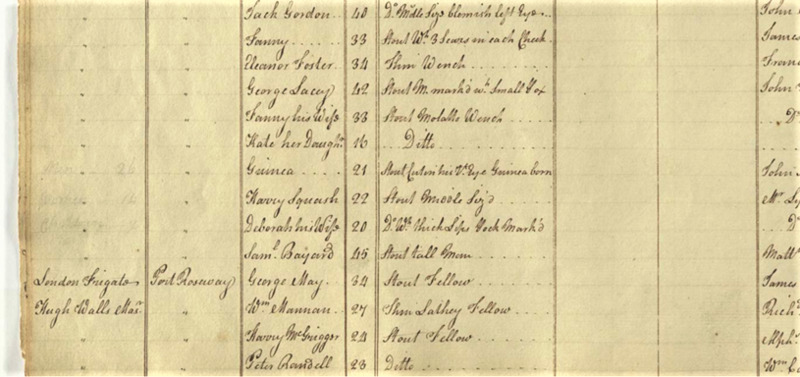
Listing of Deborah Squash in the "Book of Negroes"
The page from the "Book of Negroes" which lists Deborah Squash
Deborah Squash was one of many people enslaved by George and Martha Washington at their Virginia plantation. Because she was an enslaved woman, not much is known about her life or her servitude at Washington’s Mount Vernon. Regardless of her exact role, Squash’s enslavement was certainly extremely difficult, with no opportunities for freedom. However, that would soon change with the unrest of the American Revolution. Many enslaved people began taking advantage of British proclamations, such as the Philipsburg Proclamation of 1779, that would grant them their freedom if they joined the British forces. As British naval ships moved through the different colonies, enslaved people would join them as a way to take their freedom for themselves. Deborah Squash took a similar action, and is believed to have fled Mount Vernon for the British HMS Savage when it sailed up the Potomac River in the spring of 1781*. Squash was among sixteen other enslaved people who fled, and they are all listed as runaway slaves in a letter from Lund Washington, George Washington’s relative overseeing Mount Vernon, to George Washington. Lund Washington tried to negotiate with the captain of the Savage for the return of this group, but they were able to successfully escape.
However, Squash’s newfound freedom would have its challenges. She and thousands of other free blacks still had to contend with many issues while they were with the British forces, including disease, food shortages, exposure, and much more. While Squash suffered through many difficulties, she was able to make her way to New York City, the British military headquarters and Loyalist center during the war. While there, Deborah married a freed man, Henry Squash, and remained under British protection in the city until 1783. However, the American victory that occurred would threaten Deborah and Henry’s freedom, as well as all of the other freed people like them. Americans who had enslaved individuals escape from them during the war began to demand that the British return them. However, worried about the intense punishments these freed people would receive from their past owners and believing this was no way to reward those who sacrificed everything for the British cause, British officer Sir Guy Carleton refused to go along with this. Instead, he proposed a plan to evacuate these freed blacks from the United States alongside other Loyalists and the British military, and would pay American slaveholders for every enslaved person they had lost. This plan was reluctantly agreed to, and Carleton’s staff began the process of compiling the information of every enslaved person that had boarded a British ship, which became known as the Book of Negroes. However, limited space meant that only those most faithful to the British cause would get the chance to be evacuated, which would be determined through interviews held for the city’s entire black emancipated population. Deborah and Henry Squash were both approved for evacuation, receiving certificates of freedom to ensure they would be protected from re-enslavement. On April 27, 1783, Deborah and Henry boarded the British ship Polly heading to Port Roseway, Nova Scotia, securing their freedom once and for all.
*There is some historical debate over the exact identities of the enslaved people who escaped upon the Savage, and some sources suggest that Deborah Squash actually ran away from Mount Vernon in 1779.
Questions:
- What were the circumstances of this time that caused enslaved people like Deborah Squash to risk fleeing in order to join the British side?
- Although they gained their freedom, why did Deborah Squash and the black emancipated population have to flee New York City after war ended?
- How does the story of Deborah Squash change your view or idea of Loyalists during the American Revolution?
- Why do you think the stories of these types of Loyalists are often not represented in the general narrative of the American Revolution? How can we change that?
For more information and resources on Deborah Squash, please visit:
https://www.amrevmuseum.org/revolution-stories/finding-freedom-deborah
https://www.mountvernon.org/library/digitalhistory/digital-encyclopedia/article/h-m-s-savage/
Sources:
Boomer, Lee. “Life Story: Deborah Squash.” Women & the American Story (blog). Accessed December 7, 2020. https://wams.nyhistory.org/settler-colonialism-and-revolution/the-american-revolution/deborah-squash/.
Canada, Library and Archives. “Item,” July 24, 2015. https://www.bac-lac.gc.ca/eng/discover/military-heritage/loyalists/book-of-negroes/Pages/item.aspx?IdNumber=2351&.
“Finding Freedom: Deborah.” Accessed December 7, 2020. https://www.amrevmuseum.org/revolution-stories/finding-freedom-deborah.
George Washington’s Mount Vernon. “H.M.S. Savage.” Accessed December 7, 2020. http://www.mountvernon.org/library/digitalhistory/digital-encyclopedia/article/h-m-s-savage/.