
Charles Inglis
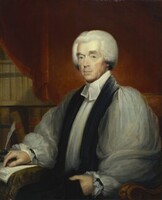
Charles Inglis was born in Ireland in 1734 to a family of Scottish descent. He emigrated to the American colonies before turning twenty. After being ordained as a deacon and priest in the Church of England in 1758, Inglis served as a missionary in Dover, Delaware. In 1765 he went to New York City, where he became the assistant rector of Trinity Church.
Reverend Inglis was an outspoken Tory. In March 1776 he wrote a response to Thomas Paine’s Common Sense titled The Deceiver Unmasked which warned that a revolution against Great Britain would have disastrous consequences. Before the pamphlet could be distributed, Liberty Boys broke into the printers office and burned all the copies. Rev. Inglis later re-released the pamphlet under a different title.
“Suppose we were to revolt from Great Britain, declare ourselves independent, and set up a Republic of our own - what would the consequences be? I stand aghast at the prospect - my blood runs chill when I think of the calamities, the complicated evils that must ensue, and may be clearly foreseen. It is impossible for any man to foresee them all.” (Read the entire text of the Deceiver Unmasked)
Until the British takeover of New York in late 1777, Rev. Inglis’ outspoken Loyalism made him a target of rebels, who plundered his home. Rev. Inglis became rector of Trinity Church in March 1777, a prominent position in the city that he held through the end of the Revolution. Behind British lines he continued to argue that the colonies should reconcile with Great Britain. Staying part of the empire, Rev. Inglis wrote, would keep America prosperous compared to the economic risk of independence.
Rev. Inglis was a slaveowner. Pyrmis, the 14 year old who Inglis enslaved, ran away in January 1779, during a period when many slaves in the chaotic city fled. In October 1779, the New York Provincial Assembly passed a bill that confiscated Inglis’ property along with other prominent Loyalists (though they were unable to seize his property within British-held New York City).
Inglis left New York for England on Evacuation Day (November 25, 1783). After three years in England, he travelled to Canada, where he became the first Bishop of Nova Scotia.
Questions:
- How would Charles Inglis’ experience in New York City during the Revolution been different than that of other Loyalists?
- How might Inglis’ personal experiences in New York have influenced his decision to leave?
- What might have motivated Inglis to leave New York City?
- When writing the history of this period, what place should we give to voices like Charles Inglis’?
For more information and resources on Charles Inglis, see:
Charles Inglis in the Dictionary of Canadian Biography
Charles Inglis on Encyclopaedia Britannica
Sources
Judith Fingard, “INGLIS, CHARLES,” in Dictionary of Canadian Biography, vol. 5, University of Toronto/Université Laval, 2003–, accessed December 7, 2020, http://www.biographi.ca/en/bio/inglis_charles_5E.html .
Ruma Chopra, Unnatural Rebellion: Loyalists in New York City during the Revolution, (Charlottesville, VA: University of Virginia Press, 2011)