
Boston King
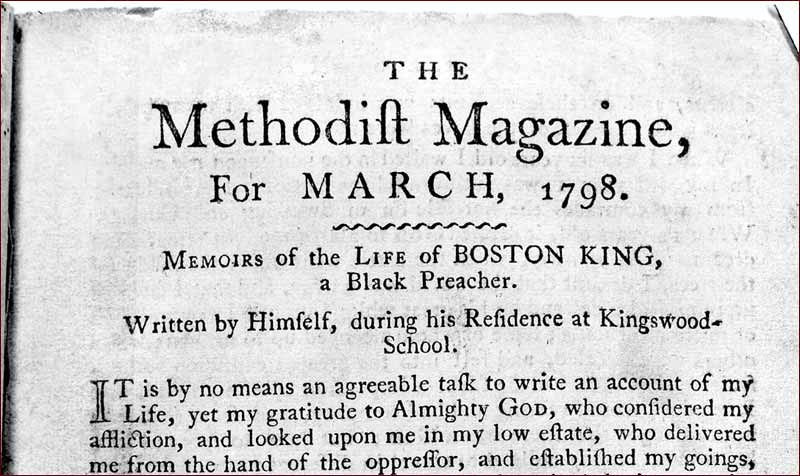
Boston King was born in either 1759 or 1760 on a plantation in South Carolina. His father was a religious, literate enslaved African brought to the Americas. His mother was an enslaved African American skilled in nursing and sewing. His father was deeply religious, and his faith had a profound impact.
By the Revolutionary War, Boston King was a young man leased to nearby plantations. One of his Masters was particularly cruel to him and beat him so severely that he could not work for three weeks. One day, the Boston King wished to borrow his Master's horse to visit his parents. A fellow enslaved person used the horse instead, fearing his Master's blame and potential violence, Boston King ran away to protect himself to British occupied Charleston.
During the Revolutionary War, enslaved people escaped to the British occupied Loyalist cities Charleston and New York with the promise of freedom. In Charleston, Boston King worked as a messenger exchanging important information between Loyalist camps. In 1782, the British lost Charleston and fearing for his freedom Boston moved to Loyalist New York. In New York, he supported the British war effort as a carpenter. In 1782, he married fellow escaped enslaved person Violet in New York City and began to build a life together in New York. In 1781, the Patriots won the war, and with that came a threat to freedom; Boston King and thousands of enslaved Loyalists were promised.
In 1783, Boston King and Violet left New York City along with 3,000 other enslaved African Loyalists. Their names appeared in the Book of Negroes, a collection of Loyalist African Americans who left America to maintain their freedom. Boston King and Violet first settled in Nova Scotia, and he was educated in England as a Christain missionary. In 1798. "The Memoirs of The Life of Boston King" was published detailing his full experience as an enslaved Loyalist in America. (Read the full text of The Memoirs of the Life of Boston King)
Questions:
- What parallels can you make between Boston King leaving Charleston and New York City during the Revolutionary War?
- Name two reasons why enslaved Loyalists such as Boston King’s memoirs might not be as well known to the general public?
- During the war, Boston King had several different roles: messenger and carpenter. What do these roles say about the opportunities for African Americans in the Loyalist army?
Sources:
PBS. “Africans in America/ Part 2” Accessed December 5, 2020
https://www.pbs.org/wgbh/aia/part2/2p60.html
Dictionary of Canadian Biography. “Boston King” Accessed December 5, 2020
http://www.biographi.ca/en/bio/king_boston_5E.html
University of Oxford. “Boston King and the Black Loyalists of the American Revolution” Accessed December 5, 2020