-
 Emily Graham's Death
 This newspaper article tells the story of Emily Graham, who was institutionalized in an asylum on Blackwell's Island after police officers arrested her on charges of drunkenness. Her husband managed to locate her, allowing her to stay in the asylum for treatment; but she quickly deteriorated from substandard, abusive medical care and eventually died from her wounds.
-
 The Case of Jacob B. Stockvis
 This document details the jury findings in the inquest of the death of Jacob Stockvis after his stay in Blackwell's Island's workhouse. The workhouse system was designed to strike a balance between punishment and rehabilitation by identifying the culprits of minor crimes and assigning them short-term sentences where they could reform their ways.
-
 An Insane Hollander Killed
 This newspaper article describes a coroner's inquest into the case of Jacob Stockvis, a mentally ill man. Stockvis was arrested and imprisoned in the workhouse on Blackwell's Island on charges of drunkenness, all while his friends and family searched for him. Stockvis died due to his treatment in the workhouse shortly after being found.
-
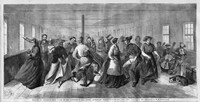 Dancing by Lunatics -- Ball Given to the Patients of the Insane Asylum on Blackwell's Island, New York
 Blackwell's Island was a grim place but there were lighthearted moments, as this newspaper clipping from 1865 shows. The image depicts asylum patients partaking of merriment.
-
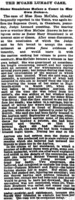 The M'Cabe Lunacy Case: Sister Stanislaus Before a Court in Her Own Defense
 McCabe wanted to prove her sanity and tell her side of the story. McCabe argued that she should never have been detained at the Bloomingdale Asylum or, subsequently, the New York City Lunatic Asylum. At the time this article was published, Rose McCabe had been relocated to the New York City Lunatic Asylum on Blackwell's Island (at her own request) as a result of the poor treatment she received at the Bloomingdale Asylum.
-
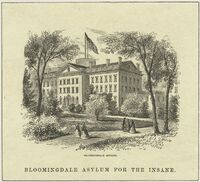 "Bloomingdale Asylum for the Insane" -- 1872
 This idyllic image of the Bloomingdale Asylum's main building portrays patients leisurely strolling the grounds of the privately owned asylum. This particular image leaves one wondering whether life was truly as good as it seemed inside such an institution, and how this life may have differed from one lived at a publicly owned institution, such as the New York City Asylum of Blackwell's Island. Rose McCabe was one of the few individuals to find out.
-
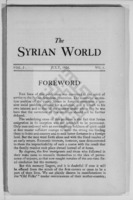 The Syrian World Vol. 01 No. 01
 Vol. 1 No. 01 of The Syrian World, published July 1926. This first issue begins with a foreword by Salloum Mokarzel and a poem by Kahlil Gibran stating the journal's aim to educate both Syrian-Americans and the broader American public about Syrian history, literature, and current events.
The Syrian World hoped to revive an appreciation for Syrian heritage in America, illustrating the extent to which integration into American life equated to the loss of cultural customs. The Syrian community in America began in the 1880s, and through the ensuing decades, the community adopted various strategies of integration. Salloum Mozarkel calls attention to what was lost through the past half century and makes an attempt to not lose Syrian culture altogether.
In addition to Syrian history, The Syrian World has articles about the Druze and the relationship between East and West, reporting on current events, especially the Great Syrian Revolt and the French Mandate. This edition closes with an editorial policy of political and religious neutrality.
-
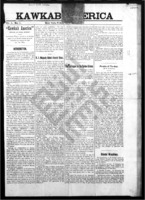 Kawkab Amirka, كوكب أمريكا, Vol. 1, no. 1
 A newspaper established by A.J. Arbeely, N.J. Arbeely, and Arteen Effendi Petrakian in 1892, Kawkab Amirka’s primary objective was to “contribute its share in bringing its eastern and western readers into closer and more intimate relations."
The Syrian’s deeply valued their native country, as can be seen in Kawkab Amrika’s repeated homage to Syria Imperial Majesty Abdul-Hamid Kahn. Their intention was not to undermine American values, but rather “join the hands of the East with those of the West” so “the world may be made better and that men may live in amicable relations with each other.”
-
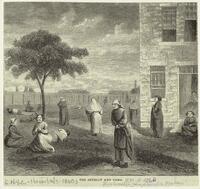 Retreat and Yard
 This etching depicts female asylum patients aimlessly wandering the grounds, with no attendants (doctors or nurses) in sight. Neglect of inmates and patients was all too common on Blackwell's Island, and a cause of death for many.
-
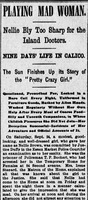 Playing Mad Woman
 This newspaper article from The Sun recounts Nellie Bly's undercover expose of sordid conditions on Blackwell's Island. Bly's story is unusual because she feigned insanity and secured a quick release from the asylum, but her story is also remarkable for its results: bringing the conditions of Blackwell’s Island to the public’s attention and making those conditions a widespread public health concern, both of which led New York City to implement changes on Blackwell's Island.
-
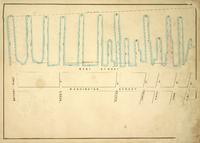 "Little Syria"
 Map of Lower Manhattan bounded by pier lines 1 to 15. The map shows Washington Street, the main street of "Little Syria" and its North, South, and West boundaries.
-
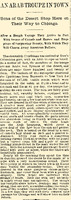 "An Arab Troupe in Town"
 "An Arab Troupe in Town" recounts the arrival of a Syrian music group to New York City. The article describes the group's journey, characteristics, personalities, and belongings they brought from Syrian, such as camels. At the end of the article, it is mentioned that the group will continue their travels to Chicago for a show, before performing in New York City upon their return.
-
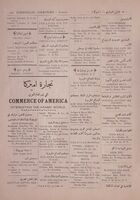 Dr. Abdou's Travels in America: Commerce of America
 This is an image representing one page of a larger collection. It lists the Syrian owned businesses in America. It dates from 1910 and is written in English and Arabic. Many of the businesses are concentrated in Manhattan, near the traditional Syrian Colony. The large presence of Syrian business owners highlights the economic motivations that first brought the Syrians to New York.
-
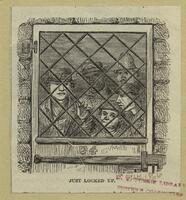 Workhouse on Blackwell's Island Just Locked Up
 This etching depicts five male inmates in the workhouse on Blackwell's Island, inside a single cell. Their differing expressions and unknown backgrounds raise questions as to how they found themselves together on Blackwell's Island.
-
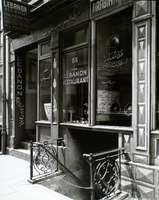 Lebanese Restaurant (Syrian) 88 Washington Street.
 This image depicts a restaurant in the former "Little Syria" neighborhood in Manhattan. This image dates from 1936, but the restaurant had been in operation since 1920. The restaurant represents the cultural contributions of the Syrian Community to New York City. Even native-born New Yorkers were drawn to Syrian restaurants and lounges for an exotic and "oriental" experience.
-
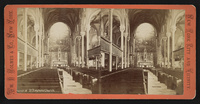 Interior of St. Stephen's RC Church
 Image of the interior of St. Stephen's Church. The place of worship was one of the various churches used by recently arrived Syrians in the 1890s. One documented member of the community, Joseph Oussani married his wife there in 1896. When the Syrians first arrived they did not yet have their own cultural institutions to utilize. Since some of these Syrian Christians were in communion with the Roman Catholic Church, they were allowed to use their religious spaces.
-
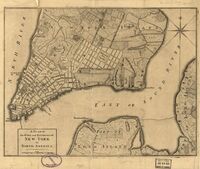 A plan of the city and environs of New York in North America
 General street map of New York City at the outbreak of the Revolutionary War, published in a British periodical. Built-up areas and field lines are defined. Indicated on the map are the "Road to Kings Bridge where the Rebels mean to make a stand" and "Road to Kepps Bay where the Kings troops landed". Also covers rural part of Manhattan Island up to present-day 14th Street and small parts of Long Island. The map provides a geography of the city, which at the time occupied only the lower portion of Manhattan Island.
Removed from: The Universal Magazine of Knowledge and Pleasure, London, Nov. 1776, v. 59.
-
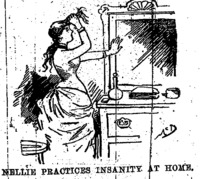 Nellie Practices Insanity at Home
 This image is an illustration from Nellie Bly's 1887 book, Ten Days in a Mad-House, detailing Bly's undercover work as an inmate at the female asylum on Blackwell's Island. Bly's book caused a stir, exposing the asylum’s wretched conditions to a public audience.
-
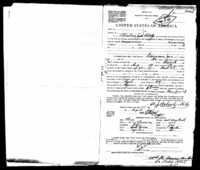 Abraham Joseph Arbeely's United States Passport Application,
August 31, 1907.
Abraham Joseph Arbeely's United States Passport Application,
August 31, 1907. Abraham Joseph Arbeely's United States Passport Application form. The form was filled out on August 31, 1907, meaning that he was naturalized and had American citizenship.
The son of Yussef Arbeely, Abraham Joseph Arbeely, immigrated to the United States with his father and the rest of his family. In 1892, Abraham, with his brother Nageeb and Arteen Petrakian published the first Arabic-language newspaper in the United States "Kawkab America".
-
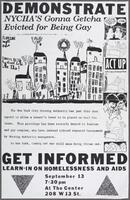 Demonstrate: NYCHA's Gonna Getcha Evicted for Being Gay
 Poster created by ACT UP New York in advance of a learn-in event on Homelessness and AIDS at their Center at 208 W. 13th St. The poster is a collage of several illustrations and its text reads: "The New York City Housing Authority has just this year agreed to allow a tenant's lover to be placed on her/his lease. This privilege has been routinely denied to lesbian and gay couples, who have instead endured repeated harassment by Housing Authority management. In New York, coming out may still mean being thrown out. Get informed."
-
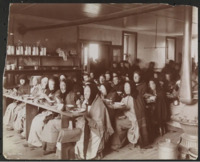 Photograph from Blackwell's Island, Women's Ward
 This resource depicts the Women's Hospital Ward at Blackwell's Island. Viewers see a group of women clustered together, hunched over their meals. The wide-eyed, vacant stares shed negative light onto the seemingly pitiful portrait sitters.
-
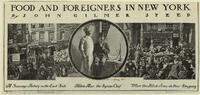 Food and Foreigners in New York
 American's were fascinated with immigrant ways of life, exemplified in these scenes depicting various immigrant communities: Germans and their sausage factories; Syrians and their narghiles; and Polish Jews and their shopping centers.
Habib Assi's (Hassey) restaurant on 30 Rector Street was one of the prominent Syrian owned restaurants in lower Manhattan, illustrating just one of the many business ventures Syrian's pursued. Assis's restaurant was subject to the American fascination with customs from the Orient, including the narghile that is front and center in this illustration.
-
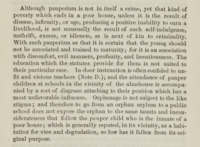 Excerpt on Pauperism
 This item is an excerpt from a report to the New York State legislature, by a committee appointed to evaluate the state's charitable institutions, workhouses, and jails. In the mid-1800s, there was little meaningful distinction between being poor and being a criminal, and a wide variety of actions (including homelessness, drunkenness, or mental illness) could lead to incarceration in a state institution.
-
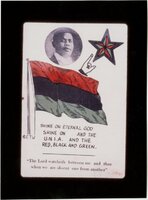 Shine on Eternal God shine on the U.N.I.A and the Red, Black and Green
 A poster celebrating the Universal Negro Improvement Association and African Communities League, a Black nationalist organization founded by Marcus Garvey.
-
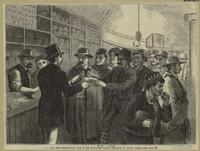 Distributing food to the defrauded Italian emigrants at Castle Garden
 A wood engraving depicting the distribution of food to defrauded immigrants at Castle Garden, the U.S.'s first immigration center now known as Castle Clinton National Monument.
