-
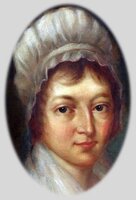 Portrait of Hannah Lawrence Schieffelin
 Hannah Lawrence Schieffelin was an American loyalist and poet who first supported the clause of the Patriots. She read a poem entitled "On the purpose" in front of Trinity Church in 1779 in opposition to the British occupation. She would later become a Loyalist after marrying British officer Jacob Schieffelin.
-
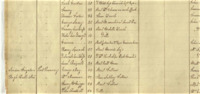 Listing of Deborah Squash in the "Book of Negroes"
 Born into slavery at the Mount Vernon plantation, Deborah Squash was just one of around three hundred enslaved people owned by George and Martha Washington. With the outbreak of the American Revolution, many enslaved individuals fled from their Patriot enslavers to the British, who promised freedom to anyone who joined their forces. Deborah decided to use the historical moment to her advantage and seize her freedom. When the British warship "Savage" was sailing up the Potomac, Squash is thought to have escaped from Mount Vernon by boarding the ship, although there is some debate over whether she fled earlier in 1779. Deborah eventually made her way to New York City where she married Henry Squash, and they remained protected in the British held city. However, the American victory threatened the security of these emancipated people, as many slaveholders were attempting to recapture the enslaved people they had lost, including George Washington. Luckily, Deborah Squash and her husband were approved for evacuation, and left for Port Roseway, Nova Scotia on April 27, 1783.
-
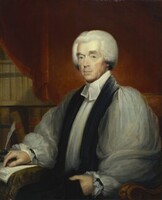 Portrait of Reverend Charles Inglis
 Painting of Reverend Charles Inglis, Anglican clergyman, religious leader, and prominent New York City loyalist during the American Revolution. Born in Ireland and of Scottish descent, Inglis spent some time in the North American colonies before being appointed curate, and then rector, of Trinity Church in 1765/1766. During the years of the American Revolution, Inglis was a prominent loyalist leader, and became infamous amongst the Patriot faction due to his authoring of the pamphlet "The Deceiver Unmasked" as a rebuttal to Thomas Paine's "Common Sense." Although he was subject to Patriot attack due to his loyalist views, Inglis remained in New York City and came under the protection of the British during their military occupation. However, the victory of the Continental Army in 1781 forced him to resign his position at Trinity Church, and he left New York City for England during the loyalist evacuation of November 1783. in 1787, Inglis was appointed as the first bishop of Nova Scotia, and it was in Canada that he lived out the remainder of his life.
-
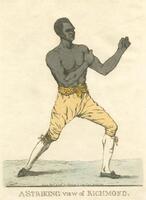 A striking view of Richmond
 An 1810 illustration of Bill Richmond, who was born into slavery on Staten Island. Richmond's freedom was secured by a British officer in New York who took notice of his fighting ability, and Richmond left for England in 1777. In England, Richmond became well known as a successful boxer.
-
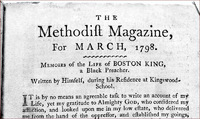 Memoirs of Boston King
 Boston King(1760-1802) was an enslaved person escaping slavery during the time of the American Revolution. Boston King worked as a carpenter during his time in New York City in the 1780s. He left at the end of the war and settled in modern-day Sierra Leone.
In the 1790's he self-published a slave narrative called: Memoirs of the Life of Boston King, a Black Preacher. He writes about his time in New York City in the memoir.
-
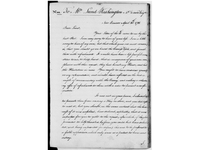 General Washington writing about escaped slave: Harry Washington
 The letter is from General Washington on the conditions of enslaved people who ran away from Mount Vernon in 1776.
One of the enslaved individuals: Harry Washington, fought for the British during the war and was stationed in New York City. Washington was evacuated along with many loyalists at the end of the war.
-
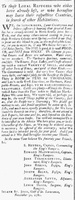 King's Rangers Address
 Proclamation by members of the King's Rangers, a British colonial military unit, promoting Nova Scotia as a destination for Loyalists who planned on leaving New York. The text ran weekly in the Royal Gazette for the first few months of 1783. While Patriot news sources disparaged Canadian provinces as a destination for Loyalists, and mocked those who decided to flee the American colonies, efforts like this promoted the region.
-
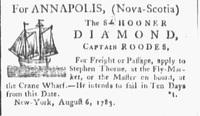 For ANNAPOLIS, (Nova-Scotia) The SCHOONER DIAMOND
 Advertisement for the schooner Diamond departing New York for Annapolis, Nova Scotia, about August 16, 1783. The Diamond was not among the ships commissioned by the British which departed in fleets beginning in October 1782. Instead, it offered people the ability to privately arrange for travel or shipment of goods to Nova Scotia, during a period when over 29,000 refugees left from New York to Nova Scotia and St. Johns.
-
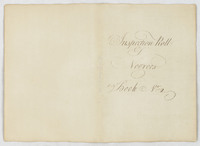 Book of Negroes
 The Inspection Roll of Negroes, also known as the "Book of Negroes" was a list of 3,000 Black Loyalists who requested alyssum from Great Britain at the end of the war. Much of the book was assembled at Fraunces Tavern before the British and their allies left New York City.
Many of the 3,000 were escaped enslaved people, some of whom fought with the British during the war with the promise of freedom. The majority were sent to other British colonies throughout the New World.
-
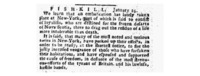 Loyalists leaving New York for Nova Scotia
 Account from a Philadelphia newspaper regarding loyalists fleeing New York and heading to Nova Scotia, Canada, after the American victory in the Revolutionary War. Discriminated against and persecuted for their loyalty to the Crown, many New York loyalists chose to leave the newly established United States and create new lives for themselves in a British controlled area, rather than remain in a country hostile to them.
-
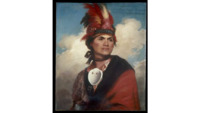 Portrait of Joseph Brant (Thayendanegea)
 Painting of Joseph Brant, a soldier and political leader from the New York Mohawk tribe. Brant is depicted here in ceremonial Iroquois dress, demonstrating his power and leadership role within the Iroquois Confederacy. Brant was instrumental in influencing four of the six tribes within the Iroquois Confederacy/Six Nations to ally with the British during the American Revolution. Brant is thought to have also fought alongside the British during the New York City campaign in 1776, and in battles across New York State, Pennsylvania, and other areas. Defeat by Continental forces and the end of the war led to Brant's retreat to Canada, where he continued to advocate for his people's rights in both the new American government and the British government.
-
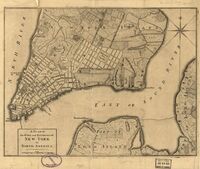 A plan of the city and environs of New York in North America
 General street map of New York City at the outbreak of the Revolutionary War, published in a British periodical. Built-up areas and field lines are defined. Indicated on the map are the "Road to Kings Bridge where the Rebels mean to make a stand" and "Road to Kepps Bay where the Kings troops landed". Also covers rural part of Manhattan Island up to present-day 14th Street and small parts of Long Island. The map provides a geography of the city, which at the time occupied only the lower portion of Manhattan Island.
Removed from: The Universal Magazine of Knowledge and Pleasure, London, Nov. 1776, v. 59.
