-
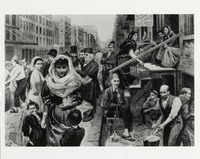 The Foreign Element in New York: The Syrian Colony
 A drawing from Harper's Weekly article titled, "The Foreign Element in New York: The Syrian Colony" depicts a typical day on Washington Street in 1895 - from the American perspective. Men in fezzes, women in scarves, and men smoking hookah were common American depictions of the Syrian community.
-
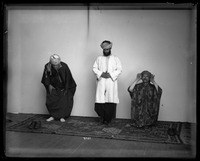 Demonstration of "Life in the Holy Land"by the Arbeely Family of Syria
 The Arbeely family is credited with being the first Syrian immigrants to the United States. They were highly educated and one way they supported themselves was through demonstrations of and lectures on Syrian life. In this image members of the Arbeely family, who were Christian, were demonstrating how Muslims prayed. To the American eye, Syrians were associated with "Mohammedan" and the Arbeely family played into this stereotype to make a living.
-
 "A Fugitive Syrian Family. A Professor of Arabic Literature, with His Wife, Six Sons and Daughter at Castle Garden."
 The article recounts the arrival of Yussef Amad Arbeely and his family to New York City. Arbeely's family was the first Syrian family to immigrate to New York City. The family immigrated to the United States due to religious persecution in Syria for their Christian faith. The article also describes the members of the family, their language skills, why the family decided to immigrate to the United Staes, and the family's future plans.
-
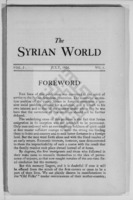 The Syrian World Vol. 01 No. 01
 Vol. 1 No. 01 of The Syrian World, published July 1926. This first issue begins with a foreword by Salloum Mokarzel and a poem by Kahlil Gibran stating the journal's aim to educate both Syrian-Americans and the broader American public about Syrian history, literature, and current events.
The Syrian World hoped to revive an appreciation for Syrian heritage in America, illustrating the extent to which integration into American life equated to the loss of cultural customs. The Syrian community in America began in the 1880s, and through the ensuing decades, the community adopted various strategies of integration. Salloum Mozarkel calls attention to what was lost through the past half century and makes an attempt to not lose Syrian culture altogether.
In addition to Syrian history, The Syrian World has articles about the Druze and the relationship between East and West, reporting on current events, especially the Great Syrian Revolt and the French Mandate. This edition closes with an editorial policy of political and religious neutrality.
-
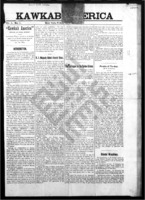 Kawkab Amirka, كوكب أمريكا, Vol. 1, no. 1
 A newspaper established by A.J. Arbeely, N.J. Arbeely, and Arteen Effendi Petrakian in 1892, Kawkab Amirka’s primary objective was to “contribute its share in bringing its eastern and western readers into closer and more intimate relations."
The Syrian’s deeply valued their native country, as can be seen in Kawkab Amrika’s repeated homage to Syria Imperial Majesty Abdul-Hamid Kahn. Their intention was not to undermine American values, but rather “join the hands of the East with those of the West” so “the world may be made better and that men may live in amicable relations with each other.”
-
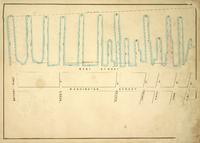 "Little Syria"
 Map of Lower Manhattan bounded by pier lines 1 to 15. The map shows Washington Street, the main street of "Little Syria" and its North, South, and West boundaries.
-
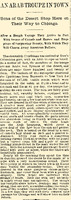 "An Arab Troupe in Town"
 "An Arab Troupe in Town" recounts the arrival of a Syrian music group to New York City. The article describes the group's journey, characteristics, personalities, and belongings they brought from Syrian, such as camels. At the end of the article, it is mentioned that the group will continue their travels to Chicago for a show, before performing in New York City upon their return.
-
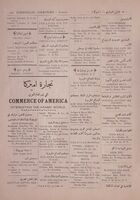 Dr. Abdou's Travels in America: Commerce of America
 This is an image representing one page of a larger collection. It lists the Syrian owned businesses in America. It dates from 1910 and is written in English and Arabic. Many of the businesses are concentrated in Manhattan, near the traditional Syrian Colony. The large presence of Syrian business owners highlights the economic motivations that first brought the Syrians to New York.
-
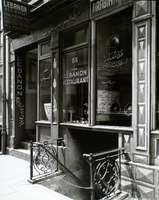 Lebanese Restaurant (Syrian) 88 Washington Street.
 This image depicts a restaurant in the former "Little Syria" neighborhood in Manhattan. This image dates from 1936, but the restaurant had been in operation since 1920. The restaurant represents the cultural contributions of the Syrian Community to New York City. Even native-born New Yorkers were drawn to Syrian restaurants and lounges for an exotic and "oriental" experience.
-
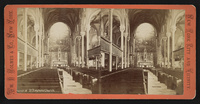 Interior of St. Stephen's RC Church
 Image of the interior of St. Stephen's Church. The place of worship was one of the various churches used by recently arrived Syrians in the 1890s. One documented member of the community, Joseph Oussani married his wife there in 1896. When the Syrians first arrived they did not yet have their own cultural institutions to utilize. Since some of these Syrian Christians were in communion with the Roman Catholic Church, they were allowed to use their religious spaces.
-
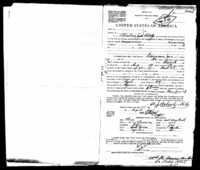 Abraham Joseph Arbeely's United States Passport Application,
August 31, 1907.
Abraham Joseph Arbeely's United States Passport Application,
August 31, 1907. Abraham Joseph Arbeely's United States Passport Application form. The form was filled out on August 31, 1907, meaning that he was naturalized and had American citizenship.
The son of Yussef Arbeely, Abraham Joseph Arbeely, immigrated to the United States with his father and the rest of his family. In 1892, Abraham, with his brother Nageeb and Arteen Petrakian published the first Arabic-language newspaper in the United States "Kawkab America".
-
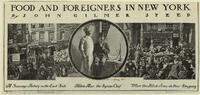 Food and Foreigners in New York
 American's were fascinated with immigrant ways of life, exemplified in these scenes depicting various immigrant communities: Germans and their sausage factories; Syrians and their narghiles; and Polish Jews and their shopping centers.
Habib Assi's (Hassey) restaurant on 30 Rector Street was one of the prominent Syrian owned restaurants in lower Manhattan, illustrating just one of the many business ventures Syrian's pursued. Assis's restaurant was subject to the American fascination with customs from the Orient, including the narghile that is front and center in this illustration.
