-
 Portrait of Hannah Lawrence Schieffelin
 Hannah Lawrence Schieffelin was an American loyalist and poet who first supported the clause of the Patriots. She read a poem entitled "On the purpose" in front of Trinity Church in 1779 in opposition to the British occupation. She would later become a Loyalist after marrying British officer Jacob Schieffelin.
-
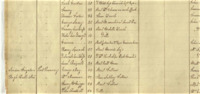 Listing of Deborah Squash in the "Book of Negroes"
 Born into slavery at the Mount Vernon plantation, Deborah Squash was just one of around three hundred enslaved people owned by George and Martha Washington. With the outbreak of the American Revolution, many enslaved individuals fled from their Patriot enslavers to the British, who promised freedom to anyone who joined their forces. Deborah decided to use the historical moment to her advantage and seize her freedom. When the British warship "Savage" was sailing up the Potomac, Squash is thought to have escaped from Mount Vernon by boarding the ship, although there is some debate over whether she fled earlier in 1779. Deborah eventually made her way to New York City where she married Henry Squash, and they remained protected in the British held city. However, the American victory threatened the security of these emancipated people, as many slaveholders were attempting to recapture the enslaved people they had lost, including George Washington. Luckily, Deborah Squash and her husband were approved for evacuation, and left for Port Roseway, Nova Scotia on April 27, 1783.
-
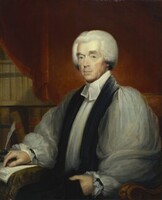 Portrait of Reverend Charles Inglis
 Painting of Reverend Charles Inglis, Anglican clergyman, religious leader, and prominent New York City loyalist during the American Revolution. Born in Ireland and of Scottish descent, Inglis spent some time in the North American colonies before being appointed curate, and then rector, of Trinity Church in 1765/1766. During the years of the American Revolution, Inglis was a prominent loyalist leader, and became infamous amongst the Patriot faction due to his authoring of the pamphlet "The Deceiver Unmasked" as a rebuttal to Thomas Paine's "Common Sense." Although he was subject to Patriot attack due to his loyalist views, Inglis remained in New York City and came under the protection of the British during their military occupation. However, the victory of the Continental Army in 1781 forced him to resign his position at Trinity Church, and he left New York City for England during the loyalist evacuation of November 1783. in 1787, Inglis was appointed as the first bishop of Nova Scotia, and it was in Canada that he lived out the remainder of his life.
-
 Excerpt from Oral history interview with Daniel William 1996
 An excerpt from an oral history interview of Daniel William performed and recorded in 1996 by Gerald Oppenheimer at the Columbia Center for Oral History. William discusses his experiences providing healthcare to gay men in New York City, the discrimination that gay men faced when seeking healthcare within New York City's medical infrastructure, the factors that lead patients to obscure their sexual history from healthcare providers, and the negative effects on health outcomes.
-
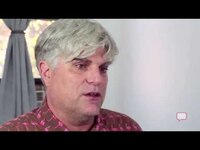 “You Have To Leave.” Facing Discrimination In A Hospital At The Height of the AIDS Crisis.
 Video interview with Doug Rice produced for I'm From Driftwood, an online LGBTQ story archive. In the interview, Rice describes being ejected from the hospital room where he was caring for his partner who was suffering from dementia and could not provide an accurate medical history. Rice's experience illustrate the ways in which discrimination against the LGBTQ community directly prevented doctors from providing patients with the highest quality care. Queer partnerships were not legally recognized, so patients and their loved ones were often forced to endure illness and treatment alone.
-
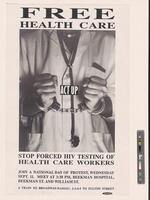 "FREE HEALTH CARE"
 A poster created by the AIDS Coalition to Unleash Power (or ACT UP, an organization at the center of the AIDS activist movements of the 1980s and 90s) in advance of a demonstration outside New York City's Beekman Hospital on September 11, 1991. The poster denounces mandatory HIV testing for healthcare workers on the grounds that it perpetuates AIDS phobia and disqualifies community based doctors and healthcare workers who are HIV positive. The poster depicts a healthcare worker in shackles to represent the unnecessary constraint that HIV testing mandates imposes on them, and provides details on the demonstration.
Text: FREE HEALTH CARE ACT UP STOP FORCED HIV TESTING OF HEALTH CARE WORKERS JOIN A NATIONAL DAY OF PROTEST, WEDNESDAY SEPT. 11 MEET AT 3:30 PM, BEEKMAN HOSPITAL, BEEKMAN ST. AND WILLIAMS ST. A TRAIN TO BROADWAY-NASSAU; 2-3-4-5 TO FULTON STREET
-
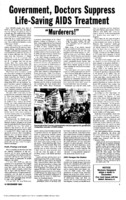 "Government, Doctors Suppress Life Saving AIDS Treatment"
 A full page article in the communist newspaper The Workers Vanguard describing the delays in publication of medical research indicating the effectiveness of steroid hormone treatment for pneumonia in patients with AIDS and expressing general frustration at the logistical and political obstacles to the distribution of new drugs to treat AIDS. The article also describes medical researchers' failure to collaborate with community based doctors and researchers, as well as delays in communication of breakthroughs in testing and treatment in service of individual professional ambitions, inflexible regulatory processes, and private pharmaceutical interests. The author links impediments in the availability of new treatments to healthcare disparities faced by LGBTQ and BIPOC populations. The article occupies the entire seventh page of the December 14, 1990 edition of the Workers Vanguard.
-
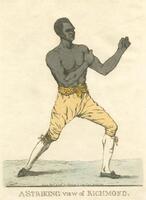 A striking view of Richmond
 An 1810 illustration of Bill Richmond, who was born into slavery on Staten Island. Richmond's freedom was secured by a British officer in New York who took notice of his fighting ability, and Richmond left for England in 1777. In England, Richmond became well known as a successful boxer.
-
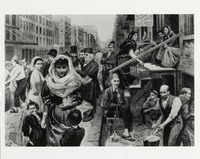 The Foreign Element in New York: The Syrian Colony
 A drawing from Harper's Weekly article titled, "The Foreign Element in New York: The Syrian Colony" depicts a typical day on Washington Street in 1895 - from the American perspective. Men in fezzes, women in scarves, and men smoking hookah were common American depictions of the Syrian community.
-
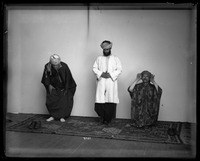 Demonstration of "Life in the Holy Land"by the Arbeely Family of Syria
 The Arbeely family is credited with being the first Syrian immigrants to the United States. They were highly educated and one way they supported themselves was through demonstrations of and lectures on Syrian life. In this image members of the Arbeely family, who were Christian, were demonstrating how Muslims prayed. To the American eye, Syrians were associated with "Mohammedan" and the Arbeely family played into this stereotype to make a living.
-
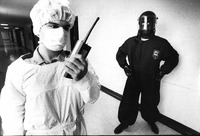 Correctional officers guarding AIDS patients at hospital ward
 Two Westchester County correctional officers in New York are pictured wearing the special protective equipment designed to guard AIDS patients in the hospital ward. Officer on left wears a face mask, hair net, and protective gown. Officer on right stands with hands on hips and wears a face shield, helmet, and a padded suit.
-
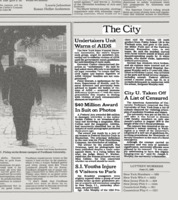 Undertakers Unit Warns of AIDS
 A short New York Times article about the New York State Funeral Directors Association formalizing their policy toward the separate treatment of those killed by AIDS. New York City funeral homes regularly refused to take in the bodies of AIDS victims throughout the early 1980s, furthering AIDS phobia even after death. This article is short and placed at the bottom right corner of the paper's 27th page.
-
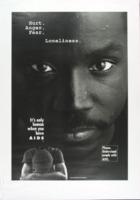 Hurt. Anger. Fear. Loneliness.
 AIDS awareness poster highlighting the social stigma and isolation experienced by People With AIDS. A man's face is pictured over the large majority of the poster, staring directly at the viewer. A smaller photo in the poster's bottom left corner pictures a man folding his head into his arms. Both photos are in black and white. Text reads: "Hurt. Anger. Fear. Loneliness. It's only human when you have AIDS. Please understand people with AIDS."
-
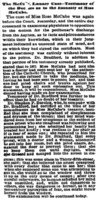 The McCabe Lunacy Case -- Testimony of the Doctors as to the Insanity of Miss McCabe
 This article outlines the testimonies of Drs. Bradford & Burdick declaring Rose McCabe insane before the Court. These accounts did not always align with Rose McCabe's testimony, which raises questions as to whose testimonies should be believed.
-
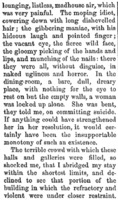 Excerpt from "American Notes," by Charles Dickens
 This excerpt from Charles Dickens' "American Notes," details the author's trip to Blackwell's Island and his horrible time seeing the ghastly conditions of the Lunatic Asylum.
-
 "A Fugitive Syrian Family. A Professor of Arabic Literature, with His Wife, Six Sons and Daughter at Castle Garden."
 The article recounts the arrival of Yussef Amad Arbeely and his family to New York City. Arbeely's family was the first Syrian family to immigrate to New York City. The family immigrated to the United States due to religious persecution in Syria for their Christian faith. The article also describes the members of the family, their language skills, why the family decided to immigrate to the United Staes, and the family's future plans.
-
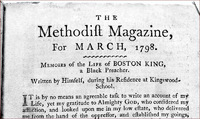 Memoirs of Boston King
 Boston King(1760-1802) was an enslaved person escaping slavery during the time of the American Revolution. Boston King worked as a carpenter during his time in New York City in the 1780s. He left at the end of the war and settled in modern-day Sierra Leone.
In the 1790's he self-published a slave narrative called: Memoirs of the Life of Boston King, a Black Preacher. He writes about his time in New York City in the memoir.
-
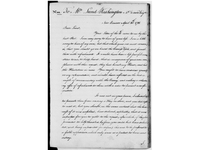 General Washington writing about escaped slave: Harry Washington
 The letter is from General Washington on the conditions of enslaved people who ran away from Mount Vernon in 1776.
One of the enslaved individuals: Harry Washington, fought for the British during the war and was stationed in New York City. Washington was evacuated along with many loyalists at the end of the war.
-
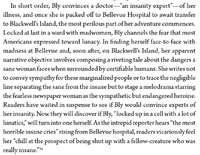 Nellie Bly Excerpt from "Sympathy, Madness, and Crime: How Four Nineteenth-Century Journalists Made the Newspaper Women's Business"
 Excerpt on p. 88 from the chapter titled, "Making a Spectacle of Herself"
-
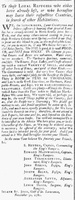 King's Rangers Address
 Proclamation by members of the King's Rangers, a British colonial military unit, promoting Nova Scotia as a destination for Loyalists who planned on leaving New York. The text ran weekly in the Royal Gazette for the first few months of 1783. While Patriot news sources disparaged Canadian provinces as a destination for Loyalists, and mocked those who decided to flee the American colonies, efforts like this promoted the region.
-
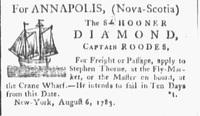 For ANNAPOLIS, (Nova-Scotia) The SCHOONER DIAMOND
 Advertisement for the schooner Diamond departing New York for Annapolis, Nova Scotia, about August 16, 1783. The Diamond was not among the ships commissioned by the British which departed in fleets beginning in October 1782. Instead, it offered people the ability to privately arrange for travel or shipment of goods to Nova Scotia, during a period when over 29,000 refugees left from New York to Nova Scotia and St. Johns.
-
 Book of Negroes
 The Inspection Roll of Negroes, also known as the "Book of Negroes" was a list of 3,000 Black Loyalists who requested alyssum from Great Britain at the end of the war. Much of the book was assembled at Fraunces Tavern before the British and their allies left New York City.
Many of the 3,000 were escaped enslaved people, some of whom fought with the British during the war with the promise of freedom. The majority were sent to other British colonies throughout the New World.
-
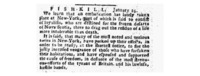 Loyalists leaving New York for Nova Scotia
 Account from a Philadelphia newspaper regarding loyalists fleeing New York and heading to Nova Scotia, Canada, after the American victory in the Revolutionary War. Discriminated against and persecuted for their loyalty to the Crown, many New York loyalists chose to leave the newly established United States and create new lives for themselves in a British controlled area, rather than remain in a country hostile to them.
-
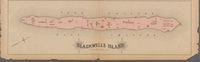 Map of Blackwells Island bounded by West Channel and East Channel (Plate # 41)
 This is an 1879 map of Blackwell's Island featuring the layout of medical and penal facilities. The specifically designated, individual buildings can be seen here as well as the fact that this community is geographically isolated by its island nature.
-
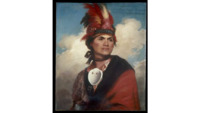 Portrait of Joseph Brant (Thayendanegea)
 Painting of Joseph Brant, a soldier and political leader from the New York Mohawk tribe. Brant is depicted here in ceremonial Iroquois dress, demonstrating his power and leadership role within the Iroquois Confederacy. Brant was instrumental in influencing four of the six tribes within the Iroquois Confederacy/Six Nations to ally with the British during the American Revolution. Brant is thought to have also fought alongside the British during the New York City campaign in 1776, and in battles across New York State, Pennsylvania, and other areas. Defeat by Continental forces and the end of the war led to Brant's retreat to Canada, where he continued to advocate for his people's rights in both the new American government and the British government.
