-
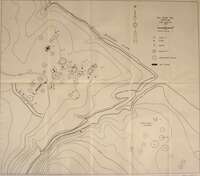 The Dodd Site, Oahe Reservoir
 Decades before citizens of the Standing Rock Sioux Tribe and their allies gathered to protect the waters of the Missouri river valley from the construction of the Dakota Access Pipeline, the Standing Rock reservation was threatened by the creation of the Oahe dam in 1948 by the United States Army Corps of Engineers. The Oceti Sakowin (Očhéthi Šakówiŋ) tens of thousands of acres of their lands and important historical and cultural sites which were flooded by the Oahe reservoir when the dam was completed. Prior to the construction of the dam, archaeologists mapped and excavated many of the Oceti Sakowin’s sacred sites. The Oceti Sakowin continue to fight for their sovereignty and to protect the lands and waters of their homelands.
-
[Untitled]
-
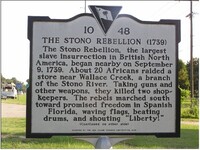 Stono Rebellion Historical Marker
 In the early 1970s, a cooperative of Black farmers known as the South Carolina Sea Island Farmers, unknowingly purchased the land where the Stono Rebellion began. The Stono Rebellion was the largest and bloodiest uprising of enslaved people in colonial North America. Slave revolts were every enslaver's worst nightmare as white people often feared revenge for their horrific treatment of enslaved people. They were also afraid that if free or enslaved Black people had access to guns it would lead to violent rebellions and eventually to Black freedom. In response to Stono, South Carolina passed the Negro Act of 1740 which imposed even stricter restrictions upon enslaved people. After discovering the land’s history, the Cooperative commemorated the uprising by erecting a historical marker on the Rebellion's anniversary date Sept. 9, 2006.
-
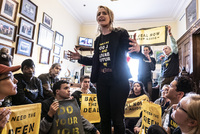 Sunrise Movement Sit-in
 The Sunrise Movement is a multi-class, multi-racial youth-led political action organization focused on questions of environmental justice and climate change. The Sunrise Movement calls into question who can be an environmentalist; they show that young people–as much as adults–have the power to make significant change. A major initiative of the Sunrise Movement is supporting the Green New Deal–a public policy which addresses climate change all while creating jobs in the renewable energy industry. On December 10, 2018, the Sunrise Movement staged numerous sit-ins inside of Congressional representatives’ offices. A year after this sit-in, Representative Alexandria Ocasio-Cortez introduced House Resolution 109 naming the duty of the Federal Government to create a Green New Deal. While the Green New Deal has yet to be wholly adopted, it has influenced the Biden administration’s approach to climate change policy.
-
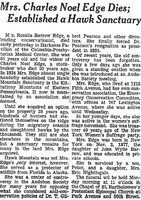 Obituary for Rosalie Barrow Edge, AKA “Mrs. Charles Edge”
 Rosalie Barrow Edge’s obituary reveals the motivations of wealthy urbanites’ involvement in the Progressive Era conservation movement: preservation by way of privatization–not through collective collaboration or government intervention. Barrow Edge became a noted conservationist upon purchasing 1,340 acres of land near Kempton, Pennsylvania. The land was previously a favored place for rural hunters to shoot hawks. On her newly purchased land, Edge formed the Hawk Mountain Sanctuary, the world's first private preserve for birds of prey. Barrow Edge’s obituary also shows how would-be allies in the early conservation movement were sometimes at odds with one another. Barrow Edge fought with the Audubon Society over their policies which allowed for the killing of predator animals.
-
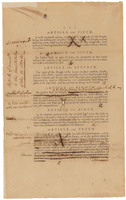 Senate Revisions to House Proposed Amendments to the U.S. Constitution (page 2)
 This annotated page, which lists the House of Representatives’ initial seventeen amendments to the U.S. Constitution, depicts the drafting process undertaken by the U.S. Senate in September 1789. It was the political tensions between opposing groups in the newly created American governmental body—the North and the South, the Federalists and the Anti-Federalists—that led to the creation of a Bill of Rights that, after the Senate's review, comprised twelve amendments to the Constitution. James Madison's draft of the Second Amendment (seen here as Article the Fifth) addressed concerns from Anti-Federalist Patrick Henry and other Southerners, who, remembering the role of the Southern militias in squashing slave revolts in the colonies, feared that the new federal government would prohibit armed white citizens from protecting and enforcing the slave system. On December 15, 1791, the Second Amendment was ratified by the states in its final form.
-
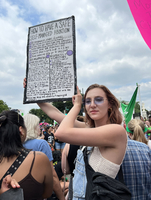 2022 Abortion Activist with Poster
 Depicted is activist Julia Tallant in Washington D.C. outside of the U.S. Supreme Courthouse protesting the overturning of the 1973 Roe decision. She is holding a home-made poster detailing instructions for having a "safe self-managed abortion." In doing so, Tallant is advocating for abortion as a matter of healthcare. The poster offers a means for women to care for their own health in the event that the government restricts their choice.
-
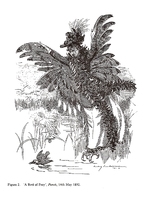 “A bird of prey" Illustration
 Cartoon by Edward Linley Sambourne (1844-1910) published in Punch Magazine in 1892 depicts a woman adorned with a feathered hat inhabiting the body of a forbidding predator bird that looms over a smaller bird. The bird plume fashion trend, which emerged in the 1860s, coincided with increased attention to bird protection among conservationists who had grown concerned over the extinction of certain avian species. The founding of the Nuttall Ornithological Club in 1873, the American Ornithological Union in 1883, and the Audubon Society in 1886 led to increased bird protection activism and legislation. In their crusade against feathered garments, and the millinery industry in particular, bird activists made fashionable women the target of their campaigns. Indeed, the inaugural lecture of the Audubon Society delivered by ornithologist Frank M. Chapman was titled “Woman as a Bird Enemy.'' This cartoon demonstrates how conservationist circles leveraged misogynistic imagery to scapegoat women.
-
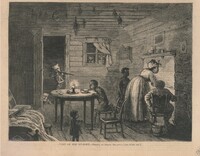 "Visit of the Ku-Klux"
 This engraved illustration by Frank Bellew depicts armed members of the Ku Klux Klan breaking and entering into the home of an African American family as they prepare for dinner. During Jim Crow, Black Codes were created to prevent Black gun ownership. The KKK (along with white militias and police forces) were known to break into and destroy Black people’s homes in search of "contraband" weapons. Unarmed, African Americans were left even more vulnerable to white domestic terrorism and violence.
-
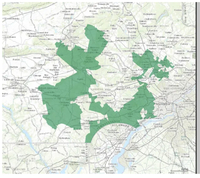 “Goofy Kicking Donald Duck” Proposed Congressional District in Pennsylvania, 2011
 This is a map of a proposed district boundary, drawn by a Republican-led state legislature in 2011, based on the 2010 US census. The map gained the nickname "Goofy Kicking Donald Duck" because it resembled the Disney characters Goofy and Donald Duck, and provided a comical example of district re-drawing to gain political power. Gerrymandering, the practice of redrawing a district in order to obtain political advantage for a political party, is a tactic that has been used both by Civil Rights supporters to get Black representatives elected, and as a tool of voter suppression to obtain White majorities in previously Black majority districts.
In 2018, the Pennsylvania Supreme Court ruled that the drawn boundaries were unconstitutional, but similar cases exist in states around the country.
-
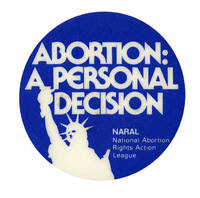 Abortion: A Personal Decision [button], circa 1980s
 This slogan was used widely by NARAL Pro-Choice America, promoting the fight for abortion access as “A Personal Decision.” The button shown here also features the Statue of Liberty, an iconic image that suggests a link between abortion as a personal decision and the American ideal of individual liberty. In response to a “pro-life” framing by anti-abortionists in the early 1970s, pro-abortion groups sought to counter this interpretation with the phrase “pro-choice.” This framing sought to appeal to notions of personal responsibility, privacy, and tropes of American freedom.
-
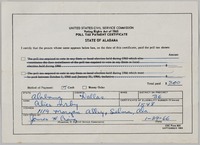 Poll Tax Payment Certificate from the state of Alabama
 Poll taxes were one of the many legal methods by which southern states prevented disproportionately impoverished Black communities from voting and exerting political power following Reconstruction. At the polls, voters in certain southern states were required to pay a fee in order to cast their ballots, but a “grandfather clause” could exempt poor white people from this requirement if they descended from someone who voted before the Civil War. In 1964, the Twenty-fourth Amendment to the United States Constitution banned poll taxes in federal elections, but five states retained them for state and local elections. This certificate issued by the United States Civil Service Commission is evidence that on January 29, 1966, Alice Irby of Selma, Alabama paid the three-dollar poll tax in order to vote in that year’s elections. Only a few months later, civil rights lawyers and grassroots activists in Virginia would challenge state poll taxes in the Supreme Court, which would result in them being declared unconstitutional.
-
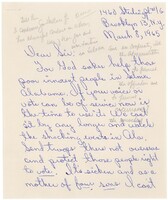 Letter to House Judiciary Committee
 Mrs. E. Jackson wrote to the House Judiciary Committee the day after Bloody Sunday in Selma, Alabama. She was reacting to scenes of police brutality during a voting rights march that many Americans witnessed on television news programs in favor of voting rights and denouncing the horrid attacks from that day. Mrs. E. Jackson was writing from Brooklyn about events she witnessed on the news that occurred in Alabama. Bloody Sunday caused a national push for civil rights and activists took advantage of this to advocate for the Voting Rights Act.
-
 The Negroes sentenced
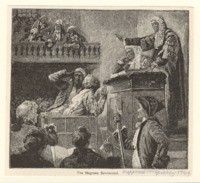
 In this image by illustrator Charles Stanley Reinhart, white lawmakers in colonial New York convict enslaved African men of suspected conspiracy after a series of unexplained fires plagued the colony. Following major slave rebellions in the colonies, such as the 1739 Stono Rebellion, the New York Conspiracy of 1741 reflected white Americans' widespread fear of armed enslaved Africans—fear that would influence the creation of the Second Amendment. Reinhart produced this illustration just a few years after the case United States v. Cruikshank, in which the U.S. Supreme Court held that the federal government was not required to protect Black citizens against private criminal conspiracy and assault that deprived them of their constitutional right (including the right to bear arms). Even decades after the Conspiracy of 1741, the American government still sought to subjugate the descendants of former slaves.
-
 Civilian Conservation Corps Pictorial Map
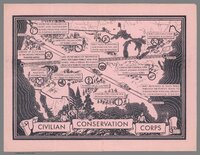
 The Civilian Conservation Corps (CCC), a Great Depression era federal relief program, provided men with jobs focused on environmental protection. This work included building national parks; clearing forests for wildfire control; and maintaining access roads. The Corps segregated units by race, and it further excluded women and Indigenous people from participation. The United States Army supported the CCC by transporting workers across the country. In 1933, the CCC deployment was the largest peacetime mobilization of the Army in US history. This map demonstrates some of the CCC’s work–much of which still impacts us today. Some activities, like planting trees, might resonate with contemporary ideas of conservation. Activities, like laying telephone lines, call into question how much conservation the Corps was actually undertaking. The map also demonstrates the patriarchal and nationalistic undertones of the Corps through the images of shirtless men and the use of militaristic language like “operations.”