-
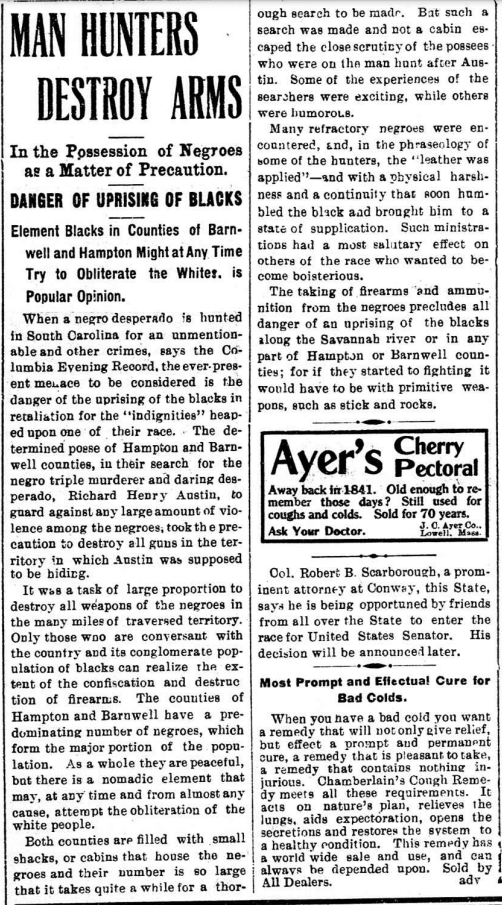 "Man Hunters Destroy Arms." The Lexington dispatch (Lexington, South Carolina), May 14, 1913
 This 1913 article from The Lexington Dispatch (Lexington, SC) showcases the fear that armed Black men provoked in rural Whites. The subject of the article is a pogrom of destruction that a “determined posse” embarked upon while supposedly searching for a “triple murderer.” The armed men “took the precaution to destroy all guns” in “the many miles of traversed territory,” in order to ward against a possible uprising. Black Americans are clearly considered to have no claim to Second Amendment rights, and the text makes it clear that the seizure and destruction of weapons was totally indiscriminate, aside from the consideration of race. The article speaks in congratulatory terms of the beatings of Black people who resisted the onslaught.
-
 Youth Activists Hold Hunger Strike for Voting Rights
 Youth activists Adrian Horton and Brandon Ortega discuss their use of hunger strikes as a tactic to pressure politicians to protect voting rights. While interviewed on "The Damage Report," these activists discuss their first 15-day hunger strike, which successfully placed political pressure on Congress to put the "Freedom to Vote: John R. Lewis Act" on the top of their legislative agenda at the end of 2021.
At the time of this interview, Horton and Ortega were on day 8 of their second hunger strike, which they initiated to pressure the Senate to pass the Act. Ultimately, the Act was blocked in the Senate on January 20th, 2022.
This interview highlights both the power and limitations of hunger strikes to elicit political change.
-
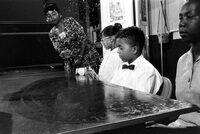 Children Trained for Sit-In Harassment, 1960
 This photograph was taken in Petersburg, VA in 1960 during a training for children that would participate in civil rights sit-ins. Throughout the U.S., children as young as 6 years old participated in civil rights actions that placed them in danger of violence and harassment. Organizations like the NAACP Youth Council prepared young people for non-violent tactics through role-playing that exposed them to the kind of harassment they would encounter when sitting in "whites only" public spaces. While sit-ins were usually aimed more at de-segregation than at voting rights specifically, they exposed violence in the South on a national level, which ultimately led to policymakers and citizens fighting for the Voting Rights Act of 1965.
-
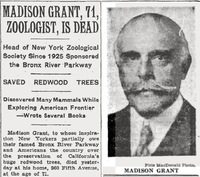 “Madison Grant, 71, Zoologist, Is Dead”
 New York Times obituary for Madison Grant, a prominent zoologist, conservationist, and eugenicist. Grant was one of many conservationists who espoused pseudo-scientific white supremacist ideas. The redwood tree preservation movement in particular drew the interest of well-known eugenicists such as Grant, Henry Fairfield Osborn, Charles Goethe, and Vernon Kellogg. Believing that the superior Nordic race would go extinct due to inbreeding with inferior blood lines, Grant served as the vice president of the Immigration Restriction League for many years. He also co-founded the Save the Redwoods League in 1918 and helped to create Glacier National Park and Denali National Park.
-
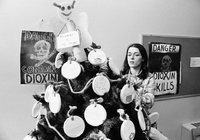 Lois Marie Gibbs, Mother of the EPA Superfund
 Photograph of Lois Marie Gibbs decorating a Christmas tree trimmed with ornaments naming chemicals found in the Love Canal neighborhood of Niagara Falls, New York. A middle class housewife with no college education or political organizing background, Gibbs began her celebrated career in environmental activism in 1978 after discovering that her son’s elementary school was built on top of more than 20,000 tons of toxic chemical waste dumped by the Hooker Chemical Company. In her neighborhood of Love Canal, most children born in the 1970s had birth defects. Gibbs’ own children had been ill from birth and her son began having seizures once he started school. Gibbs went door to door petitioning for the closure of the school. As she spoke with neighbors and learned of their health problems, she formed a homeowner’s association and worked to have 810 Love Canal families evacuated, prompting the creation of the EPA’s Superfund program responsible for responding to environmental emergencies and cleanups. In 1981, Gibbs founded Clearinghouse for Hazardous Waste – later renamed to the Center for Health, Environment, and Justice – to help train and support grassroots organizations working to protect neighborhoods from exposure to hazardous wastes. Gibbs was nominated for the Nobel Peace Prize in 2003 and holds honorary degrees from several universities.
-
 Ford Motor Company–Glacier National Park Tourism Film
 Can private companies be environmentalists? “...And as you breathe in the bracing mountain air, you get a new grip on life,” says this 1939 tourist film just moments after describing the nearby Blackfeet Nation as a remnant of a historical past. The land on which Glacier National Park stands was stolen from the Blackfeet through a deal brokered by George Bird Grinnell, the founder of the Audubon Society. This calls into focus the ways in which private organizations and private companies–like the Ford Motor Company–have used environmentalist thinking to their own financial and commercial benefit, often to the detriment of those most impacted by their actions. As much as this film depicts the stunning terrain of Glacier National Park, it is more-so an advertisement for Ford vehicles. In 2022, we understand fossil fuels and fossil fuels emissions to be a leading cause of climate change. Here, Ford plays a sleight of hand in suggesting that their vehicles have some connection to the conservation of park lands. In contemporary terms, when a company misguides consumers into believing their product has a positive environmental impact, we call this “greenwashing.”
-
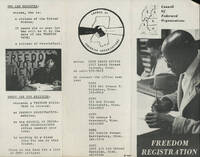 Council of Federated Organizations (COFO) Pamphlet
 COFO was a group of organizations that, in the summer of 1964, banded together to organize the Freedom Summer. The four groups that made up COFO were the Student Nonviolent Coordinating Committee (SNCC), Congress of Racial Equality (CORE), National Association for the Advancement of Colored People (NAACP), and the Southern Christian Leadership Conference (SCLC). The goal of the participating organizations and the hundreds of white volunteers who helped was to increase the number of registered Black voters in Mississippi. This goal was largely a failure, only a fraction more voters registered that summer. The most prominent event was the disappearance of one Black and two white volunteers and their rediscovery weeks later beaten to death. This event was covered by the national news and was one of the earliest causes of public outcry in defense civil rights
-
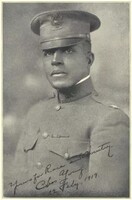 Captain Charles Young, First Black National Parks Superintendent
 National Parks are often heralded as important sites of land and wildlife conservation. Before the National Parks Service existed, the United States Army managed National Parks spaces. After fighting as Buffalo Soldiers in the Civil War, Brigadier General Charles Young and his troops were placed on duty at Sequoia National Park. Young was named Acting Superintendent, making him the first Black person in a National Parks leadership role--and at a time when the National Parks were still segregated. As Superintendent, Young completed numerous infrastructure projects like blazing the summit trail to Mount Whitney. This photograph, inscribed by Young, says “Yours for Race and Country, Chas. Young 22, July 1919.” Without minimizing Young’s contributions to the National Parks, we must also consider that the creation of Sequoia National Park displaced the Mono (Monache), Yokuts, Tübatulabal, Paiute, and Western Shoshone peoples from their homelands. We should additionally question why the United States believed it needed armed forces to manage parklands, and whose interests Young’s activities truly served.
-
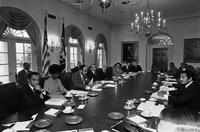 Congressional Black Caucus
 The Congressional Black Caucus (CBC) was established in 1971 following the VRA, the same year this photo was taken, and still exists today. Their current stated goal is to use the full power of the Constitution to ensure that African Americans and other minorities have equal rights. Since its founding in 1971 the CBC has grown in numbers and influence. The current elected Congress includes 56 CBC members across the House and Senate. While the caucus is majority Democratic, they have members throughout both parties and partake in bipartisan collaboration. Their current agenda includes “fighting to expand access to the ballot through initiatives like automatic voter registration and early voting.” Despite the split in political makeup, the CBC is dedicated to fighting for the rights of minority groups.
-
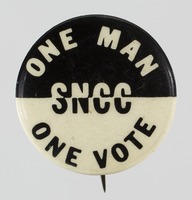 Student Nonviolent Coordinating Committee (SNCC) Pin
 One of the ways Americans were encouraged to vote was through the distribution of small memorabilia like this pin. This pin was made by the Student Nonviolent Coordinating Committee (SNCC), and likely passed to other young voters. SNCC used nonviolent acts of protest (ex; sit-ins and boycotts) to advocate for civil rights since their founding in 1960. The nonviolent aspect was an important part of their rise in notoriety because members who participated in the sit-ins had to deal with anti-civil rights hate and abuse. Their ability to remain calm in the face of such abuse changed the attitudes of many witnesses.
-
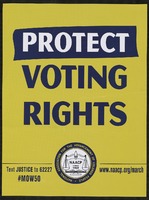 National Association for the Advancement of Colored People (NAACP) Poster
 A poster used during the March on Washington August 24-28, 2013. This is a modern poster that states in large letters “Protect Voting Rights.” Made by the NAACP, founded in 1909 by major historical civil rights activists, the organization still exists and works toward racial justice today. Just months before this march, in June the same year, the Supreme Court released its decision in Shelby County v. Holder that declared section 5 and section 4(b) of the VRA unconstitutional. These sections regulated the states on how they were allowed to change election rules. Following this ruling, voting access was more strict across the country and it became harder for minorities to register to vote.
-
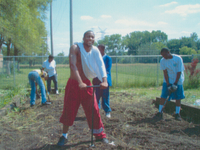 Youth Trainees at the People for Community Recovery
 A photograph of the People for Community Recovery’s Youth Environmental Training Program participants. Founded in 1979 by environmental justice leader Hazel M. Johnson, the People for Community Recovery (PCR) is a community-led organization that promotes environmental sustainability and safety in Chicago’s South Side neighborhoods. PCR’s work has been at the center of a decades-long grassroots movement to protect Chicago’s Black communities from environmental toxins. PCR’s youth training program gained national recognition in 1992 when Johnson was awarded the President's Environment and Conservation Challenge Award. President George H. W. Bush commended PCR’s founder for “cultivating our human resources to conserve our natural ones,” harkening back to Progressive-era conservation ethics while sidestepping the issue of environmental racism at the heart of PCR’s work.
-
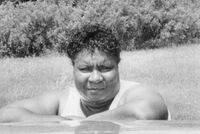 Hazel M. Johnson, Mother of Environmental Justice
 A photograph of Hazel M. Johnson, recognized as “the mother of environmental justice” for her local activism in response to the impact of environmental hazards on a community of Chicago public housing residents as well as work at the federal level against environmental racism. Following the death of her husband from cancer in 1969, Johnson began surveying and documenting her neighbors’ chronic health problems and the poor maintenance of her housing complex. Johnson agitated for accountability from the Chicago Housing Authority, leading to water testing that found that the building’s drinking water was contaminated. In 1979, Johnson founded the People for Community Recovery, spawning a grassroots movement to protect public housing residents from environmental toxins. Johnson entered the national stage in the 1990s when she was awarded the President's Environment and Conservation Challenge Award in recognition of her advocacy work, joined a team of activists in fighting for the 1994 Environmental Justice Executive Order, and worked with Al Gore on his environmental platform.
-
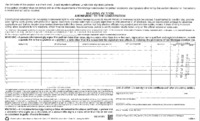 "Promote the Vote" Petition, 2022
 The "Promote the Vote" Petition, filed in Michigan on January 31, 2022, proposed various constitutional amendments to address voting rights in the state, including creating an early voting period and devoting state funds for postage on mail-in ballots. The Michigan State Board of Canvassers voted to approve the petition form on February 11th, and by July 11th, the Promote the Vote 2022 organization announced that supporters submitted 669,972 signatures. This ensured that the constitutional amendment will be on the ballot on election day, November 8th, 2022.
As of 2022, twenty six states have laws that allow ballot initiatives and/or veto initiatives, which provide opportunities for citizens to propose, amend, and shape laws in their state. This archive document provides an example of a tactic that citizens can use to secure voting rights. By proposing amendments to state constitutions and then gathering sufficient signatures, citizens can organize to protect voting rights in their state.
-
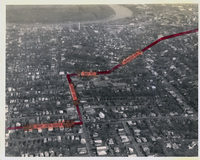 Proposed March Route to Alabama State Capitol 1965
 An aerial photograph annotated with crayon by the Department of Defense to outline the proposed route for the Selma to Montgomery Civil Rights March, 1965. This was the third march organized from Selma to Montgomery, after a previous march --- later called "Bloody Sunday" - where Alabama state troopers violently brutalized civil rights protesters. The violence on Bloody Sunday led Lyndon B. Johnson to send federal troops to protect protestors for this third march. This image highlights the preparation required to implement large-scale marches that can lead to national mobilization and, in this case, political change like the VRA. It also illustrates how governmental bodies like the Department of Defense have served both to protect and to surveil the actions of civil rights activists.
-
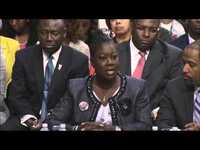 Trayvon's Mother Denounces 'Stand Your Ground'
 On February 26, 2012, Florida resident and member of the local neighborhood watch George Zimmerman shot and killed 17-year-old Trayvon Martin, an unarmed Black boy who had been on his way home after an evening snack run. Zimmerman claimed to have shot Martin in self-defense. The members of the jury, considerate of the state’s 2005 Stand Your Ground Law that meant that Zimmerman had the right to use deadly force if necessary to defend himself, found this argument convincing—Zimmerman was acquitted of second-degree murder charges on July 13, 2013. In a Senate committee later that year, captured in this video, Martin’s mother Sybrina Fulton decries Stand Your Ground, stating that “our [Black] kids cannot feel safe in their own community.” In the decade following Martin’s murder and Fulton’s plea, states across the U.S. adopted similar legal doctrine, setting a widespread legal precedent that allows for bias against Black victims in favor of the white shooters who see them as a threat.
-
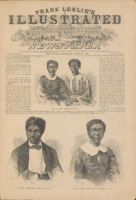 Eliza and Lizzie, children of Dred Scott [top]; Dred Scott [and] his wife, Harriet
 The newspaper cover refers to the legal case Dred Scott v. John F.A. Sandford, which brought the issue of Black citizenship to the U.S. Supreme Court and made the formerly enslaved Dred Scott and his family a focus of the public eye. On March 6, 1857, the Supreme Court ruled that both enslaved and free people of black African descent in America were not considered to be citizens under the U.S. Consitution, and thus were not recipients of the document’s rights and privileges—including the right to own and use guns. The Second Amendment was clearly at top of mind for the presiding judges, as the Court’s written decision includes the right to "to keep and carry arms wherever [Black people] went" amongst a description of the frightening consequences of ruling in Scott's favor. This newspaper cover page (published only a few months after Scott's case was struck down) describes Scott and his family in a dehumanizing manner, detailing how they were more or less harassed and forced to be photographed for the paper.
-
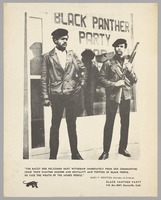 Black and white poster of Huey Newton and Bobby Seale
 In 1966, Californian college students Huey Newton and Bobby Seale (depicted in this poster) founded the Black Panther Party for Self-Defense, which became a prodigious force within the Black Power movement—and, for many white Americans, a significant threat to U.S. security. BPP members engaged in “copwatching” patrols, in which party members took advantage of their Second Amendments rights and the period’s open-carry gun laws to act as armed security for Black community members, who were often victims of police brutality. In direct response to white America's fear of the BPP's armed resistance, California Governor Ronald Reagan passed the 1967 Mulford Act, which repealed a law that allowed Californians to open-carry loaded guns without a permit. This 1971 poster features a photograph of Seale and Newton holding a Colt .45 handgun and shotgun, respectively, seemingly in defiance of the Mulford Act.
-
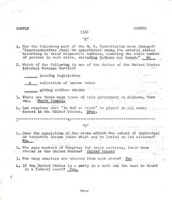 Alabama Literacy Test, circa mid-1960s
 Before the Voting Rights Act banned literacy tests, southern states used them to prevent Black citizens from voting. Alabama required people registering to vote to recite a section from the state’s Constitution and answer several written questions. The use of literacy tests was based on the discretion of local officials, so most white citizens did not take literacy tests, and if they did, their tests were often easier. In an effort to combat this discrimination, civil rights activists formed Citizenship Schools to teach Black adults how to fill out registration forms and pass the literacy test. A Citizenship School developed this worksheet to prepare Black people for what they would face on the test by providing sample questions and answers, highlighting the fact that literacy tests included overly complicated and subjective civics questions.
-
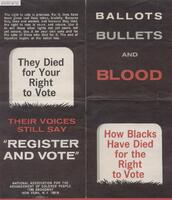 Ballots, Bullets, and Blood
 Following the implementation of the Voting Rights Act, organizations like the NAACP worked to register Black voters across the south and elsewhere in the country. This 1968 pamphlet was designed by the NAACP to encourage Black citizens to vote by referencing the violent history of voter suppression. White supremacists used violence and terrorism to discourage Black people from voting and organizing for the right to vote. This pamphlet tells the stories of thirteen Black and white people murdered for their activism surrounding voting rights, including Martin Luther King, Jr. The NAACP's tactic of appealing to history and readers' emotions heightens the stakes of voter registration. By portraying the ballot as something worth dying for, this pamphlet frames voting as a way to honor those slain in the struggle to secure this right.
-
 Mrs. Guilford, 94, reflects on poll taxes, literacy tests and new efforts to limit voting
 In the twenty-first century, many states have passed laws requiring voters to present a government-issued photo ID at the polls in order to vote. Republican state legislators argue that voter ID laws combat fraud, but there has been no evidence of widespread fraud to support these claims. These voter ID laws have a disproportionate impact on the elderly, poor, and communities of color, who generally have more limited financial resources and reduced access to locations where they can acquire acceptable forms of identification. This video produced by the Southern Poverty Law Center connects historical acts of discrimination, like literacy tests and poll taxes, to voter ID laws by interviewing an elderly Black woman who experienced restrictive voting laws in her youth. By appealing to civil rights history and placing these new laws into historical context, the SPLC makes an argument against voter ID laws and for the necessity of voting.
-
Selma, Alabama Demonstration
The violence that police officers committed against voting rights activists in Selma, Alabama in March 1965 galvanized the nation and put pressure on President Lyndon B. Johnson to pass the Voting Rights Act. That was not, however, the first demonstration in Selma for voting rights. This footage displays the nonviolent civil disobedience tactics that Black adults and teenagers utilized in February 1965 to spread their message about Selma’s racist voter registration practices across the country. It also highlights the police’s efforts to end the protest with threats of imprisonment. Martin Luther King Jr. had been jailed as a part of this multi-day protest along with many others and after his release, he announced that he planned to use the injustices committed against these peaceful protesters to convince President Johnson to pass legislation that would remedy this crisis.
-
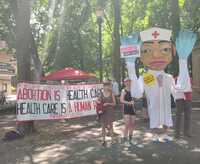 Abortion is Healthcare, Healthcare is a Human Right
 This banner, which states “Abortion is Healthcare, Healthcare is a Human Right” was displayed at a rally for Medicare For All organized by the Portland, Oregon branch of the Democratic Socialists of America (DSA). For some pro-abortion groups, abortion is part of a larger struggle for free, universal healthcare, which they consider a basic human right. This framework puts forward abortion access as a positive right—freedom to get access to universal healthcare.
-
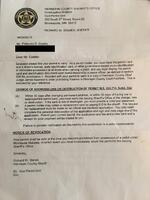 Philando Castile's Concealed Carry Permit
 Philando Castile was shot seven times and killed by a Minnesota police officer while his girlfriend and her four-year-old daughter were in the same car, after Castile politely informed the policeman that he had a licensed gun with him. The National Rifle Association, a leading gun rights advocacy group, was notably silent on Castile’s case, and local law enforcement officials even disputed the legality of Castile’s gun until his family released this photo of his concealed carry permit to the media. Castile’s attempt to exercise his Second Amendment rights ended in his death, while his killer was acquitted of all charges by the American justice system.
-
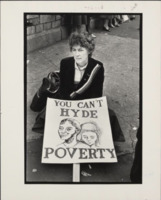 Abortion Demonstration in Union Square
 In this photo, a woman holds a sign reading "You Can't Hyde Poverty," a reference to the Hyde Amendment--a 1980 restriction on federal money and Medicaid in the use of abortion- impeding access for the most vulnerable groups. The Hyde Amendment was considered a direct attack on the reproductive rights of women living in poverty, particularly women of color. This is an example of why parts of the movement for abortion access became connected to concepts of social justice (age, race, and class). By talking about poverty, pro-abortion advocates expanded the limitations of choice and privacy frameworks to one of socioeconomic inequality.