-
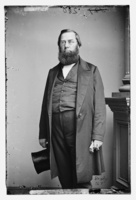 George Perkins Marsh
-
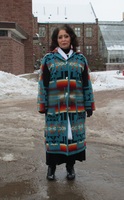 LaDonna Allard
-
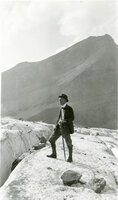 George Bird Grinnell
-
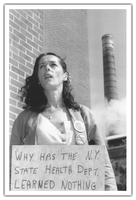 Lois Gibbs with Poster
-
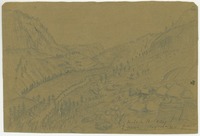 John Muir Hetch Hetchy drawing
 John Muir is well known for his role in the creation of the National Park System and the organization of the Sierra Club. His preservationist environmental philosophy informed his opposition to the creation of the Hetch Hetchy Reservoir, which was completed in 1923 with the help of conservationist-minded environmentalists. Conservationists argued that the reservoir was necessary to supply San Franciso with water, whereas Muir believed Hetch Hetchy Valley, drawn here by Muir, needed to be protected from this type of utility project, arguing that the environment need to be preserved for future generations to enjoy. Muir's white supremist and anti-Indigenous ideologies excluded many from his vision of who should be able to enjoy the parks.
-
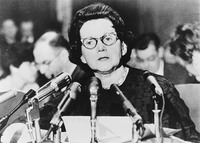 Environmentalist Authors
 Rachel Carson’s Silent Spring published in 1962 became one of the most influential environmental writings. The following year she was a speaker at a Senate Government Operations subcommittee hearing on the hazards of pesticide use. In her remarks, Carson argued that the problem of pesticides and other poisonous chemicals “must be resolved in our time.” Carson warned of the damage chemicals had already done to the environment and to all living things: “Contamination of various kinds has now invaded all of the physical environment that supports us — water, soil, air, and vegetation. It has even penetrated that internal environment within the bodies of animals and of men.” Silent Spring is one work within a body of literature by environmentalist authors, including Henry David Thoreau, Aldo Leopold, and others, who have increased public awareness of environmental concerns.
-
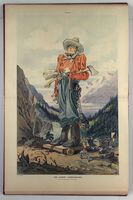 "The Dummy Homesteader"
 This cartoon from Puck published in 1909 satirizes business environmentalists who hid their interests in public lands behind the visage of rural homesteaders when, in reality, their interest in public lands were “power monopolists” and “land grifters” who were primarily interested in mineral and waterpower rights. Businessmen are depicted taking “fraudulent titles” from the “dummy homesteader.” In the following decades, rural homesteaders and local hunters attempted to hold wealthy elite recreationists accountable to wildlife conservation laws by writing editorials with a similar critique of elite misuse of resources for their own interests.
-
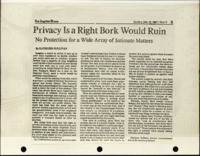 "Privacy is a Right Bork would Ruin"
 This is a scanned copy of a 1987 LA Times article about the potential consequences of the future of privacy and choice threatened by Judge Robert H. Bork. Bork at the time was a Supreme Court seat nominee selected by President Reagan and many saw him as a threat to privacy and ultimately choice in reproductive matters. This is important to show the legislative side of this because when the concept of privacy is threatened, who is impacted by that?
-
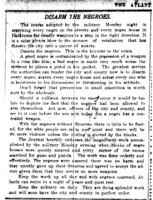 “Disarm the Negroes”
 In September, 1906, a riot exploded in Atlanta, Georgia. Inflammatory and far exaggerated press reports on the alleged rapes of white women by Black men had whipped the white population into a frenzy, which was taken out on Black Atlantans in four days of lynchings, beatings, and shootings which claimed between ten and one hundred lives as well as many Black homes and businesses destroyed. When the violence was abated by the intervention of the National Guard–some of whom were alleged to have participated in the riots–the state disarmed local Black residents, systematically bulldozing their Second Amendment rights in the process.
-
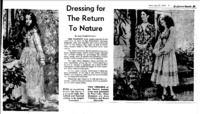 Back-to-the-Land
 This advertisement for peasant dresses in the May 27, 1970 San Francisco Chronicle capitalizes on the growing popularity, essentially among young people living in cities, of the “Back-to-the-Land” movement. The counterculture and environmental movements of the 1960s and 1970s led many to leave their lives in cities in search of more self-sufficient and environmentally friendly lifestyles. This advertisement suggests that anyone could be an environmentalist if they begin dressing in a particular way, “growing her own vegetables,” and “protecting the environment.” The advertisements references to Volkswagons and jobs “where straight clothes are required” target a specific group of white, middle-class San Franciscans. The threads of elitism within the back-to-the-land movement was a point of tension between this new group of environmentalists and rural homesteaders.
-
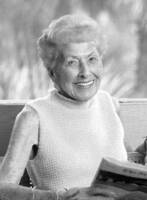 Jane E. Hodgson, American gynecologist
 This is a photo of Dr. Jane Hodgson. She was a pioneer in the abortion rights movement, challenging the legal system and improving the availability of gynecologic and reproductive care to all women through free-standing clinics. In 1970, Hodgson challenged Minnesota's restrictive abortion laws when a twenty-three-year-old mother of three who had contracted rubella early in her fourth pregnancy wanted an abortion. Hodgson became the first doctor convicted of performing an abortion in a hospital (Hodgson v. Minnesota). In 1990 the US Supreme Court issued a decision supporting her position. In terms the role choice plays in abortion rights, not only is it important that choice not only involves the person seeking the services needed but also those who are part of the process, like people who do abortion procedures.
-
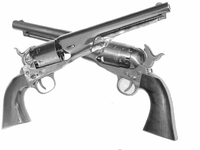 Colt Navy (foreground) and Colt Army (background). 19th-century laws restricting handguns to the Army and Navy pistol were the first "Saturday night special" bans.
 These pistols were standard issue for Union and Confederate soldiers and were kept by many after the Civil War ended. In 1879, Tennessee enacted the Army and Navy Law, restricting handgun ownership to only these models, which were far too expensive for most freedmen to buy, but which many economically privileged whites either already owned or could acquire relatively easily. The Army and Navy Law became the first of many laws restricting the sale of cheap handguns, long argued as a tactic that specifically and purposefully targets Black and other minority communities.
-
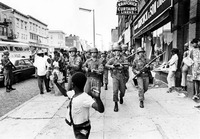 The National Guard on Springfield Avenue in Newark on July 14, 1967.
 This picture was taken during the Newark Riots, which were sparked by a Black taxi driver beaten by police, but had roots in a long-simmering resentment at a white-dominated city government in a Black-majority city overseeing persistent police brutality and corruption. Fully-armed National Guardsmen were deployed to quell the rioting. Claiming they faced sniper fire from buildings, the soldiers fired indiscriminately, killing 26 Black men, women, and children in all, many of whom were in their own apartments. No Guardsmen were killed, and no snipers were ever found. The Newark riots exemplified how white fear could still lead to Black death, and how the fear of armed resistance could lead mothers standing by their windows, as well as the babies in cradles behind them, to become “legitimate targets.”
-
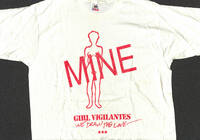 Girl Vigilantes, We Draw the Line [t-shirt], circa 1990s
 This is a photography of a t-shirt made by the collective Girl Vigilantes. Not much of the group is known but this shirt may have been worn for a demonstration or a protest. Not much is know about where it came from but it has the words "We Draw the Line" followed by a design of a woman's body on the t-shirt in red to mark the emphasis of choice and significance. For some, a collective is needed to demonstrate the fight for reproductive choice.
-
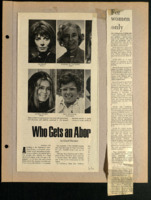 "Who gets an Abortion?"
 This is an excerpt of a newspaper article published by Lloyd Shearer, a celebrity columnist. This article is about the people that get abortions and how famous women celebrities of the time such as Gloria Steinem and Billie Jean King share their testimonies of making a choice regarding their bodies. This is important to contextualize because it shows regardless of race, class and gender, the right to chose is a part of their experiences.
-
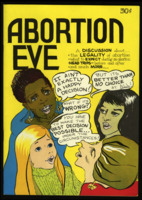 Abortion Eve Zine Cover
 This image is the cover of a 1973 zine that addressed the legality of abortion, and informed women of what to expect before and after the procedure. Like the women depicted on this cover, the contents of the zine is conveyed by multiple women. This effectively demonstrates the diversity of how women of different backgrounds understand their ability to choose abortion. The back-and-forth dialogue in this image frames abortion as a personal choice.
-
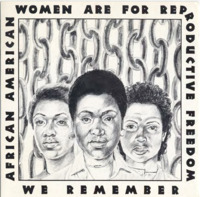 African American Women Are For Reproductive Freedom, brochure 1990
 In this brochure titled “African American Women are for Reproductive Freedom,” the authors define abortion not only a choice, nor an aspect of the right to healthcare, but as a discrete aspect of a universal right coined as “reproductive freedom.” Here, abortion is part of a list of basic rights to control one’s reproductive life. The brochure’s meaning of “reproductive freedom” significantly broadens the fight for abortion to include racial, economic, and social justice. This brochure squarely situates abortion as one part of the larger struggle for reproductive rights, which they deem an elemental right for all women.
-
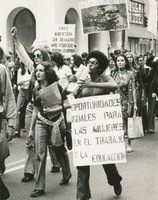 1970 Women's March for Equality in NYC
 The pro-abortion movement consists of overlap with the broader Women's Rights Movement because, to many activists, it is understood as a fight for women's rights to bodily autonomy. Depicted in this image are activists with signs demanding equal opportunities for women, and control over their reproduction. For women of color, abortion access is often accompanied with financial barriers and coerced sterilization. Such barriers ultimately strip women of the ability to gain equal opportunities in work or academia by restricting their ability to choose to become a mother.
-
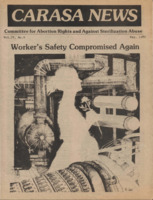 CARASA News newsletter, 1980
 Committee for Abortion Rights and Against Sterilization Abuse (CARASA) was a socialist feminist membership-based organization that fought for reproductive justice and against sterilization abuse. This CARASA News article highlights how women in one factory faced the choice of sterilization or loss of employment. Oftentimes, women’s employment status is linked to their reproductive lives, where workplace conditions, attitudes, or low pay could severely limit their reproductive choices. CARASA challenged these realities by connecting the cause for abortion rights to those of workers’ rights; framing the fight for abortion in a socioeconomic context.
-
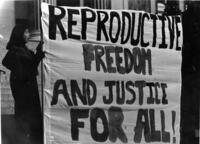 Reproductive Freedom Banner
 Depicted is an unidentified student with a large banner advocating for universal reproductive freedom in front of Low Steps at Columbia University. Although abortion was legalized about a decade prior to this demonstration, the banner addresses the issue of unequal access that persisted. Historically, white women were able to access and receive safe legal abortions more often than women of color. In demanding all women receive the freedom to choose, abortion in this photo is defined as a matter of reproductive justice.
-
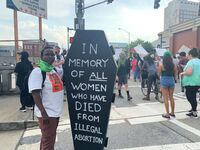 Georgia Abortion Rights Advocate
 Depicted is activist Gathegu Gatungo in Atlanta, Georgia holding a poignant sign to protest the overturning of the 1973 Roe decision. The sign blatantly defines abortion and its legalization as a matter of life or death. While women throughout history have accessed abortion regardless of its legality, here we see them fighting for the choice to access safe, legal abortions.
-
 Pro-choice button, 1989
 A photograph of a button pin commemorating the 1989 pro-choice march in Washington, D.C. It reads, "I Marched For Choice In Spirit" and "Never Again!" in an image of a coat hanger to memorialize those who have lost their lives due to unsafe abortions. The April pro-choice march was just one of many where hundreds of thousands attended. This framing of marching for "choice" appeals to the notions of personal freedom and contextualizes the framework of abortion rights from an autonomous lens rather than a social and political ideology.
-
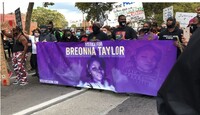 Justice For Breonna Taylor
 This photograph taken at a Black Lives Matter protest in Louisville, Kentucky, depicts protesters calling for justice for the murder of Breonna Taylor. On March 13, 2020, Louisville Metro police officers served a no-knock search warrant at Breonna Taylor’s apartment meant for her ex-boyfriend. A no-knock warrant meant that the cops did not have to announce their presence nor their status as police officers before entering the premises. As such, Breonna Taylor and her boyfriend Kenneth Walker had no idea who was at their door and believed a stranger was attempting to break into their apartment. Fearing for their safety, Walker fired a warning shot using his registered firearm. The cops returned a volley of fire, killing Taylor. Despite the existence of the Castle Doctrine which stipulates that residents have the right to use deadly force when defending their home against intruders, Taylor and Walker were not allowed to protect their home. Instead, the use of a legal gun in self-defense led to the death of another innocent Black woman at the hands of the police.
-
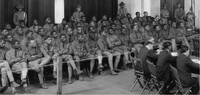 Largest Murder Trial in the History of the United States
 In 1917, the all-Black 24th Infantry Regiment was transferred to Camp Logan in Houston, Texas. Their presence was not welcomed as armed Black soldiers were often deemed a threat to the white supremacist social order enforced by Jim Crow. To assuage the white locals and police, the highly decorated battalion was assigned the lowly task of guard duty and their guns were confiscated when not on call. However, tensions remained between the soldiers and the Houston police, who had a reputation of harassing the city’s Black community. Problems came to a head on August 23, 1917 after a particularly egregious case of police brutality in which an officer and corporal of the 24th were assaulted and arrested by the Houston police. Tired of the disrespect and unwilling to endure any more racist violence, the 24th reclaimed their guns and a large riot ensued. Four soldiers and fifteen white people were killed. As seen in the photograph, the government placed all of the blame on the 24th, resulting in the largest murder trial and biggest court martial in United States history. In the end, 19 Black soldiers were executed and 54 were sentenced to life in prison.
-
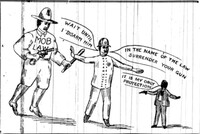 Cop Abets White Mob
 Featured in the Black newspaper, "The Washington Bee", this cartoon depicts a cop disarming an African American man during the Red Summer of 1919. While African Americans could now legally own firearms, it did not mean that their Second Amendment rights were protected. As racial tensions flared, the police repeatedly failed to prevent white mobs from attacking African Americans. The Black community understood that the cops could not be relied upon to protect them from racial terror and that they had no other option but to arm themselves in self-defense. The police incorrectly believed they could prevent riots and appease white mobs by disarming Black citizens. Not only did law enforcement illegally deny African Americans their constitutional rights, but their actions failed to prevent white violence. From April to November of 1919, the NAACP recorded at least 25 large anti-black riots and at least 52 Black people were lynched across the United States.