-
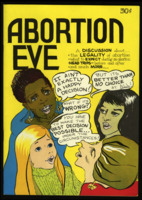 Abortion Eve Zine Cover
 This image is the cover of a 1973 zine that addressed the legality of abortion, and informed women of what to expect before and after the procedure. Like the women depicted on this cover, the contents of the zine is conveyed by multiple women. This effectively demonstrates the diversity of how women of different backgrounds understand their ability to choose abortion. The back-and-forth dialogue in this image frames abortion as a personal choice.
-
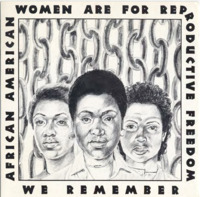 African American Women Are For Reproductive Freedom, brochure 1990
 In this brochure titled “African American Women are for Reproductive Freedom,” the authors define abortion not only a choice, nor an aspect of the right to healthcare, but as a discrete aspect of a universal right coined as “reproductive freedom.” Here, abortion is part of a list of basic rights to control one’s reproductive life. The brochure’s meaning of “reproductive freedom” significantly broadens the fight for abortion to include racial, economic, and social justice. This brochure squarely situates abortion as one part of the larger struggle for reproductive rights, which they deem an elemental right for all women.
-
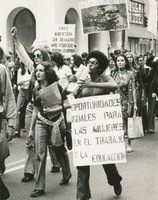 1970 Women's March for Equality in NYC
 The pro-abortion movement consists of overlap with the broader Women's Rights Movement because, to many activists, it is understood as a fight for women's rights to bodily autonomy. Depicted in this image are activists with signs demanding equal opportunities for women, and control over their reproduction. For women of color, abortion access is often accompanied with financial barriers and coerced sterilization. Such barriers ultimately strip women of the ability to gain equal opportunities in work or academia by restricting their ability to choose to become a mother.
-
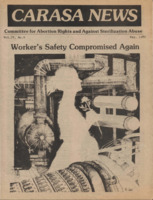 CARASA News newsletter, 1980
 Committee for Abortion Rights and Against Sterilization Abuse (CARASA) was a socialist feminist membership-based organization that fought for reproductive justice and against sterilization abuse. This CARASA News article highlights how women in one factory faced the choice of sterilization or loss of employment. Oftentimes, women’s employment status is linked to their reproductive lives, where workplace conditions, attitudes, or low pay could severely limit their reproductive choices. CARASA challenged these realities by connecting the cause for abortion rights to those of workers’ rights; framing the fight for abortion in a socioeconomic context.
-
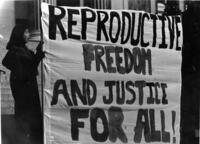 Reproductive Freedom Banner
 Depicted is an unidentified student with a large banner advocating for universal reproductive freedom in front of Low Steps at Columbia University. Although abortion was legalized about a decade prior to this demonstration, the banner addresses the issue of unequal access that persisted. Historically, white women were able to access and receive safe legal abortions more often than women of color. In demanding all women receive the freedom to choose, abortion in this photo is defined as a matter of reproductive justice.
-
 Georgia Abortion Rights Advocate
 Depicted is activist Gathegu Gatungo in Atlanta, Georgia holding a poignant sign to protest the overturning of the 1973 Roe decision. The sign blatantly defines abortion and its legalization as a matter of life or death. While women throughout history have accessed abortion regardless of its legality, here we see them fighting for the choice to access safe, legal abortions.
-
 Pro-choice button, 1989
 A photograph of a button pin commemorating the 1989 pro-choice march in Washington, D.C. It reads, "I Marched For Choice In Spirit" and "Never Again!" in an image of a coat hanger to memorialize those who have lost their lives due to unsafe abortions. The April pro-choice march was just one of many where hundreds of thousands attended. This framing of marching for "choice" appeals to the notions of personal freedom and contextualizes the framework of abortion rights from an autonomous lens rather than a social and political ideology.
-
 Abortion is Healthcare, Healthcare is a Human Right
 This banner, which states “Abortion is Healthcare, Healthcare is a Human Right” was displayed at a rally for Medicare For All organized by the Portland, Oregon branch of the Democratic Socialists of America (DSA). For some pro-abortion groups, abortion is part of a larger struggle for free, universal healthcare, which they consider a basic human right. This framework puts forward abortion access as a positive right—freedom to get access to universal healthcare.
-
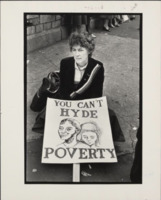 Abortion Demonstration in Union Square
 In this photo, a woman holds a sign reading "You Can't Hyde Poverty," a reference to the Hyde Amendment--a 1980 restriction on federal money and Medicaid in the use of abortion- impeding access for the most vulnerable groups. The Hyde Amendment was considered a direct attack on the reproductive rights of women living in poverty, particularly women of color. This is an example of why parts of the movement for abortion access became connected to concepts of social justice (age, race, and class). By talking about poverty, pro-abortion advocates expanded the limitations of choice and privacy frameworks to one of socioeconomic inequality.
-
 2022 Abortion Activist with Poster
 Depicted is activist Julia Tallant in Washington D.C. outside of the U.S. Supreme Courthouse protesting the overturning of the 1973 Roe decision. She is holding a home-made poster detailing instructions for having a "safe self-managed abortion." In doing so, Tallant is advocating for abortion as a matter of healthcare. The poster offers a means for women to care for their own health in the event that the government restricts their choice.
-
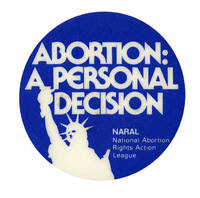 Abortion: A Personal Decision [button], circa 1980s
 This slogan was used widely by NARAL Pro-Choice America, promoting the fight for abortion access as “A Personal Decision.” The button shown here also features the Statue of Liberty, an iconic image that suggests a link between abortion as a personal decision and the American ideal of individual liberty. In response to a “pro-life” framing by anti-abortionists in the early 1970s, pro-abortion groups sought to counter this interpretation with the phrase “pro-choice.” This framing sought to appeal to notions of personal responsibility, privacy, and tropes of American freedom.