-
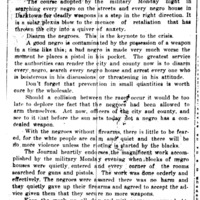
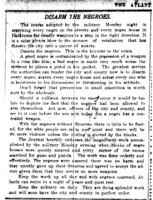 “Disarm the Negroes”
 In September, 1906, a riot exploded in Atlanta, Georgia. Inflammatory and far exaggerated press reports on the alleged rapes of white women by Black men had whipped the white population into a frenzy, which was taken out on Black Atlantans in four days of lynchings, beatings, and shootings which claimed between ten and one hundred lives as well as many Black homes and businesses destroyed. When the violence was abated by the intervention of the National Guard–some of whom were alleged to have participated in the riots–the state disarmed local Black residents, systematically bulldozing their Second Amendment rights in the process.
-
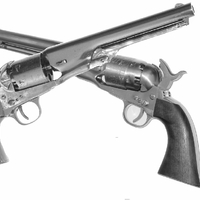
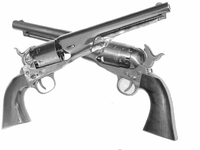 Colt Navy (foreground) and Colt Army (background). 19th-century laws restricting handguns to the Army and Navy pistol were the first "Saturday night special" bans.
 These pistols were standard issue for Union and Confederate soldiers and were kept by many after the Civil War ended. In 1879, Tennessee enacted the Army and Navy Law, restricting handgun ownership to only these models, which were far too expensive for most freedmen to buy, but which many economically privileged whites either already owned or could acquire relatively easily. The Army and Navy Law became the first of many laws restricting the sale of cheap handguns, long argued as a tactic that specifically and purposefully targets Black and other minority communities.
-
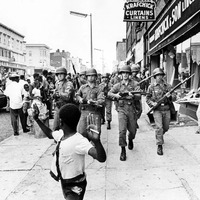
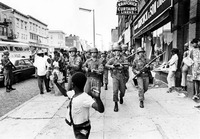 The National Guard on Springfield Avenue in Newark on July 14, 1967.
 This picture was taken during the Newark Riots, which were sparked by a Black taxi driver beaten by police, but had roots in a long-simmering resentment at a white-dominated city government in a Black-majority city overseeing persistent police brutality and corruption. Fully-armed National Guardsmen were deployed to quell the rioting. Claiming they faced sniper fire from buildings, the soldiers fired indiscriminately, killing 26 Black men, women, and children in all, many of whom were in their own apartments. No Guardsmen were killed, and no snipers were ever found. The Newark riots exemplified how white fear could still lead to Black death, and how the fear of armed resistance could lead mothers standing by their windows, as well as the babies in cradles behind them, to become “legitimate targets.”
-
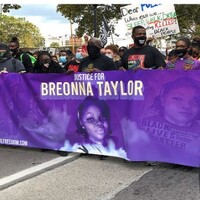
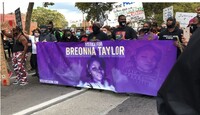 Justice For Breonna Taylor
 This photograph taken at a Black Lives Matter protest in Louisville, Kentucky, depicts protesters calling for justice for the murder of Breonna Taylor. On March 13, 2020, Louisville Metro police officers served a no-knock search warrant at Breonna Taylor’s apartment meant for her ex-boyfriend. A no-knock warrant meant that the cops did not have to announce their presence nor their status as police officers before entering the premises. As such, Breonna Taylor and her boyfriend Kenneth Walker had no idea who was at their door and believed a stranger was attempting to break into their apartment. Fearing for their safety, Walker fired a warning shot using his registered firearm. The cops returned a volley of fire, killing Taylor. Despite the existence of the Castle Doctrine which stipulates that residents have the right to use deadly force when defending their home against intruders, Taylor and Walker were not allowed to protect their home. Instead, the use of a legal gun in self-defense led to the death of another innocent Black woman at the hands of the police.
-
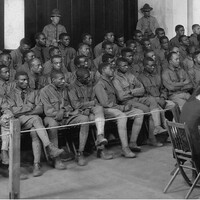
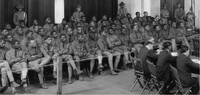 Largest Murder Trial in the History of the United States
 In 1917, the all-Black 24th Infantry Regiment was transferred to Camp Logan in Houston, Texas. Their presence was not welcomed as armed Black soldiers were often deemed a threat to the white supremacist social order enforced by Jim Crow. To assuage the white locals and police, the highly decorated battalion was assigned the lowly task of guard duty and their guns were confiscated when not on call. However, tensions remained between the soldiers and the Houston police, who had a reputation of harassing the city’s Black community. Problems came to a head on August 23, 1917 after a particularly egregious case of police brutality in which an officer and corporal of the 24th were assaulted and arrested by the Houston police. Tired of the disrespect and unwilling to endure any more racist violence, the 24th reclaimed their guns and a large riot ensued. Four soldiers and fifteen white people were killed. As seen in the photograph, the government placed all of the blame on the 24th, resulting in the largest murder trial and biggest court martial in United States history. In the end, 19 Black soldiers were executed and 54 were sentenced to life in prison.
-
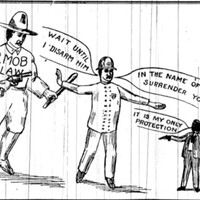
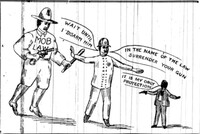 Cop Abets White Mob
 Featured in the Black newspaper, "The Washington Bee", this cartoon depicts a cop disarming an African American man during the Red Summer of 1919. While African Americans could now legally own firearms, it did not mean that their Second Amendment rights were protected. As racial tensions flared, the police repeatedly failed to prevent white mobs from attacking African Americans. The Black community understood that the cops could not be relied upon to protect them from racial terror and that they had no other option but to arm themselves in self-defense. The police incorrectly believed they could prevent riots and appease white mobs by disarming Black citizens. Not only did law enforcement illegally deny African Americans their constitutional rights, but their actions failed to prevent white violence. From April to November of 1919, the NAACP recorded at least 25 large anti-black riots and at least 52 Black people were lynched across the United States.
-
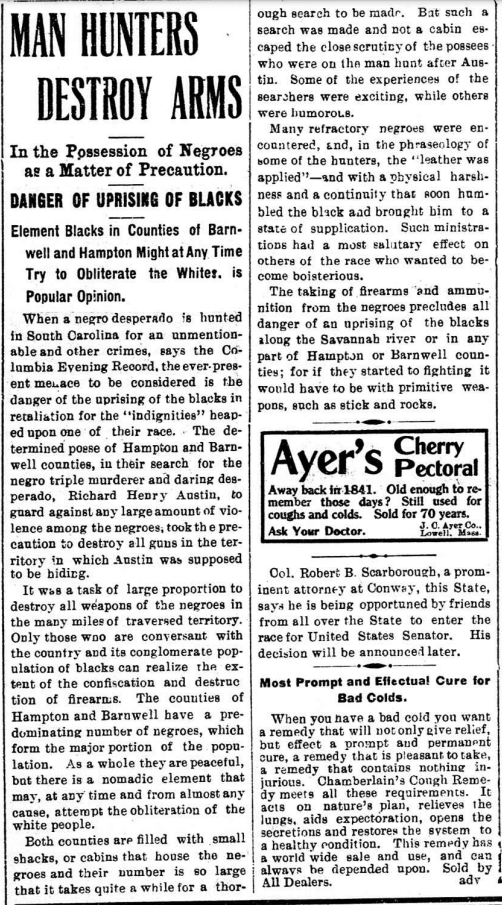 "Man Hunters Destroy Arms." The Lexington dispatch (Lexington, South Carolina), May 14, 1913
 This 1913 article from The Lexington Dispatch (Lexington, SC) showcases the fear that armed Black men provoked in rural Whites. The subject of the article is a pogrom of destruction that a “determined posse” embarked upon while supposedly searching for a “triple murderer.” The armed men “took the precaution to destroy all guns” in “the many miles of traversed territory,” in order to ward against a possible uprising. Black Americans are clearly considered to have no claim to Second Amendment rights, and the text makes it clear that the seizure and destruction of weapons was totally indiscriminate, aside from the consideration of race. The article speaks in congratulatory terms of the beatings of Black people who resisted the onslaught.
-
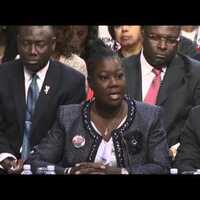
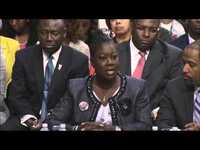 Trayvon's Mother Denounces 'Stand Your Ground'
 On February 26, 2012, Florida resident and member of the local neighborhood watch George Zimmerman shot and killed 17-year-old Trayvon Martin, an unarmed Black boy who had been on his way home after an evening snack run. Zimmerman claimed to have shot Martin in self-defense. The members of the jury, considerate of the state’s 2005 Stand Your Ground Law that meant that Zimmerman had the right to use deadly force if necessary to defend himself, found this argument convincing—Zimmerman was acquitted of second-degree murder charges on July 13, 2013. In a Senate committee later that year, captured in this video, Martin’s mother Sybrina Fulton decries Stand Your Ground, stating that “our [Black] kids cannot feel safe in their own community.” In the decade following Martin’s murder and Fulton’s plea, states across the U.S. adopted similar legal doctrine, setting a widespread legal precedent that allows for bias against Black victims in favor of the white shooters who see them as a threat.
-
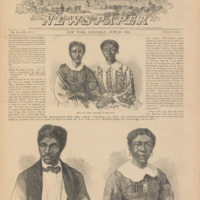
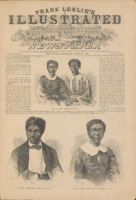 Eliza and Lizzie, children of Dred Scott [top]; Dred Scott [and] his wife, Harriet
 The newspaper cover refers to the legal case Dred Scott v. John F.A. Sandford, which brought the issue of Black citizenship to the U.S. Supreme Court and made the formerly enslaved Dred Scott and his family a focus of the public eye. On March 6, 1857, the Supreme Court ruled that both enslaved and free people of black African descent in America were not considered to be citizens under the U.S. Consitution, and thus were not recipients of the document’s rights and privileges—including the right to own and use guns. The Second Amendment was clearly at top of mind for the presiding judges, as the Court’s written decision includes the right to "to keep and carry arms wherever [Black people] went" amongst a description of the frightening consequences of ruling in Scott's favor. This newspaper cover page (published only a few months after Scott's case was struck down) describes Scott and his family in a dehumanizing manner, detailing how they were more or less harassed and forced to be photographed for the paper.
-
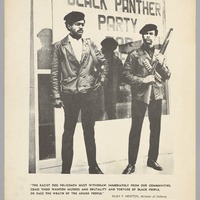
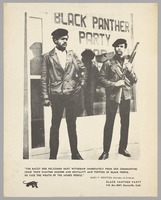 Black and white poster of Huey Newton and Bobby Seale
 In 1966, Californian college students Huey Newton and Bobby Seale (depicted in this poster) founded the Black Panther Party for Self-Defense, which became a prodigious force within the Black Power movement—and, for many white Americans, a significant threat to U.S. security. BPP members engaged in “copwatching” patrols, in which party members took advantage of their Second Amendments rights and the period’s open-carry gun laws to act as armed security for Black community members, who were often victims of police brutality. In direct response to white America's fear of the BPP's armed resistance, California Governor Ronald Reagan passed the 1967 Mulford Act, which repealed a law that allowed Californians to open-carry loaded guns without a permit. This 1971 poster features a photograph of Seale and Newton holding a Colt .45 handgun and shotgun, respectively, seemingly in defiance of the Mulford Act.
-
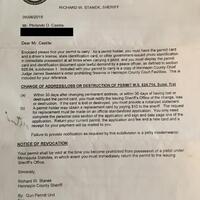
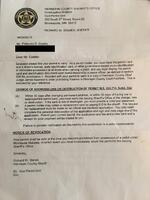 Philando Castile's Concealed Carry Permit
 Philando Castile was shot seven times and killed by a Minnesota police officer while his girlfriend and her four-year-old daughter were in the same car, after Castile politely informed the policeman that he had a licensed gun with him. The National Rifle Association, a leading gun rights advocacy group, was notably silent on Castile’s case, and local law enforcement officials even disputed the legality of Castile’s gun until his family released this photo of his concealed carry permit to the media. Castile’s attempt to exercise his Second Amendment rights ended in his death, while his killer was acquitted of all charges by the American justice system.
-
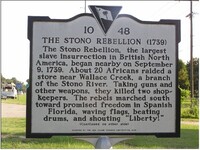 Stono Rebellion Historical Marker
 In the early 1970s, a cooperative of Black farmers known as the South Carolina Sea Island Farmers, unknowingly purchased the land where the Stono Rebellion began. The Stono Rebellion was the largest and bloodiest uprising of enslaved people in colonial North America. Slave revolts were every enslaver's worst nightmare as white people often feared revenge for their horrific treatment of enslaved people. They were also afraid that if free or enslaved Black people had access to guns it would lead to violent rebellions and eventually to Black freedom. In response to Stono, South Carolina passed the Negro Act of 1740 which imposed even stricter restrictions upon enslaved people. After discovering the land’s history, the Cooperative commemorated the uprising by erecting a historical marker on the Rebellion's anniversary date Sept. 9, 2006.
-
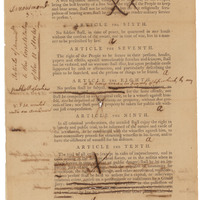
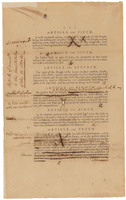 Senate Revisions to House Proposed Amendments to the U.S. Constitution (page 2)
 This annotated page, which lists the House of Representatives’ initial seventeen amendments to the U.S. Constitution, depicts the drafting process undertaken by the U.S. Senate in September 1789. It was the political tensions between opposing groups in the newly created American governmental body—the North and the South, the Federalists and the Anti-Federalists—that led to the creation of a Bill of Rights that, after the Senate's review, comprised twelve amendments to the Constitution. James Madison's draft of the Second Amendment (seen here as Article the Fifth) addressed concerns from Anti-Federalist Patrick Henry and other Southerners, who, remembering the role of the Southern militias in squashing slave revolts in the colonies, feared that the new federal government would prohibit armed white citizens from protecting and enforcing the slave system. On December 15, 1791, the Second Amendment was ratified by the states in its final form.
-
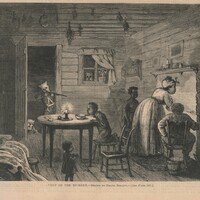
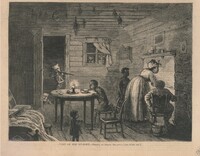 "Visit of the Ku-Klux"
 This engraved illustration by Frank Bellew depicts armed members of the Ku Klux Klan breaking and entering into the home of an African American family as they prepare for dinner. During Jim Crow, Black Codes were created to prevent Black gun ownership. The KKK (along with white militias and police forces) were known to break into and destroy Black people’s homes in search of "contraband" weapons. Unarmed, African Americans were left even more vulnerable to white domestic terrorism and violence.
-
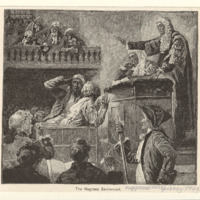
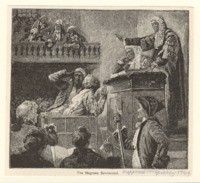 The Negroes sentenced
 In this image by illustrator Charles Stanley Reinhart, white lawmakers in colonial New York convict enslaved African men of suspected conspiracy after a series of unexplained fires plagued the colony. Following major slave rebellions in the colonies, such as the 1739 Stono Rebellion, the New York Conspiracy of 1741 reflected white Americans' widespread fear of armed enslaved Africans—fear that would influence the creation of the Second Amendment. Reinhart produced this illustration just a few years after the case United States v. Cruikshank, in which the U.S. Supreme Court held that the federal government was not required to protect Black citizens against private criminal conspiracy and assault that deprived them of their constitutional right (including the right to bear arms). Even decades after the Conspiracy of 1741, the American government still sought to subjugate the descendants of former slaves.
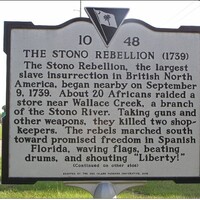 Stono Rebellion Historical Marker
 Senate Revisions to House Proposed Amendments to the U.S. Constitution (page 2)
 "Visit of the Ku-Klux"
 The Negroes sentenced
 Eliza and Lizzie, children of Dred Scott [top]; Dred Scott [and] his wife, Harriet
 Cop Abets White Mob
 Largest Murder Trial in the History of the United States
 Black and white poster of Huey Newton and Bobby Seale
 Trayvon's Mother Denounces 'Stand Your Ground'
 Philando Castile's Concealed Carry Permit
 Justice For Breonna Taylor
 “Disarm the Negroes”
 Colt Navy (foreground) and Colt Army (background). 19th-century laws restricting handguns to the Army and Navy pistol were the first "Saturday night special" bans.
 The National Guard on Springfield Avenue in Newark on July 14, 1967.