-
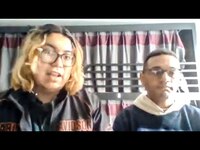 Youth Activists Hold Hunger Strike for Voting Rights
 Youth activists Adrian Horton and Brandon Ortega discuss their use of hunger strikes as a tactic to pressure politicians to protect voting rights. While interviewed on "The Damage Report," these activists discuss their first 15-day hunger strike, which successfully placed political pressure on Congress to put the "Freedom to Vote: John R. Lewis Act" on the top of their legislative agenda at the end of 2021.
At the time of this interview, Horton and Ortega were on day 8 of their second hunger strike, which they initiated to pressure the Senate to pass the Act. Ultimately, the Act was blocked in the Senate on January 20th, 2022.
This interview highlights both the power and limitations of hunger strikes to elicit political change.
-
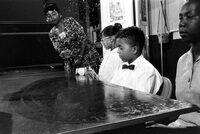 Children Trained for Sit-In Harassment, 1960
 This photograph was taken in Petersburg, VA in 1960 during a training for children that would participate in civil rights sit-ins. Throughout the U.S., children as young as 6 years old participated in civil rights actions that placed them in danger of violence and harassment. Organizations like the NAACP Youth Council prepared young people for non-violent tactics through role-playing that exposed them to the kind of harassment they would encounter when sitting in "whites only" public spaces. While sit-ins were usually aimed more at de-segregation than at voting rights specifically, they exposed violence in the South on a national level, which ultimately led to policymakers and citizens fighting for the Voting Rights Act of 1965.
-
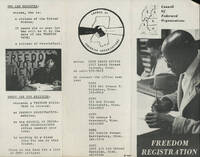 Council of Federated Organizations (COFO) Pamphlet
 COFO was a group of organizations that, in the summer of 1964, banded together to organize the Freedom Summer. The four groups that made up COFO were the Student Nonviolent Coordinating Committee (SNCC), Congress of Racial Equality (CORE), National Association for the Advancement of Colored People (NAACP), and the Southern Christian Leadership Conference (SCLC). The goal of the participating organizations and the hundreds of white volunteers who helped was to increase the number of registered Black voters in Mississippi. This goal was largely a failure, only a fraction more voters registered that summer. The most prominent event was the disappearance of one Black and two white volunteers and their rediscovery weeks later beaten to death. This event was covered by the national news and was one of the earliest causes of public outcry in defense civil rights
-
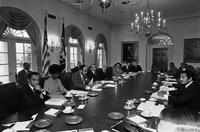 Congressional Black Caucus
 The Congressional Black Caucus (CBC) was established in 1971 following the VRA, the same year this photo was taken, and still exists today. Their current stated goal is to use the full power of the Constitution to ensure that African Americans and other minorities have equal rights. Since its founding in 1971 the CBC has grown in numbers and influence. The current elected Congress includes 56 CBC members across the House and Senate. While the caucus is majority Democratic, they have members throughout both parties and partake in bipartisan collaboration. Their current agenda includes “fighting to expand access to the ballot through initiatives like automatic voter registration and early voting.” Despite the split in political makeup, the CBC is dedicated to fighting for the rights of minority groups.
-
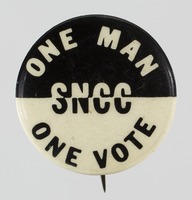 Student Nonviolent Coordinating Committee (SNCC) Pin
 One of the ways Americans were encouraged to vote was through the distribution of small memorabilia like this pin. This pin was made by the Student Nonviolent Coordinating Committee (SNCC), and likely passed to other young voters. SNCC used nonviolent acts of protest (ex; sit-ins and boycotts) to advocate for civil rights since their founding in 1960. The nonviolent aspect was an important part of their rise in notoriety because members who participated in the sit-ins had to deal with anti-civil rights hate and abuse. Their ability to remain calm in the face of such abuse changed the attitudes of many witnesses.
-
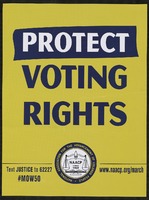 National Association for the Advancement of Colored People (NAACP) Poster
 A poster used during the March on Washington August 24-28, 2013. This is a modern poster that states in large letters “Protect Voting Rights.” Made by the NAACP, founded in 1909 by major historical civil rights activists, the organization still exists and works toward racial justice today. Just months before this march, in June the same year, the Supreme Court released its decision in Shelby County v. Holder that declared section 5 and section 4(b) of the VRA unconstitutional. These sections regulated the states on how they were allowed to change election rules. Following this ruling, voting access was more strict across the country and it became harder for minorities to register to vote.
-
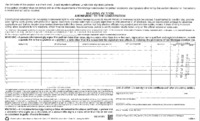 "Promote the Vote" Petition, 2022
 The "Promote the Vote" Petition, filed in Michigan on January 31, 2022, proposed various constitutional amendments to address voting rights in the state, including creating an early voting period and devoting state funds for postage on mail-in ballots. The Michigan State Board of Canvassers voted to approve the petition form on February 11th, and by July 11th, the Promote the Vote 2022 organization announced that supporters submitted 669,972 signatures. This ensured that the constitutional amendment will be on the ballot on election day, November 8th, 2022.
As of 2022, twenty six states have laws that allow ballot initiatives and/or veto initiatives, which provide opportunities for citizens to propose, amend, and shape laws in their state. This archive document provides an example of a tactic that citizens can use to secure voting rights. By proposing amendments to state constitutions and then gathering sufficient signatures, citizens can organize to protect voting rights in their state.
-
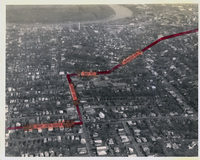 Proposed March Route to Alabama State Capitol 1965
 An aerial photograph annotated with crayon by the Department of Defense to outline the proposed route for the Selma to Montgomery Civil Rights March, 1965. This was the third march organized from Selma to Montgomery, after a previous march --- later called "Bloody Sunday" - where Alabama state troopers violently brutalized civil rights protesters. The violence on Bloody Sunday led Lyndon B. Johnson to send federal troops to protect protestors for this third march. This image highlights the preparation required to implement large-scale marches that can lead to national mobilization and, in this case, political change like the VRA. It also illustrates how governmental bodies like the Department of Defense have served both to protect and to surveil the actions of civil rights activists.
-
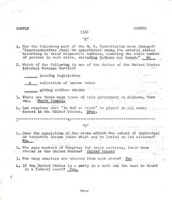 Alabama Literacy Test, circa mid-1960s
 Before the Voting Rights Act banned literacy tests, southern states used them to prevent Black citizens from voting. Alabama required people registering to vote to recite a section from the state’s Constitution and answer several written questions. The use of literacy tests was based on the discretion of local officials, so most white citizens did not take literacy tests, and if they did, their tests were often easier. In an effort to combat this discrimination, civil rights activists formed Citizenship Schools to teach Black adults how to fill out registration forms and pass the literacy test. A Citizenship School developed this worksheet to prepare Black people for what they would face on the test by providing sample questions and answers, highlighting the fact that literacy tests included overly complicated and subjective civics questions.
-
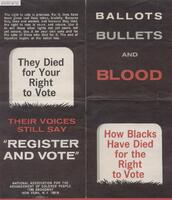 Ballots, Bullets, and Blood
 Following the implementation of the Voting Rights Act, organizations like the NAACP worked to register Black voters across the south and elsewhere in the country. This 1968 pamphlet was designed by the NAACP to encourage Black citizens to vote by referencing the violent history of voter suppression. White supremacists used violence and terrorism to discourage Black people from voting and organizing for the right to vote. This pamphlet tells the stories of thirteen Black and white people murdered for their activism surrounding voting rights, including Martin Luther King, Jr. The NAACP's tactic of appealing to history and readers' emotions heightens the stakes of voter registration. By portraying the ballot as something worth dying for, this pamphlet frames voting as a way to honor those slain in the struggle to secure this right.
-
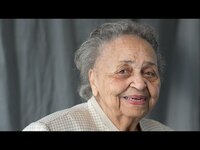 Mrs. Guilford, 94, reflects on poll taxes, literacy tests and new efforts to limit voting
 In the twenty-first century, many states have passed laws requiring voters to present a government-issued photo ID at the polls in order to vote. Republican state legislators argue that voter ID laws combat fraud, but there has been no evidence of widespread fraud to support these claims. These voter ID laws have a disproportionate impact on the elderly, poor, and communities of color, who generally have more limited financial resources and reduced access to locations where they can acquire acceptable forms of identification. This video produced by the Southern Poverty Law Center connects historical acts of discrimination, like literacy tests and poll taxes, to voter ID laws by interviewing an elderly Black woman who experienced restrictive voting laws in her youth. By appealing to civil rights history and placing these new laws into historical context, the SPLC makes an argument against voter ID laws and for the necessity of voting.
-
 Selma, Alabama Demonstration
 The violence that police officers committed against voting rights activists in Selma, Alabama in March 1965 galvanized the nation and put pressure on President Lyndon B. Johnson to pass the Voting Rights Act. That was not, however, the first demonstration in Selma for voting rights. This footage displays the nonviolent civil disobedience tactics that Black adults and teenagers utilized in February 1965 to spread their message about Selma’s racist voter registration practices across the country. It also highlights the police’s efforts to end the protest with threats of imprisonment. Martin Luther King Jr. had been jailed as a part of this multi-day protest along with many others and after his release, he announced that he planned to use the injustices committed against these peaceful protesters to convince President Johnson to pass legislation that would remedy this crisis.
-
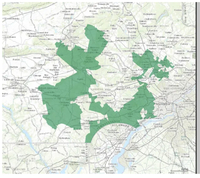 “Goofy Kicking Donald Duck” Proposed Congressional District in Pennsylvania, 2011
 This is a map of a proposed district boundary, drawn by a Republican-led state legislature in 2011, based on the 2010 US census. The map gained the nickname "Goofy Kicking Donald Duck" because it resembled the Disney characters Goofy and Donald Duck, and provided a comical example of district re-drawing to gain political power. Gerrymandering, the practice of redrawing a district in order to obtain political advantage for a political party, is a tactic that has been used both by Civil Rights supporters to get Black representatives elected, and as a tool of voter suppression to obtain White majorities in previously Black majority districts.
In 2018, the Pennsylvania Supreme Court ruled that the drawn boundaries were unconstitutional, but similar cases exist in states around the country.
-
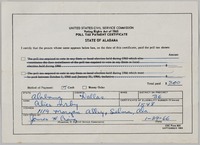 Poll Tax Payment Certificate from the state of Alabama
 Poll taxes were one of the many legal methods by which southern states prevented disproportionately impoverished Black communities from voting and exerting political power following Reconstruction. At the polls, voters in certain southern states were required to pay a fee in order to cast their ballots, but a “grandfather clause” could exempt poor white people from this requirement if they descended from someone who voted before the Civil War. In 1964, the Twenty-fourth Amendment to the United States Constitution banned poll taxes in federal elections, but five states retained them for state and local elections. This certificate issued by the United States Civil Service Commission is evidence that on January 29, 1966, Alice Irby of Selma, Alabama paid the three-dollar poll tax in order to vote in that year’s elections. Only a few months later, civil rights lawyers and grassroots activists in Virginia would challenge state poll taxes in the Supreme Court, which would result in them being declared unconstitutional.
-
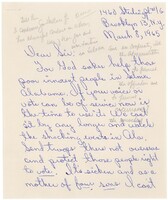 Letter to House Judiciary Committee
 Mrs. E. Jackson wrote to the House Judiciary Committee the day after Bloody Sunday in Selma, Alabama. She was reacting to scenes of police brutality during a voting rights march that many Americans witnessed on television news programs in favor of voting rights and denouncing the horrid attacks from that day. Mrs. E. Jackson was writing from Brooklyn about events she witnessed on the news that occurred in Alabama. Bloody Sunday caused a national push for civil rights and activists took advantage of this to advocate for the Voting Rights Act.