-
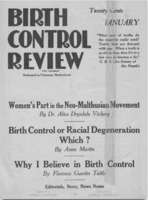 The Birth Control Review. Volume V. No. 1. The American Birth Control League. New York, NY.
 In the early 1920s, under the supervision of Dorothy Bocker, a physician, Margaret Sanger established the Clinical Research Bureau – later renamed the Birth Control Clinical Research Bureau – in New York city. The Birth Control Clinical Research Bureau (BCCRB) – considered the first legal birth control clinic in the country – functioned primarily as a contraceptive dispensary and research laboratory and served as an autonomous clinic and research facility from 1928 to 1939.
The Birth Control Review, from which the BCCRB grew, was edited by Sanger and its first edition published in 1917 under the banner of "Dedicated to the Principle of Intelligent and Voluntary Motherhood”. According to the Margaret Sanger Papers Project, the journal featured an array of the speeches that Sanger herself gave in pursuit of normalizing and organizing for the legal proliferation of birth control from the early 1910s and 1920s; issues of the journal also contained artwork, political cartoons, poetry, book reviews, and a lively letters section that often included opposing views and sometimes "mothers letters," excerpts from the letters of women seeking birth control advice.
The featured writings cover a range of topics, themes and approaches to the concept and practice of birth control; for example, an opinion piece by a Florence Guertin Tuttle titled “Why I Believe in Birth Control” whereby she discusses – at length – what it means to think through the principle, practice, and ethic of birth control. Meanwhile, another article penned by Anna Martin that appears on page 12 of the journal features a different perspective that simultaneously discussed the meaning of birth control as a means to “arrest the procreation of the unfit” with the aim of forwarding the social and economic benefits of selective birth control. Ultimately, inclusion of the fifth volume of the BCR journal is with the purpose of showcasing where the rhetoric surrounding birth control had gotten in 1923.
-
 “Portland Moral or Ridiculous? Colonel Wood Makes Arrests Pamphlet Sellers Basis of Inquiry”
 On June 19, 1916 Margaret Sanger – an American birth control activist, sex educator, writer, and nurse – gave a lecture titled “Birth Control” to educate on sexual health and pregnancy prevention, a stop she made as part of a seventeen-city speaking tour. In preparation for the talk, Sanger was approached by a union worker, Carl Rave, who asked whether he and two others—E.L. Jenkins and Ralph Chervin—could sell one of her pamphlets, which presented excerpts of information from one of Sanger’s monographs titled Family Limitations (1914).
According to the Oregon Encyclopedia, a project of the Oregon Historical Society, the contents of the pamphlet in question described birth control methods—including pessaries, condoms, sponges, laxatives, vaginal tablets, and douches—and highlighted the pleasures of sex. The sale of these pamphlets ultimately led to Sanger’s arrest, making Portland the only city during her speaking tour to put her in jail.
This article aptly captures the varying reactions and forms of engagement with a public lecture on sex, birth control, and family planning given by a woman. Moreover, the article captures the rhetoric that began to escalate around the public discussion of sexual health and birth control in the 1920s that began in New York city before spreading across the country.
-
 Why Study Home Economics?
 After World War II, men started to take over the workforce, leaving most women unemployed and in charge of household responsibilities – since during the war and the great depression, women occupied a great part of the workplaces.
In this informative video, a teacher explains to a prospective student the benefits of taking the Home Economics subject. This class was greatly popularized among schoolgirls because it prepared them to care for a house and a family and to be wives – they became “homemakers”, a person capable of improving the life quality of their families or themselves. The teacher mentions the possibilities of using the acquired knowledge of “home ec” to apply for college. However, the scientific knowledge taught in the class does not provide a realistic basis for scientific careers, so job opportunities are limited to areas related to the social sciences and the professionalization of home economics itself.
-
 College-educated women in the U.S., by occupation: 2021
 The report “Diversity and STEM: Women, Minorities, and Persons with Disabilities” presents statistical information about the representation of these three groups in STEM education and employment.
This graph analyzes the involvement of college-educated women (with a bachelor degree) in Science and Engineering (S&E) careers in the United States. By 2021, only 29% of the S&E workforce are college-educated women, while the remaining 71% are men.
This gender disparity is also reflected in the unequal distribution of women with degrees in the various fields of science. Earlier we mentioned that social sciences (such as home economics) and natural sciences (like botany) were mostly popularized among women. Now, in 2021 and according to this study, we can see that women participate more in the educated workforce related to “Social and related sciences” and “Biological, agricultural and other life sciences”. What does this tell us about the legacies of female science education in the U.S.?
-
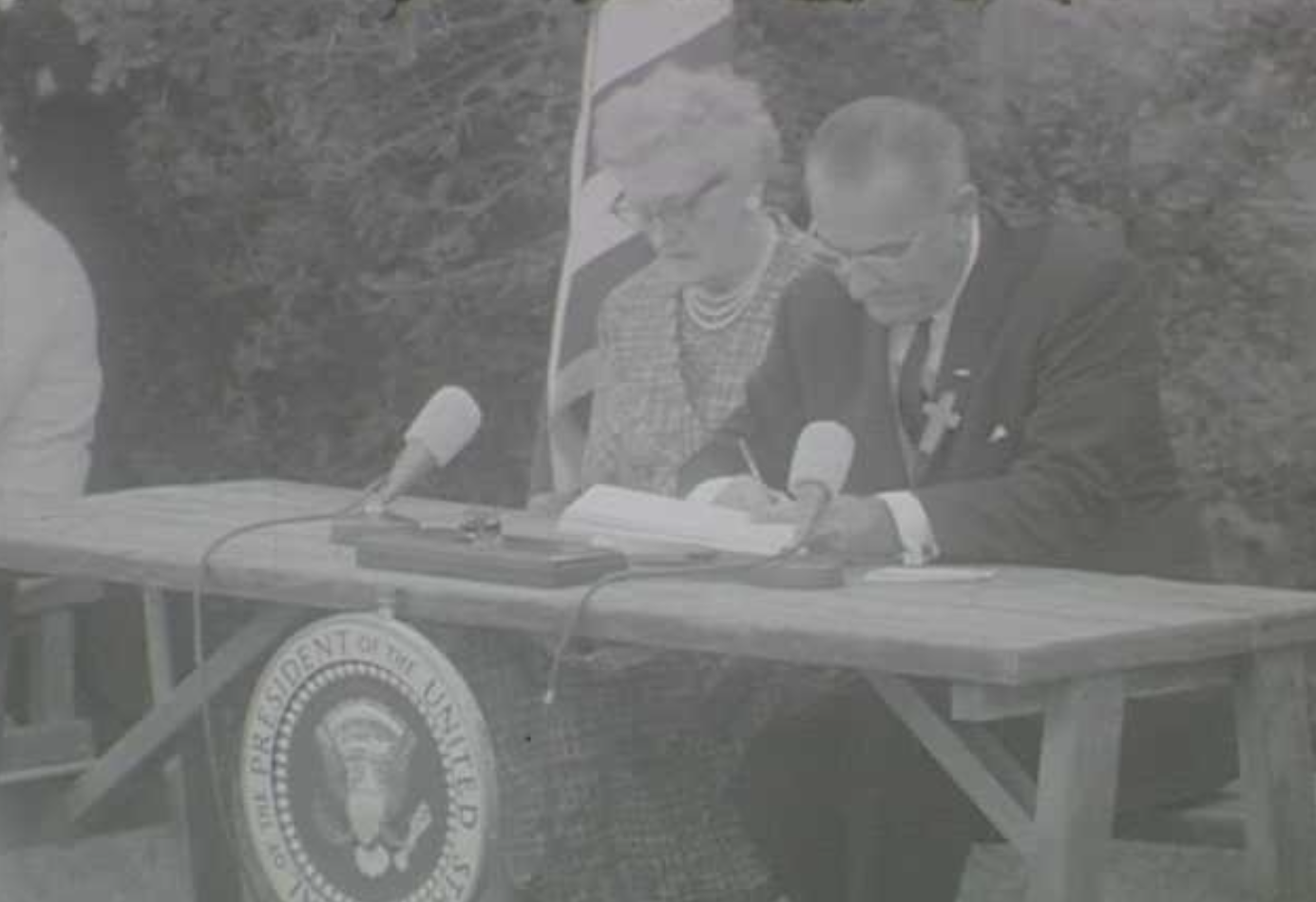 President Johnson Signs Elementary and Secondary Education Act (1965)
 This short clip shows President Lyndon Baines Johnson signing the Elementary and Secondary Education Act in Johnson City in 1965. Beside him is his childhood teacher, Kate Deadrich Loney, sitting outside the President’s former one-room school, Junction Elementary School. The act was a part of Johnson's War on Poverty, as it served to mandate funding for primary and secondary education, with an emphasis on equal access and opportunity. It depicts a moment in history in which we move forward with understanding the importance of equality within public education as a nation.
-
 Texas Adopted Textbook List 1990
 The 126-page document from the Texas Education Agency provides the list of textbooks adopted by the State of Texas for use in K-12 public schools. With this list, one can get a glimpse into what Texas education was like shortly after 1990, particularly with regard to the teaching of history and social studies in elementary schools. Texas state history is focused on in the curriculum during years four and seven, with the grade seven social studies/history course appearing as “Texas History & Geography” specifically. However, from first through fifth grade, students are frequently taught about Texas history using other modules.
-
 National Survey of State Requirements Course Offerings and Assessment in Social Studies K-12 2002-2003
 These are pages 78 and 79 of the 2002-2003 version of the National Survey of State Requirements, Course Offerings and Assessment in Social Studies, Kindergarten – Grade 12 was put together by The Council of State Social Studies Specialists (CS4). Inside can be found the state requirements in regard to history education. Page 78 depicts Texas’ course offerings in Social Studies education. In grade four, students take “Texas in the Western Hemisphere,” and in grade seven, they take “Texas Studies.” The document states that at the time, curriculum revision was not yet scheduled and may not occur for another three to eight years. Additionally, one of the key issues they focus on is the No Child Left Behind Act of 2001.
-
 The 1836 Project: Telling the Texas Story (Pamphlet)
 In 2021, the 87th Texas Legislature passed House Bill 2497, which established The 1836 Project “as an advisory committee to promote patriotic education and increase awareness of the Texas values that continue to stimulate boundless prosperity across this state.” This pamphlet communicates the project’s mission and the historical narratives that it seeks to proliferate in Texas public education.
-
 Children marching in a Juneteenth parade, Galveston, Texas
 This photo shows children marching in a Juneteenth parade on June 19, 1991 in Galveston, TX. Juneteenth received official recognition by the state of Texas in 1980 and was made a national holiday in 2021, but Black communities have commemorated their emancipation from enslavement since they first received the news from General Gordon Granger on June 19, 1865 in Galveston.
For over 100 years before any validation from the state or federal governments, Black communities in and beyond Texas organized community gatherings where young generations learned much more acutely about the history of slavery and emancipation from their elders’ collective memories and oral histories than was being taught in public schools.
-
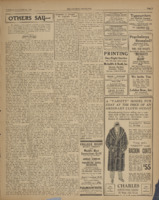 Student Marriage by Huntington Sharp
 This article was originally published in Cornell University’s literary magazine, The Columns, and was reprinted in Columbia’s daily student publication, The Columbia Spectator, in the “Others Say” column. The article was written by Huntington Sharp, who was the managing editor of The Columns at Cornell. In this piece, Sharp identifies the problem of “greater promiscuity” among Cornell’s students and explores the question of what physical relations should look like between men and women on campus, evincing the perennial fear of college students having too much sex. Sharp goes on to argue that “young men'' should be sufficiently educated about sexual development so that they can advance from the “sadism of boyhood, through onanism, homosexuality, and narcissism of adolescence, to a normal heterosexual maturity…” Sharp, who exclusively addresses his male peers, credits this chain of development to the prominent psychoanalyst Carl Jung, whose collected works were published and widely circulated in English in the 1920s, influencing a new kind of thinking about sex as it relates to the psyche. This statement also demonstrates Sharp’s complete rejection of homosexuality and points to the pervasiveness of a larger social homophobia that refuses to accommodate or even fathom the possibility of homosexual relations on campus. Sharp proceeds to declare that marriage among undergraduates is the solution and “compromise” between abstinence and promiscuity, arguing that students should strive to build healthy marital partnerships in order to control their physical desires and find meaningful satisfaction in laying the foundations for a traditional family life, an opinion that reflects conservative social mores among students in the 1920s, despite exposure and receptiveness to new developments in scholarship surrounding human sexuality. The Columbia Spectator’s republication of this article from a Cornell student paper indicates that sexual relations among students was a common issue on campuses across New York State.
-
 Oral History Interview with Larry Running Turtle Salazar
 In this oral history interview, Larry Running Turtle Salazar discusses his Cherokee and Mescalero Apache heritage and how his Indigenous identity influenced his upbringing in Corpus Christi, TX. Salazar speaks extensively about racist violence and discrimination perpetrated by school teachers and administrators against him and other Indigenous students during the 1960s-70s.
-
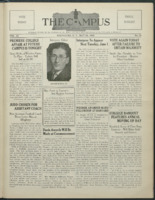 Men Faint in Fauver’s Sex Hygiene Lecture
 This article published in The University of Rochester’s weekly student publication, The Campus, details a fainting spell in a sex hygiene lecture. As the article chronicles, the lecture, administered by a professor from the physical education department, was interrupted when several men fainted. The professor, Dr. Fauver, attributes the fainting primarily to “nervousness caused by the vaso-motor system,” a diagnosis that can be read as a sarcastic, scientifically-veiled acknowledgment of the students’ squeamishness around the subject of sex. This source demonstrates how, despite a century of distance, students today are not dissimilar from students in the 1920s in terms of feeling nervous and uncomfortable when learning about sex in an academic setting. However, this source reveals some key differences from our contemporary sex education milieu: The Campus, according to its tagline, was published by the Men’s College of Arts and Sciences at the University of Rochester, indicative of the fact that the University was not coeducational at the time (its campuses were not fully coeducational in 1955). The article, then, is addressed to a male readership and concerns an all-male classroom. This single-gendered learning environment reflects the changing but still relatively firm separation of social spheres for men and women in the 1920s.
-
 Big Mouth Season 2 Teaser: Attack of the Hormone Monsters
 This clip from the Netflix show Big Mouth shows a group of middle school students in a sex education class learning about female anatomy (here, the teacher incorrectly calls fallopian tubes as “Ethiopian tubes”) before the class is then interrupted by attacking “hormone monsters” who swallow a number of the students. Big Mouth, an animated comedy series that premiered in 2017, is set in a New York City suburb and explores the painfully awkward, often hilarious realities of its protagonists as they experience puberty and navigating their changing bodies and emotions. This clip in particular sheds light on the often insufficiently trained educators as well as the absurdity and discomfort of learning about sex and the body as an early teen or young adult. Whether in an animated, fictionalized town or in the very real halls of 1920s New York universities, sex education can be a frightening endeavor.
-
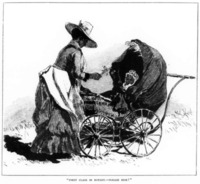 First Class in Botany.—Please Rise!
 By the end of the 19th century, courses related to natural history, such as botany, became the most popular among girls. There was a widespread belief that studying nature would benefit girls because not only was nature’s delicacy aligned with the sensitive traits of women, but they could also learn pedagogical skills and learn about God. This gender-specific idea around natural sciences was strongly disseminated by schoolbook authors like Almira H. L. Phelps.
This image, where a mother shows her child some plants and the text reads: “First class in botany—Please Rise!” is a humorous illustration that satirizes the conceptions of girls’ education and when it should “start”.
-
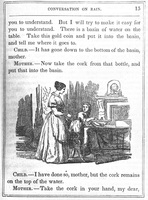 Conversation on Rain
 Before the Civil War, science education was most accessible to middle and upper-class white ladies. Science education was part of the core curricula for girls leaving some other “ornamental subjects” as optional. Boys had scientific courses too, but for them, it was a priority to learn the classics to gain entrance to university, something girls didn’t have the opportunity to do.
In this illustration, we can see a mother talking with her daughter about how some objects sink or not in water, in this case, a gold coin and a cork. This example is used to explain why rain falls. Books like this one by Richard G. Parker, Juvenile Philosophy, give us a glimpse of the social status of the mother and child while showing that science was regarded by parents and educators as particularly suitable for females during the 19th century. The reason? Simply because the study of science was considered to elevate the female character (and it was not a requirement for university entrance).
-
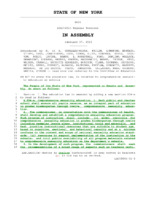 The New York State Senate Assembly Bill A4604
 Bill A4604 is an active bill that was introduced in the New York State Senate during the 2023-2024 Legislative Session. It is still in its early stages and, as of fall, 2023, is pending review by the Education Committee Assembly before continuing onto the next stage of the approval process. Previous versions of this bill were introduced by lawmakers in the New York State Senate in Legislative Sessions 2017-2018, 2019-2020, and 2021-2022. Each previous version, however, failed to pass into law.
If adopted, Bill A4604 would require students in grades Kindergarten through 12 in the state of New York to receive comprehensive sexuality instruction. This bill would include a model curricula for comprehensive sexuality education which, at a minimum, would conform to the content and scope of national sexuality education standards.
While its parameters are broad, New York State Senate Assembly Bill A4604 would dramatically alter the landscape of New York education. Currently, New York schools are not required to teach sex education to their students, although HIV/AIDS instruction is required. Though previous versions did not pass into law, this bill demonstrates a preoccupation among state lawmakers to enact a standardized, mandatory curricula through which New York students of all ages will be equipped to understand sex and sexuality.
-
 The Calutron Girls
 The photograph shows Y-12 calutron operators, a group of recent high school graduates known as the “Calutron Girls”, who joined the Manhattan Project during World War II. The girls were trained to control the separation of isotopes from uranium as part of the efforts to build the first atomic bomb, called “Little Boy”, without ever knowing the machinery’s real purpose. Their tasks were focused on reading meters and making necessary adjustments as indicated, but with no scientific involvement in the project. The “Calutron Girls” were made aware of the purpose of their work when the people of Hiroshima, Japan, were bombed by the United States on August 6, 1945.
After World War II, the notion of science as a male discipline was crystallized, and the involvement of women in the field was mostly as technicians.
-
 Mae Jemison: Astronaut and Doctor
 Portrait of American engineer, physician, and NASA astronaut Mae C. Jemison, who became the first African American woman to travel in space in 1992. This illustration by Karina Pérez is part of a project through which “Nevertheless”, an educational podcast, commissioned female illustrators to create hi-resolution, downloadable posters featuring female STEM role models. The mission behind the commission was to raise awareness of the achievements of female scientists and inspire future generations of girls and women in STEM.
Why is it relevant to broadcast women in STEM in the 21st century? Would it mean the same if the posters featured male scientists too? To this day, the representation of the male gender in those fields is greater than that of women and non-binary people.
-
 School Heads Won't Agree On Sex Study; Usurping Home's Function, One Says
 Brooklyn Daily Eagle was an afternoon daily newspaper published in Brooklyn, New York from 1841 to 1955. At its peak, it was the largest daily circulated afternoon paper in the United States.
This front-page article contains snippets of interviews of high school principals from across the New York City metropolitan area. Its purpose was to highlight opposing views of the debate over whether hygiene should be taught in schools. Some principals stated that they were vehemently against sex education in schools, believing that it encroached on parents’ rightful authority over their children. Others feared that teaching students about sex would only encourage them to engage in sexual activities. Pro-sex education principals, however, voiced concerns that parents were ill-equipped to provide answers and resources to their children’s questions about sex. Still others believed that educators should answer individual students’ questions about sex without teaching a formalized course on the subject.
The article offers firsthand insights into the tensions, concerns, and disagreements present among high school administrators regarding the rollout of sex education in early 1920s New York. It reveals a diverse spectrum of responses and solutions put forth by those on different sides of this complex, multifaceted issue.
-
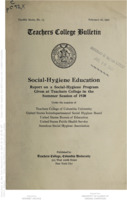 Social-Hygiene Education: Report on a Social-Hygiene Program Given at Teachers College in the Summer Session of 1920
 In the summer of 1920, the subject of sexual hygiene was first being introduced in New York schools. To address educators' needs, the Teachers College of Columbia University in New York City invited high school and college educators, social workers, and public health nurses to attend a program of courses, conferences, and exhibits in how to teach social hygiene. The program was created in collaboration with wider federal agencies and expert organizations, including the United States Interdepartmental Social Hygiene Board, the United States Bureau of Education, the United States Public Health Service, and the American Social Hygiene Association.
The guiding principle of the program was the belief that social hygiene education in schools and colleges should not be taught exclusively by a single specialist or in a designated course. Rather, sexual health should be folded into regular school subjects, specifically biology, general hygiene, nursing, physical education, sociology, ethics, literature, and homemaking. To support this interdepartmental vision of hygiene instruction, the program instructed educators in how to incorporate the teaching of sexual hygiene in their regular courses and to prepare educators in how to delicately teach this information to young people.
Following the conference, this Report was created and disseminated to educators across the state of New York by the Teachers College. It outlines why social hygiene should be taught in schools, who should teach it, and exactly what kind of information should be included in its instruction to young people. The Report sheds light on educators' ongoing feelings of unease at being ill-equipped to inform their students about topics related to sex.
-
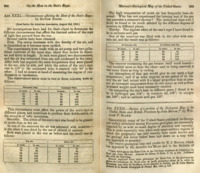 Circumstances Affecting the Heat of the Sun's Rays
 In 1856, American scientist Eunice Foote (1819-1888) published the results from an experiment in which she discovered what is now known as the Greenhouse effect. There, Foote stated: "An atmosphere of that gas [i.e., carbon dioxide] would give to our earth a high temperature; and if as some suppose, at one period of its history the air had mixed with it a larger proportion than as present, an increased temperature from its own action as well as from increased weight must have necessarily resulted." Her theory was thus the first to introduce the phenomenon of climate warming caused by increased levels of CO2 in the atmosphere.
The work of Eunice Foote, as well as that of other female scientists of the 19th century, encourages us to reflect on the possibilities offered by the type of education received by girls during that period.
-
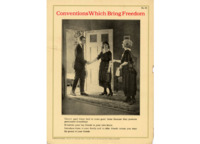 Conventions Which Bring Freedom
 The American Social Health (originally “Hygiene”) Association (ASHA) was established in 1913 at a professional public health conference in Buffalo, New York. Its initial purpose was to combat the rampant cases of venereal disease in the nation’s military. During the interwar years, its purpose expanded to include public education about what was, according to these experts, the relationship between individual health and high moral standards. To support this purpose, the ASHA aimed to prevent venereal disease, sex work, and drug addiction in New York through educational, legal, and medical measures.
Arguably, their most successful campaign was the production and proliferation of printed materials related to social hygiene. The ASHA created this poster as part of its “Youth and Life Exhibit” series. The poster encourages young women to socialize with young men around the safety of their family and friends. Interacting with a young man under the watchful eye of others, experts argued, freed young women from the risk of contracting venereal disease and the shame of impurity attached to a woman who engaged in sex outside of marriage.
Posters such as this one were distributed to students and parents as a teaching tool. Parents could utilize this poster to inform the young people in their care about a wide variety of uncomfortable and awkward topics, such as hygiene, abstinence, marriage, sexually transmitted infections, and puberty.
-
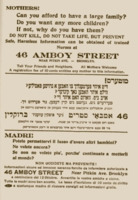 Flyer for the Brownsville Birth Control Clinic, 1916.
 According to Margaret Sanger Papers Project – a historical editing project sponsored by the Department of History at New York University formed by Dr. Esther Katz in 1985 to locate, arrange, edit, research, and publish the papers of the noted birth control pioneer – the country’s first ever birth control clinic opened on October 16, 1916. Located on 46 Amboy Street, in Brooklyn, New York, one of the city’s then burgeoning neighborhoods, the clinic’s promotional flier is directed at mothers and addresses them directly by posing questions about their financial ability to care for a large family and whether or not they might be interested in family planning.
In three different languages – English, Yiddish, and Italian – the clinic offers all mothers to access information about birth control. The advertisment reads, in all three languages, the following: “Mothers! Can you afford to have a large family? Do you want any more children? If not, why do you have them? Do not kill, Do not take life, but Prevent. Safe, Harmless Information can be obtained of trained Nurses at 46 Amboy Street…All Mothers Welcome”.
In just a little over a 100 years since its printing and the clinic’s opening, the inferences that this flier offers us now about early twentieth century New York City are many and worth investigating with respect to the City’s broader history of informative access to birth control resources.
-
 Charro Days (1956)
 The Charro Days Fiesta in Brownsville, TX celebrates the rich traditions and culture of the Texas-Mexican border region. From 1938 to present day, the Charro Days Fiesta is an important part of Brownsville’s culture and community, which is overwhelmingly Mexican and Mexican American, because of its focus on traditional dance, dress, and performances that reflect the history of Mexican Texas, or Tejas. The word charro refers to a Mexican horseman of great skill who would perform in competitions showing off their vaquero, or cattle ranching, skills – a legacy still reflected in Texan cowboy and rodeo culture. This newsreel captures a portion of the 1956 fiesta, which shows children performing various Mexican folk dances.
-
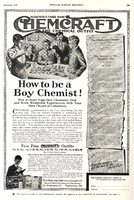 How to be a Boy Chemist!
 Advertised in "Popular Science Monthly", an American magazine for general readers interested in scientific topics, “Chemcraft” were educational chemistry sets targeted to young boys exclusively. In contrast with sources of the previous century, the advertisement only addresses the male gender despite the fact that, as its text reads, it was “originated by chemists, used in schools and colleges, and endorsed by teachers and professors.”
The beginning of the 20th century marked a shift in the cultural associations between the female gender and science. Events such as World War I encouraged boys to start taking up science courses in school, as it offered future possibilities in careers like engineering. Science, now linked to pure reason, began to be thought of as a boys’ subject.