-
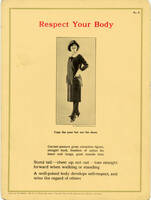 Respect Your Body
 The American Social Health (originally “Hygiene”) Association (ASHA) was established in 1913 at a professional public health conference in Buffalo, New York. Its initial purpose was to combat the rampant cases of venereal disease in the nation’s military. As American men returned home from fighting in Europe’s trenches of World War I, they brought with them high numbers of syphilis and gonorrhea. During the interwar years, the ASHA’s purpose expanded to include public education about what was, according to these experts, the relationship between individual health and high moral standards. To support this purpose, the ASHA aimed to prevent venereal disease, sex work, and drug addiction in New York through educational, legal, and medical measures.
This poster, which was created as part of their sexual hygiene educational campaign as disseminated through printed materials. In the poster, we see a young woman standing fitted in a dress and hat. The text below instructs young women to "stand tall" like the woman depicted in the picture. The text also reads, "A well-poised body develops self-respect, and wins the regard of others." This instructional poster was targeted toward girls and young women and fits in line with the American Social Hygiene Association's objective of linking moral standards such as "self-respect" through physical presentation and grooming.
-
 Don't Demand Purity Unless You Offer It
 The American Social Health (originally “Hygiene”) Association (ASHA) was established in 1913 at a professional public health conference in Buffalo, New York. Its initial purpose was to combat the rampant cases of venereal disease in the nation’s military. As American men returned home from fighting in Europe’s trenches of World War I, they brought with them high numbers of syphilis and gonorrhea. During the interwar years, the ASHA’s purpose expanded to include public education about what was, according to these experts, the relationship between individual health and high moral standards. To support this purpose, the ASHA aimed to prevent venereal disease, sex work, and drug addiction in New York through educational, legal, and medical measures.
Arguably, their most successful campaign was the production and proliferation of printed materials related to social hygiene. This poster confronts young men with questions of purity, honor, and cleanliness as euphemisms for sexually transmitted disease. From the perspective of these experts, the only women who engaged in sex outside of marriage were sex workers, whom society regarded not only as “dirty” and “impure”, but, moreover, the source of venereal disease. Therefore, if a man engaged in sex outside of marriage, he inherently ran the risk of contracting a sexual infection. Lest a young man be tempted into sex before marriage, this poster, which notably assumes the heterosexuality of its male reader, urges him to consider his future bride. A man who exposed an innocent girl to venereal disease through marriage, experts argued, made him nothing more than a hypocrite and an immoral crook.
Posters such as this one were created by the public health experts of the ASHA to serve as a teaching tool. Educators and parents could utilize this poster to visually and simply inform the young people in their care about a wide variety of uncomfortable and awkward topics, such as hygiene, sexually transmitted infections, abstinence, marriage, and puberty.
-
 A Not-So-Healthy “Health” Education by Shreya Paul
 In this 2019 article, Shreya Paul, a student at Stuyvesant High School in lower Manhattan, criticizes her school's health curriculum for its lack of LGBTQIA+ representation. Citing legislation in California, Iowa, Colorado, and Washington D.C. mandating LGBTQIA+ inclusive education, Paul calls for similar a state law in New York, arguing that current curricula stigmatizes non-heterosexual or cis-gender students and fails to provide them with adequate information about sexual health practices. Paul's article reflects an increasing sexuality and gender diversity among New York City teens and young adults and indicates a need for a sexual education curriculum that meets the needs of its LGBTQIA+ students.
-
 Free Abortion for All. Advertisement for NYC Health + Hospitals Abortion Access Hub Virtual ExpressCare. October 2023.
 In the lead up to the overturn of the landmark decision of Roe v. Wade on the eve of its 50th anniversary, New York state’s 57th governor Kathy Hochul signed a nation-leading legislative package to immediately protect the rights of patients and empower reproductive healthcare providers in anticipation of a final decision by the Supreme Court on abortion access. These packages were signed into law in June 2022, titled Comprehensive Six-Bill Package Protects Both Patients and Providers in Anticipation of Final Decision by Supreme Court on Dobbs v. Jackson.
More recently in New York City, Mayor Eric Adams and NYC Health + Hospitals – New York city’s cross-borough governmental healthcare system – launched the country’s first telehealth abortion access program through Virtual ExpressCare where patients in New York City seeking abortion care can connect with a New York state-licensed health care professional by video or phone, on-demand, for an assessment and counseling.
Commemorating the program’s official launch on October 2, 2023 Mayor Adams asserted that "Today, I am proud to announce another first for any city government: Access to abortion care will now be available through telehealth visits at NYC Health + Hospitals sites from the comfort of one's home. In New York City, we will never stop fighting for a woman's right to choose the care that is right for them, and we will never stop working to make abortion care more accessible to all New Yorkers”. The advertisement of this program can be seen displayed on LinkNYC kiosks, billboards across the city, and virtual ads on third party websites. Accessibility to healthcare in 2023, according to New York’s leading politicians, includes equitable access to abortion care and birth control.
-
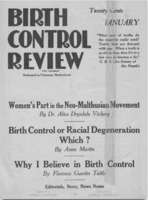 The Birth Control Review. Volume V. No. 1. The American Birth Control League. New York, NY.
 In the early 1920s, under the supervision of Dorothy Bocker, a physician, Margaret Sanger established the Clinical Research Bureau – later renamed the Birth Control Clinical Research Bureau – in New York city. The Birth Control Clinical Research Bureau (BCCRB) – considered the first legal birth control clinic in the country – functioned primarily as a contraceptive dispensary and research laboratory and served as an autonomous clinic and research facility from 1928 to 1939.
The Birth Control Review, from which the BCCRB grew, was edited by Sanger and its first edition published in 1917 under the banner of "Dedicated to the Principle of Intelligent and Voluntary Motherhood”. According to the Margaret Sanger Papers Project, the journal featured an array of the speeches that Sanger herself gave in pursuit of normalizing and organizing for the legal proliferation of birth control from the early 1910s and 1920s; issues of the journal also contained artwork, political cartoons, poetry, book reviews, and a lively letters section that often included opposing views and sometimes "mothers letters," excerpts from the letters of women seeking birth control advice.
The featured writings cover a range of topics, themes and approaches to the concept and practice of birth control; for example, an opinion piece by a Florence Guertin Tuttle titled “Why I Believe in Birth Control” whereby she discusses – at length – what it means to think through the principle, practice, and ethic of birth control. Meanwhile, another article penned by Anna Martin that appears on page 12 of the journal features a different perspective that simultaneously discussed the meaning of birth control as a means to “arrest the procreation of the unfit” with the aim of forwarding the social and economic benefits of selective birth control. Ultimately, inclusion of the fifth volume of the BCR journal is with the purpose of showcasing where the rhetoric surrounding birth control had gotten in 1923.
-
 “Portland Moral or Ridiculous? Colonel Wood Makes Arrests Pamphlet Sellers Basis of Inquiry”
 On June 19, 1916 Margaret Sanger – an American birth control activist, sex educator, writer, and nurse – gave a lecture titled “Birth Control” to educate on sexual health and pregnancy prevention, a stop she made as part of a seventeen-city speaking tour. In preparation for the talk, Sanger was approached by a union worker, Carl Rave, who asked whether he and two others—E.L. Jenkins and Ralph Chervin—could sell one of her pamphlets, which presented excerpts of information from one of Sanger’s monographs titled Family Limitations (1914).
According to the Oregon Encyclopedia, a project of the Oregon Historical Society, the contents of the pamphlet in question described birth control methods—including pessaries, condoms, sponges, laxatives, vaginal tablets, and douches—and highlighted the pleasures of sex. The sale of these pamphlets ultimately led to Sanger’s arrest, making Portland the only city during her speaking tour to put her in jail.
This article aptly captures the varying reactions and forms of engagement with a public lecture on sex, birth control, and family planning given by a woman. Moreover, the article captures the rhetoric that began to escalate around the public discussion of sexual health and birth control in the 1920s that began in New York city before spreading across the country.
-
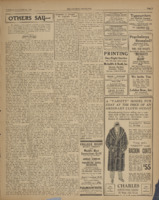 Student Marriage by Huntington Sharp
 This article was originally published in Cornell University’s literary magazine, The Columns, and was reprinted in Columbia’s daily student publication, The Columbia Spectator, in the “Others Say” column. The article was written by Huntington Sharp, who was the managing editor of The Columns at Cornell. In this piece, Sharp identifies the problem of “greater promiscuity” among Cornell’s students and explores the question of what physical relations should look like between men and women on campus, evincing the perennial fear of college students having too much sex. Sharp goes on to argue that “young men'' should be sufficiently educated about sexual development so that they can advance from the “sadism of boyhood, through onanism, homosexuality, and narcissism of adolescence, to a normal heterosexual maturity…” Sharp, who exclusively addresses his male peers, credits this chain of development to the prominent psychoanalyst Carl Jung, whose collected works were published and widely circulated in English in the 1920s, influencing a new kind of thinking about sex as it relates to the psyche. This statement also demonstrates Sharp’s complete rejection of homosexuality and points to the pervasiveness of a larger social homophobia that refuses to accommodate or even fathom the possibility of homosexual relations on campus. Sharp proceeds to declare that marriage among undergraduates is the solution and “compromise” between abstinence and promiscuity, arguing that students should strive to build healthy marital partnerships in order to control their physical desires and find meaningful satisfaction in laying the foundations for a traditional family life, an opinion that reflects conservative social mores among students in the 1920s, despite exposure and receptiveness to new developments in scholarship surrounding human sexuality. The Columbia Spectator’s republication of this article from a Cornell student paper indicates that sexual relations among students was a common issue on campuses across New York State.
-
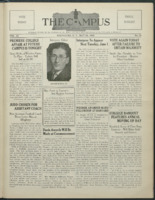 Men Faint in Fauver’s Sex Hygiene Lecture
 This article published in The University of Rochester’s weekly student publication, The Campus, details a fainting spell in a sex hygiene lecture. As the article chronicles, the lecture, administered by a professor from the physical education department, was interrupted when several men fainted. The professor, Dr. Fauver, attributes the fainting primarily to “nervousness caused by the vaso-motor system,” a diagnosis that can be read as a sarcastic, scientifically-veiled acknowledgment of the students’ squeamishness around the subject of sex. This source demonstrates how, despite a century of distance, students today are not dissimilar from students in the 1920s in terms of feeling nervous and uncomfortable when learning about sex in an academic setting. However, this source reveals some key differences from our contemporary sex education milieu: The Campus, according to its tagline, was published by the Men’s College of Arts and Sciences at the University of Rochester, indicative of the fact that the University was not coeducational at the time (its campuses were not fully coeducational in 1955). The article, then, is addressed to a male readership and concerns an all-male classroom. This single-gendered learning environment reflects the changing but still relatively firm separation of social spheres for men and women in the 1920s.
-
 Big Mouth Season 2 Teaser: Attack of the Hormone Monsters
 This clip from the Netflix show Big Mouth shows a group of middle school students in a sex education class learning about female anatomy (here, the teacher incorrectly calls fallopian tubes as “Ethiopian tubes”) before the class is then interrupted by attacking “hormone monsters” who swallow a number of the students. Big Mouth, an animated comedy series that premiered in 2017, is set in a New York City suburb and explores the painfully awkward, often hilarious realities of its protagonists as they experience puberty and navigating their changing bodies and emotions. This clip in particular sheds light on the often insufficiently trained educators as well as the absurdity and discomfort of learning about sex and the body as an early teen or young adult. Whether in an animated, fictionalized town or in the very real halls of 1920s New York universities, sex education can be a frightening endeavor.
-
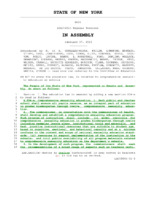 The New York State Senate Assembly Bill A4604
 Bill A4604 is an active bill that was introduced in the New York State Senate during the 2023-2024 Legislative Session. It is still in its early stages and, as of fall, 2023, is pending review by the Education Committee Assembly before continuing onto the next stage of the approval process. Previous versions of this bill were introduced by lawmakers in the New York State Senate in Legislative Sessions 2017-2018, 2019-2020, and 2021-2022. Each previous version, however, failed to pass into law.
If adopted, Bill A4604 would require students in grades Kindergarten through 12 in the state of New York to receive comprehensive sexuality instruction. This bill would include a model curricula for comprehensive sexuality education which, at a minimum, would conform to the content and scope of national sexuality education standards.
While its parameters are broad, New York State Senate Assembly Bill A4604 would dramatically alter the landscape of New York education. Currently, New York schools are not required to teach sex education to their students, although HIV/AIDS instruction is required. Though previous versions did not pass into law, this bill demonstrates a preoccupation among state lawmakers to enact a standardized, mandatory curricula through which New York students of all ages will be equipped to understand sex and sexuality.
-
 School Heads Won't Agree On Sex Study; Usurping Home's Function, One Says
 Brooklyn Daily Eagle was an afternoon daily newspaper published in Brooklyn, New York from 1841 to 1955. At its peak, it was the largest daily circulated afternoon paper in the United States.
This front-page article contains snippets of interviews of high school principals from across the New York City metropolitan area. Its purpose was to highlight opposing views of the debate over whether hygiene should be taught in schools. Some principals stated that they were vehemently against sex education in schools, believing that it encroached on parents’ rightful authority over their children. Others feared that teaching students about sex would only encourage them to engage in sexual activities. Pro-sex education principals, however, voiced concerns that parents were ill-equipped to provide answers and resources to their children’s questions about sex. Still others believed that educators should answer individual students’ questions about sex without teaching a formalized course on the subject.
The article offers firsthand insights into the tensions, concerns, and disagreements present among high school administrators regarding the rollout of sex education in early 1920s New York. It reveals a diverse spectrum of responses and solutions put forth by those on different sides of this complex, multifaceted issue.
-
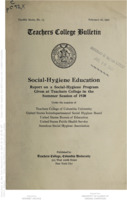 Social-Hygiene Education: Report on a Social-Hygiene Program Given at Teachers College in the Summer Session of 1920
 In the summer of 1920, the subject of sexual hygiene was first being introduced in New York schools. To address educators' needs, the Teachers College of Columbia University in New York City invited high school and college educators, social workers, and public health nurses to attend a program of courses, conferences, and exhibits in how to teach social hygiene. The program was created in collaboration with wider federal agencies and expert organizations, including the United States Interdepartmental Social Hygiene Board, the United States Bureau of Education, the United States Public Health Service, and the American Social Hygiene Association.
The guiding principle of the program was the belief that social hygiene education in schools and colleges should not be taught exclusively by a single specialist or in a designated course. Rather, sexual health should be folded into regular school subjects, specifically biology, general hygiene, nursing, physical education, sociology, ethics, literature, and homemaking. To support this interdepartmental vision of hygiene instruction, the program instructed educators in how to incorporate the teaching of sexual hygiene in their regular courses and to prepare educators in how to delicately teach this information to young people.
Following the conference, this Report was created and disseminated to educators across the state of New York by the Teachers College. It outlines why social hygiene should be taught in schools, who should teach it, and exactly what kind of information should be included in its instruction to young people. The Report sheds light on educators' ongoing feelings of unease at being ill-equipped to inform their students about topics related to sex.
-
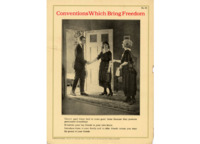 Conventions Which Bring Freedom
 The American Social Health (originally “Hygiene”) Association (ASHA) was established in 1913 at a professional public health conference in Buffalo, New York. Its initial purpose was to combat the rampant cases of venereal disease in the nation’s military. During the interwar years, its purpose expanded to include public education about what was, according to these experts, the relationship between individual health and high moral standards. To support this purpose, the ASHA aimed to prevent venereal disease, sex work, and drug addiction in New York through educational, legal, and medical measures.
Arguably, their most successful campaign was the production and proliferation of printed materials related to social hygiene. The ASHA created this poster as part of its “Youth and Life Exhibit” series. The poster encourages young women to socialize with young men around the safety of their family and friends. Interacting with a young man under the watchful eye of others, experts argued, freed young women from the risk of contracting venereal disease and the shame of impurity attached to a woman who engaged in sex outside of marriage.
Posters such as this one were distributed to students and parents as a teaching tool. Parents could utilize this poster to inform the young people in their care about a wide variety of uncomfortable and awkward topics, such as hygiene, abstinence, marriage, sexually transmitted infections, and puberty.
-
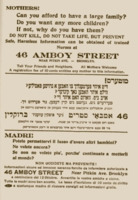 Flyer for the Brownsville Birth Control Clinic, 1916.
 According to Margaret Sanger Papers Project – a historical editing project sponsored by the Department of History at New York University formed by Dr. Esther Katz in 1985 to locate, arrange, edit, research, and publish the papers of the noted birth control pioneer – the country’s first ever birth control clinic opened on October 16, 1916. Located on 46 Amboy Street, in Brooklyn, New York, one of the city’s then burgeoning neighborhoods, the clinic’s promotional flier is directed at mothers and addresses them directly by posing questions about their financial ability to care for a large family and whether or not they might be interested in family planning.
In three different languages – English, Yiddish, and Italian – the clinic offers all mothers to access information about birth control. The advertisment reads, in all three languages, the following: “Mothers! Can you afford to have a large family? Do you want any more children? If not, why do you have them? Do not kill, Do not take life, but Prevent. Safe, Harmless Information can be obtained of trained Nurses at 46 Amboy Street…All Mothers Welcome”.
In just a little over a 100 years since its printing and the clinic’s opening, the inferences that this flier offers us now about early twentieth century New York City are many and worth investigating with respect to the City’s broader history of informative access to birth control resources.
-
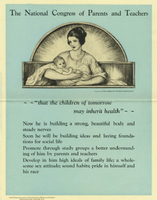 That The Children of Tomorrow May Inherit Health
 This poster, published by The National Congress of Parents and Teachers, encourages parents and children to instill certain “high ideals,” attitudes, and habits in children to prepare them for a healthy life. The National Congress of Parents and Teachers, the predecessor of the National Parent Teacher Association, was established in 1897 in New York for the expressed purposes of facilitating closer cooperation between the home and school in the project of child rearing and child welfare. This poster and its depiction of mother and child surrounded by halo-like beams of light demonstrates the sanctification of parenting (specifically mothering) and the kinds of moralistic attitudes applied to the subject of sex education and social relations in the 1920s.
The text reads: "that the children of tomorrow may inherit health: Now he is building a strong, beautiful body and steady nerves: Soon he will be building ideas and laying foundations for social life: Promote through study groups a better understanding of him by parents and teachers: Develop in him high ideals of family life; a wholesome sex attitude; sound habits; pride in himself and his race"