-
 Women of the Future Will Make the Moon a Cleaner Place to Live
 This 1968 advertisement shows a woman in a futuristic astronaut-like space suit. The woman pictured in the image is holding a cleaning product, and the accompanying caption reads: “Women of the future will make the Moon a cleaner place to live.” During the 1960’s, women typically were expected to assume the role of homemakers. This notion was not only encouraged through the educational programs offered at the time, but also strengthened by depictions in popular culture. This was also the time when the “space race” between the United States and the Soviet Union was taking place. This image depicts a possible future of life on the Moon, but where stereotyped gender roles remain unchanged. Instead of being professional scientists or astronauts of the future, in this advertisement women are destined to be housewives.
-
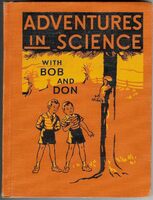 Adventures in Science with Bob and Don
 After World War II, science provided professional opportunities for men, for example, as engineers. In addition, certain beliefs of the time enforced the idea that women belonged to a separate sphere than men. This rhetoric strengthened the notion that female and male capabilities were different, and women should be committed to their homes. In this way, science became linked to boys. “Adventures in Science with Bob and Don,” is a book of scientific education. As can be observed in its title and cover illustration, the book is targeted to boys, and science is characterized as an outdoor adventure, a sphere that belonged to the male gender.
-
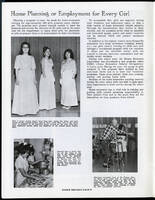 Home Planning or Employment for Every Girl
 By 1960, the growing backlash against women entering the workforce reached its peak. By then, the number of women receiving advanced degrees in science was at an all-time low. After World War II, educational curricula offered to girls and boys was differentiated by gender, in order to prepare them for their potential vocational futures.
This school newspaper publication from 1966 provides information about the type of education that was targeted to female students during that era. The source provides evidence of what was considered to be an academic program better suited for female students. In order to become future homemakers or find employment, these students were offered courses such as cooking, sewing, and child care training.
-
 Why Study Home Economics?
 After World War II, men started to take over the workforce, leaving most women unemployed and in charge of household responsibilities – since during the war and the great depression, women occupied a great part of the workplaces.
In this informative video, a teacher explains to a prospective student the benefits of taking the Home Economics subject. This class was greatly popularized among schoolgirls because it prepared them to care for a house and a family and to be wives – they became “homemakers”, a person capable of improving the life quality of their families or themselves. The teacher mentions the possibilities of using the acquired knowledge of “home ec” to apply for college. However, the scientific knowledge taught in the class does not provide a realistic basis for scientific careers, so job opportunities are limited to areas related to the social sciences and the professionalization of home economics itself.
-
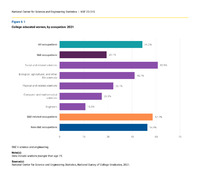 College-educated women in the U.S., by occupation: 2021
 The report “Diversity and STEM: Women, Minorities, and Persons with Disabilities” presents statistical information about the representation of these three groups in STEM education and employment.
This graph analyzes the involvement of college-educated women (with a bachelor degree) in Science and Engineering (S&E) careers in the United States. By 2021, only 29% of the S&E workforce are college-educated women, while the remaining 71% are men.
This gender disparity is also reflected in the unequal distribution of women with degrees in the various fields of science. Earlier we mentioned that social sciences (such as home economics) and natural sciences (like botany) were mostly popularized among women. Now, in 2021 and according to this study, we can see that women participate more in the educated workforce related to “Social and related sciences” and “Biological, agricultural and other life sciences”. What does this tell us about the legacies of female science education in the U.S.?
-
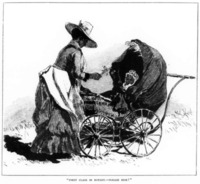 First Class in Botany.—Please Rise!
 By the end of the 19th century, courses related to natural history, such as botany, became the most popular among girls. There was a widespread belief that studying nature would benefit girls because not only was nature’s delicacy aligned with the sensitive traits of women, but they could also learn pedagogical skills and learn about God. This gender-specific idea around natural sciences was strongly disseminated by schoolbook authors like Almira H. L. Phelps.
This image, where a mother shows her child some plants and the text reads: “First class in botany—Please Rise!” is a humorous illustration that satirizes the conceptions of girls’ education and when it should “start”.
-
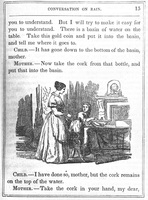 Conversation on Rain
 Before the Civil War, science education was most accessible to middle and upper-class white ladies. Science education was part of the core curricula for girls leaving some other “ornamental subjects” as optional. Boys had scientific courses too, but for them, it was a priority to learn the classics to gain entrance to university, something girls didn’t have the opportunity to do.
In this illustration, we can see a mother talking with her daughter about how some objects sink or not in water, in this case, a gold coin and a cork. This example is used to explain why rain falls. Books like this one by Richard G. Parker, Juvenile Philosophy, give us a glimpse of the social status of the mother and child while showing that science was regarded by parents and educators as particularly suitable for females during the 19th century. The reason? Simply because the study of science was considered to elevate the female character (and it was not a requirement for university entrance).
-
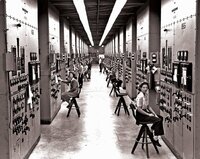 The Calutron Girls
 The photograph shows Y-12 calutron operators, a group of recent high school graduates known as the “Calutron Girls”, who joined the Manhattan Project during World War II. The girls were trained to control the separation of isotopes from uranium as part of the efforts to build the first atomic bomb, called “Little Boy”, without ever knowing the machinery’s real purpose. Their tasks were focused on reading meters and making necessary adjustments as indicated, but with no scientific involvement in the project. The “Calutron Girls” were made aware of the purpose of their work when the people of Hiroshima, Japan, were bombed by the United States on August 6, 1945.
After World War II, the notion of science as a male discipline was crystallized, and the involvement of women in the field was mostly as technicians.
-
 Mae Jemison: Astronaut and Doctor
 Portrait of American engineer, physician, and NASA astronaut Mae C. Jemison, who became the first African American woman to travel in space in 1992. This illustration by Karina Pérez is part of a project through which “Nevertheless”, an educational podcast, commissioned female illustrators to create hi-resolution, downloadable posters featuring female STEM role models. The mission behind the commission was to raise awareness of the achievements of female scientists and inspire future generations of girls and women in STEM.
Why is it relevant to broadcast women in STEM in the 21st century? Would it mean the same if the posters featured male scientists too? To this day, the representation of the male gender in those fields is greater than that of women and non-binary people.
-
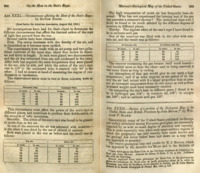 Circumstances Affecting the Heat of the Sun's Rays
 In 1856, American scientist Eunice Foote (1819-1888) published the results from an experiment in which she discovered what is now known as the Greenhouse effect. There, Foote stated: "An atmosphere of that gas [i.e., carbon dioxide] would give to our earth a high temperature; and if as some suppose, at one period of its history the air had mixed with it a larger proportion than as present, an increased temperature from its own action as well as from increased weight must have necessarily resulted." Her theory was thus the first to introduce the phenomenon of climate warming caused by increased levels of CO2 in the atmosphere.
The work of Eunice Foote, as well as that of other female scientists of the 19th century, encourages us to reflect on the possibilities offered by the type of education received by girls during that period.
-
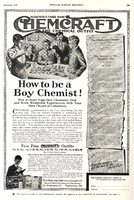 How to be a Boy Chemist!
 Advertised in "Popular Science Monthly", an American magazine for general readers interested in scientific topics, “Chemcraft” were educational chemistry sets targeted to young boys exclusively. In contrast with sources of the previous century, the advertisement only addresses the male gender despite the fact that, as its text reads, it was “originated by chemists, used in schools and colleges, and endorsed by teachers and professors.”
The beginning of the 20th century marked a shift in the cultural associations between the female gender and science. Events such as World War I encouraged boys to start taking up science courses in school, as it offered future possibilities in careers like engineering. Science, now linked to pure reason, began to be thought of as a boys’ subject.