-
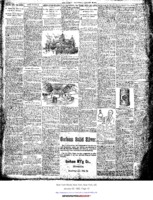 Annie's Golden Greeting
 Article describing the opening of Ellis Island Immigration Station from the New York World on January 2nd, 1892. The first ship to land at the new station was the Nevada, and the first immigrant to land and be processed was Annie Moore, a fifteen-year-old Irish immigrant. The article describes the scene, has a drawing of inside the new immigration station, and describes Annie as a little girl several times throughout. The choice of Annie was thought to be contrived, to present a rosier picture of immigrants coming to America, and so they chose the most palatable immigrant on the ship: a young girl from Ireland. The New York World was owned and operated by Joseph Pulitzer until 1911.
-
Rescue Thru Emigration
Cover of the 1941 HIAS Annual Report: HIAS is portrayed as a "tower of hope" for Jewish emigres.
-
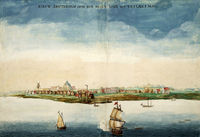 Nieuw Amsterdam ofte Nue Nieuw Iorx opt ' Teylant man
 Original description:
" An early picture of New Amsterdam made in the year when it would swop 'ownership' and become New York."
The image depicts New Amsterdam at the southern tip of present-day Manhattan looking northwards in 1664. This was the same year that the land would be taken by the English. Take note of the aspects of the settlement which mark it as a Dutch space such as the flags, the houses, and the windmill in the distance.
-
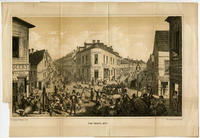 Street scene of the nineteenth-century working-class neighborhood, Five Points
 An illustration of New York’s Five Points neighborhood depicting peddlers, taverns, men and women, and brawl scenes. The artist chooses to portray a diverse street tableau—populated by both women and men, white workers, immigrants, and African-Americans—all engaging in activities that the illustration implies are sinful. Of particular note are men and women walking in "couples"; a euphemism used to imply that unmarried women were promiscuous by walking freely in the street with men. In neighborhoods like Five Points and the Bowery, women's presence, regardless of their actual reasons for being there, was often seen as inherently immoral. Many women who did actually work in street industries, from peddling to prostitution, but the open nature of the streets in Five Points also represented a new possibility for working women: that they deserved pleasure and leisure, regardless of what popular discourses had to say about the value of hard work and frugality.
-
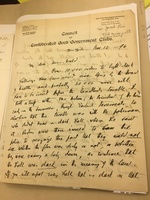 Correspondence from Jacob Riis to Lillian D. Wald Papers
 Riis mentions about the tenement issues in New York.