-
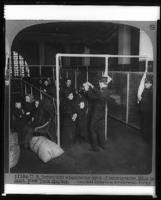 Inspection at Ellis Island
 The medical examination is one of the most notorious aspects of Ellis Island during the first three decades of its existence. The eye exam, looking for trachoma, was the most dreaded by immigrants. Inspectors would use their bare hands or button hooks to peel back the lids and do a quick search. The sanitary conditions were noted to be horrible and many feared the spread of the disease by those doing the inspection.
-
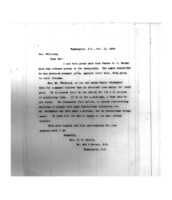 William Williams Memos and Correspondence
 Memos and Correspondence from William Williams, who was Commissioner of Immigration at Ellis Island from 1902-1905 and again in 1909-1914. These memos and letters are in regard to the treatment of Immigrants at Ellis Island by workers and shed light on the way in which immigrants were discussed, treated, and viewed by those in charge of their care. This selection of memos are from 1902-1910.
-
Dora Maisler
test
-
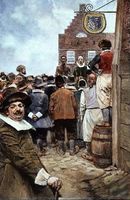 The First Slave Auction at New Amsterdam in 1655
 This image depicts what painter Howard Pyle imagined a slave auction to have looked like in New Amsterdam. He adds a momentous wait to the image by calling it the "First" Slave Auction at New Amsterdam. The first slave auction happened in New Amsterdam in 1655 but slaves had been brought to the settlement ever since 1626 to augment its laborforce. What do you think Pyle is trying to say about slavery in New Amsterdam from the faces he chooses to reveal?
-
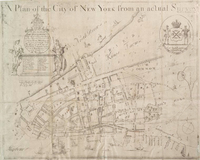 A plan of the city of New York from an actual survey
 "This plan of the city of New York is humbly Dedicd by Your Excellencys Obet & most humble Sert Wm Bradford."
-
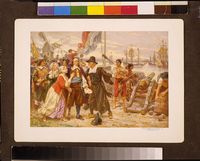 The fall of New Amsterdam
 Print shows Peter Stuyvesant, in 1664, standing on shore among residents of New Amsterdam who are pleading with him not to open fire on the British who have arrived in warships waiting in the harbor to claim the territory for England.
-
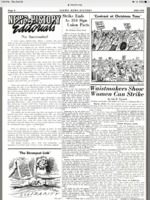 Strike Ends As 354 Sign Union Pacts
 An article by Miriam Finn Scott in a chronicle from 1950 of the International Ladies’ Garment Workers’ Union, done in the manner of a newspaper. It was prepared and edited by the staff of Justice, the official publication of the I.L.G.W.U.
-
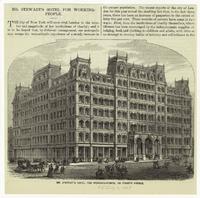 Mr. Stewart's Hotel For Working-Women, On Fourth Avenue
 Stewart's Hotel for Working Women was a philanthropic venture of Alexander Stewart, a self-made Irish-American millionaire businessman. Stewart was committed to providing a space—beyond tenements or unscrupulous boardinghouses—for unmarried working women to live in good conditions at a low cost. Though the hotel ultimately failed (unsurprisingly, many men at the time did not feel similarly to Stewart regarding women's right to live alone in dignity), it points to the fact that new forms of women's domestic independence were being discussed in practical ways. Stewart was focused on the idea of providing structural support for working-class women with limited resources, seeking to uplift the conditions of their lives and give them the tools to independently support themselves.
-
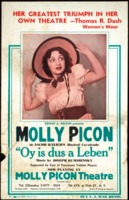 Poster of "Oy Is Dus A Leben"
 Oy Is Dus A Leben is a musical played between 1942 and 1943 at the Molly Picon Theatre. Molly Picon (1904-1984) was one of the greatest stars of Yiddish theatre and film and wrote a lot of Yiddish songs. In 1931 she bought the Second Avenue Theater, which was renamed the Molly Picon Theater.
-
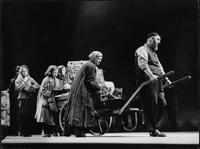 Zero Mostel in the stage production of Fiddler on the Roof as Tevye
 The photograph taking one scene of "Fiddler on the Roof" played in around 1964. Zero Mostel had the role of Tevye, as the first cast of the musical. This picture depicts the scene where Tevye and his family were exiled from the Ukrainian village of Anatevka and about to immigrate to New York.
-
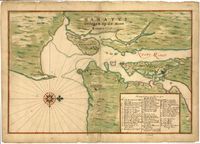 Mahatvs Gelegen op de Noot Rivier
 Map depicting buildings and points of interest within and around the colony of New Amsterdam. The map legend indicates letter F to be the location of slave quarters.
-
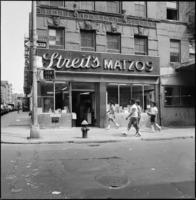 Streit's Matzos
 The Streit's factory was founded in 1916 in the Lower East Side. First located on Pitt street, it moved to 1925 to Rivington Street and finally to Orangeburg, NY is 2015.
-
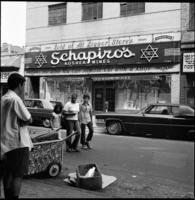 Schapiro's Kosher Wines
 Founded in 1899, Schapiro's became one of the top names in kosher wine and the only winery in Manhattan until its closure in 2007.
-
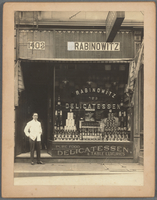 Harry Rabinowitz in Front of Rabinowitz Delicatessen
 Harry Rabinowitz, father of choreographer Jerome Robbins, stands in front of his delicatessen on Madison Avenue.
-
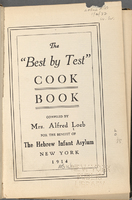 The Best by Test Cookbook
 This cookbook was published by the Hebrew Immigrant Asylum of New York and aimed at immigrant women. Despite this, it contains treyf, or non-kosher food, such as shellfish although it still avoids pork.
-
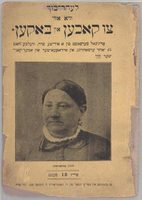 Lehr-bukh vi azoy tsu kokhen un baken [Textbook on How to Cook and Bake]
 The first Yiddish cookbook published in America. The author, Hinde Amchanitzki, was an experienced cook who had worked in Europe and America, and her cookbook was intended to teach Jewish immigrants about both American and traditional Jewish cuisine.
-
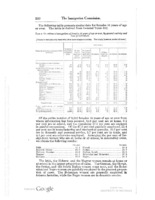 Statistics of Female Immigrant Employment
 The Dillingham Commission was a bipartisan special committee lead by its chairman, Republican Senator William P. Dillingham of Vermont. It began in 1907 and was published in 1911. It was commissoned to study the effects of recent immigration on American society and the effects of new immigrants versus old immigrants. The conclusion reached was that immigration from eastern and southern Europe was a threat to the fabric of American society and there should be greater restrictions placed on these populations. These two pages here are an extract from Volume 26 Part II regarding Immigration in New York City and show the statistics of employment for female immigrants at the time.
-
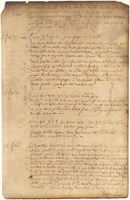 Dutch colonial council minutes, 1 February - 3 March 1644
 Dutch Council minutes from February 1 to March 3, 1644. Included, is the manumission of eleven peoples from the Dutch West India Company: "where they shall be permitted to earn their livelihood by agriculture on the land shown and granted to them." On terms, that each of the men pay a yearly sum of agricultural goods to the Dutch Council, and that their children born or hereafter shall be enslaved. (2 pages)
-
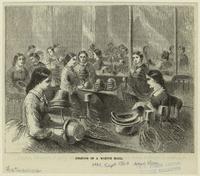 Portion Of A Wiring Hall
 This still image portrays a shop of young women doing the "wiring" work on hats for sale. The illustration depicts young women who all appear to be around the same age; it is a distinct choice on the artist's part to portray the shop floor as a young woman's domain. Not only does their presence on the shop floor demonstrate the new pressures that young women felt to find work outside of the home and domestic contexts, but also points to their increased involvement in traditionally male labor spaces. The garment industry, while not yet fully radicalized, would soon become an important space for women's labor organizing around the turn of the twentieth century.
-
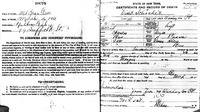 Violet Schochet Death Certificate
 The death certificate of Violet Schochet, who was 21 years old at the time of the fire. She was born in Germany and had lived in the U.S. for 9 years. She was a union member and fought for stricter labor laws.
From her documented injuries and cause of death, Violet was overcome by the smoke and flames and never escaped the burning building.
-
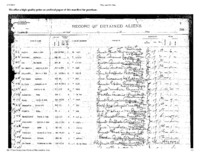 Record of Detained Aliens
 A record of a group of women and children detained at the Ellis Island Immigration station because they weren't allowed to leave without guardians. Adult women were not allowed to leave unaccompanied, the same as the children, and were often detained for days while they waited for their husbands, brothers, or male relatives to pick them up.
-
 Scene in the Magdalen Asylum
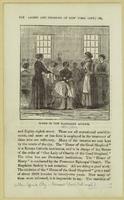
 An illustration of women undergoing "moral reform" in the Magdalen Asylum, one of New York's nineteenth-century correctional facilities used to penalize the working poor. Magdalen asylums were designed to house women who had "lost" their virtue—through sexual encounters, prostitution, intemperance, or indigence—and to reform them through the process of hard work. Accounts differ on the experiences of women at Magdalen; some point to women's ability to leave at their own discretion, while others frame the experience as a mandatory commitment to a prison-like workhouse. Regardless, the Magdalen system—started in England, then exported to the United States' East Coast cities—fit neatly into the nineteenth century's religious revival and desire to control poor women's autonomy.
-
 van der Donck's map of New Netherland, 1656
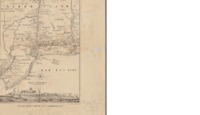
 This map depicts how a Dutch cartographer named Adriaen van der Donck understood colonial Dutch space in the decades after its settlment. Are there placenames that seem familiar to you ? In any process of mapmaking one must decide what features they would like to add as well as omit. What do you think Van Der Donck omits in his depiction of the region? What might have been his motivation in doing so?
-
 Deposition of Dr. John Archer
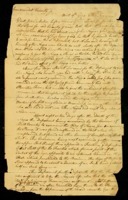
 Two-page deposition of Dr. John Archer of Annarundel [Anne Arundel] County [Maryland], describing circumstances surrounding the death of Jos, a slave belonging to Mr. James Lee. Archer testifies that an autopsy of the victim showed cause of death to be consistent with an accidental head injury at the hand of his master, Lee, despite Jos's complaints of "a pain in the side." Recorded by Annandale Lordship Justice of the Peace, Reverdy Ghiseln.
-
 The Ladies’ Garment Worker, volume 2 issue 10
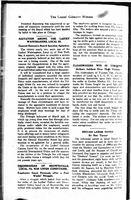
 This is an article titled, “Agitation Among the Ladies’ Waistmakers, Local 255” in The Ladies’ Garment Worker, which was the official publication of the International Ladies’ Garment Workers’ Union (ILGWU) through 1918. This article makes reference to the successful garment worker strike in 1909 of the Ladies’ Waistmakers, Local 25, of New York. This union consisted of many immigrant women workers who worked at the Triangle Shirtwaist Factory.