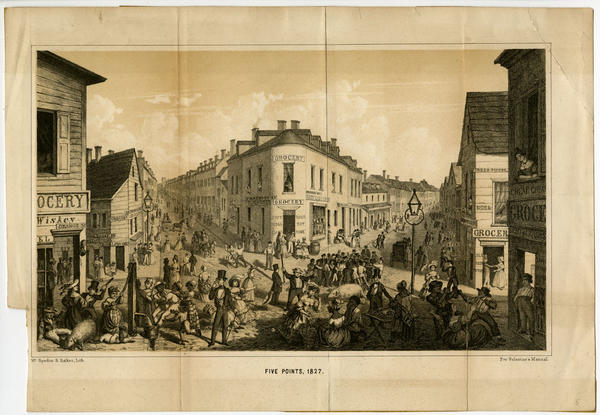
Street scene of the nineteenth-century working-class neighborhood, Five Points
Item
-
Title
-
Street scene of the nineteenth-century working-class neighborhood, Five Points
-
Description
-
An illustration of New York’s Five Points neighborhood depicting peddlers, taverns, men and women, and brawl scenes. The artist chooses to portray a diverse street tableau—populated by both women and men, white workers, immigrants, and African-Americans—all engaging in activities that the illustration implies are sinful. Of particular note are men and women walking in "couples"; a euphemism used to imply that unmarried women were promiscuous by walking freely in the street with men. In neighborhoods like Five Points and the Bowery, women's presence, regardless of their actual reasons for being there, was often seen as inherently immoral. Many women who did actually work in street industries, from peddling to prostitution, but the open nature of the streets in Five Points also represented a new possibility for working women: that they deserved pleasure and leisure, regardless of what popular discourses had to say about the value of hard work and frugality.
-
Creator
-
Catlin, George (artist); McSpedon & Baker (lithographer)
-
Date
-
1855
-
Source
-
George Catlin and McSpedon & Baker, "Five Points, 1827," published by New York Common Council, 1855. Originally available from the Library Company of Philadelphia Print Department, African Americana Prints and Watercolors and Drawings Collection. URL: https://digital.librarycompany.org/islandora/object/digitool%3A129421
-
Rights
-
Public domain, via Library Company of Philadelphia
-
Type
-
Lithograph [tinted; 24 x 25 cm.(9.25 x 13 in.)]
-
Format
-
JPG
-
Language
-
English
-
Coverage
-
Expansion and Reform (1801–1861)
-
How to Cite
-
George Catlin and McSpedon & Baker, "Five Points, 1827," published by New York Common Council, 1855. Originally available from the Library Company of Philadelphia Print Department, African Americana Prints and Watercolors and Drawings Collection. Accessed [today's date] at https://aphnyu.org/creatingdigitalhistory/fall2019/s/uncoveringnyc/item/4.
-
Publisher
-
New York Common Council
-
Contributor
-
Josie Naron
 Five Points, 1827