
Fergus Peniston to Abraham Lincoln, Wednesday, December 28, 1864 (Requests tax exemption)
Dublin Core
Title
Fergus Peniston to Abraham Lincoln, Wednesday, December 28, 1864 (Requests tax exemption)
Subject
United States--History--Civil War, 1861-1865--Economic aspects
Cotton
Description
In this second petition to President Lincoln, Louisiana cotton merchant Fergus Peniston reiterated his request for an exemption from a particular tax on his cotton that was passed after he acquired the cotton and freedom to trade outside Union-occupied territory. He emphasized the urgency of his cause by explaining the cotton is "liable every day to destruction or seizure for the purpose of sending it to Mexico." Peniston was granted a permit in January 1865.
Creator
Fergus Peniston
Source
Library of Congress, Rare Book and Special Collections Division
Date
1864-12-28
Contributor
AB, PP
Rights
Public Domain
Format
jpeg/gif
Language
English
Manuscript Item Type Metadata
Text
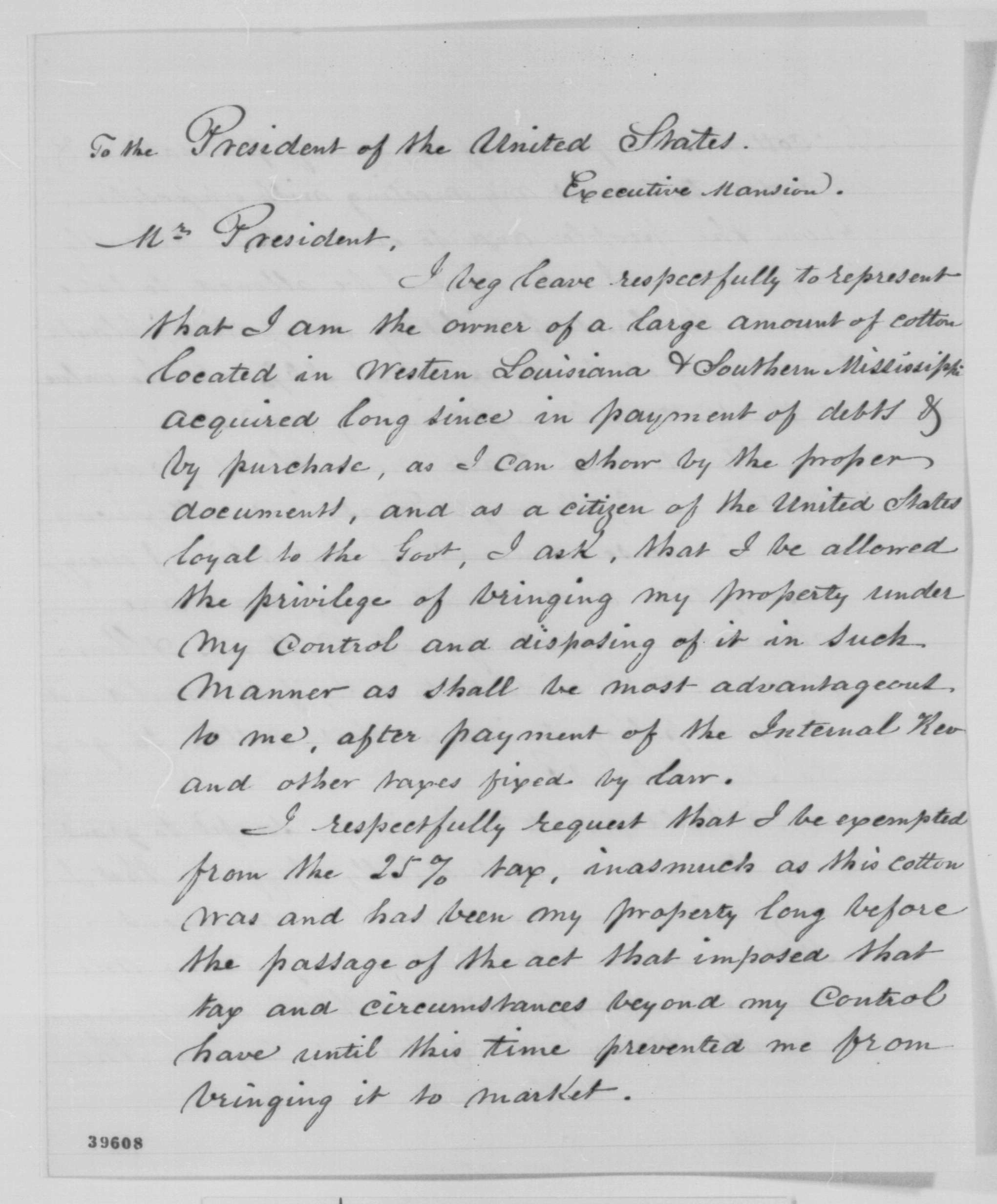
Mr President,
I beg leave respectfully to represent that I am the owner of a large amount of cotton located in Western Louisiana & Southern Mississippi acquired long since in payment of debts & by purchase, as I can show by the proper documents, and as a citizen of the United States loyal to the Govt, I ask, that I be allowed the privilege of bringing my property under my control and disposing of it in such manner as shall be most advantageous to me, after payment of the Internal Rev and other taxes fixed by law.
I respectfully request that I be exempted from the 25% tax, inasmuch as this cotton was and has been my property long before the passage of the act that imposed that tax and circumstances beyond my Control have until this time prevented me from bringing it to market.
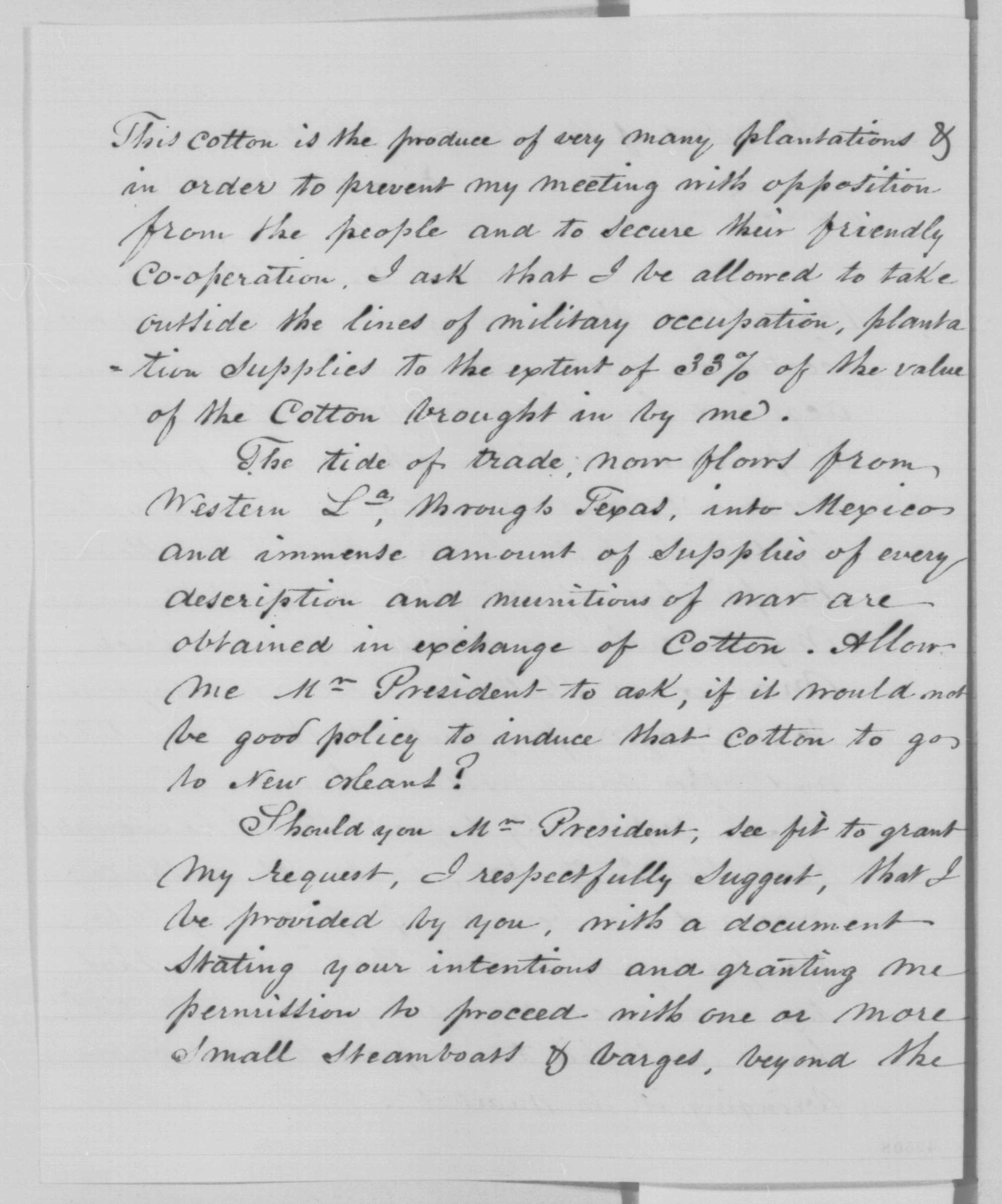
This cotton is the produce of very many plantations & in order to prevent my meeting with opposition from the people and to secure their friendly co-operation, I ask that I be allowed to take outside the lines of military occupation, plantation supplies to the extent of 33% of the value of the Cotton brought in by me.
The tide of trade; now flows from Western La, through to Texas, into Mexico and immense amount of supplies of every description and munitions of war are obtained in exchange of Cotton. Allow me Mr President to ask, if it would not be good policy to induce that cotton to go to New Orleans?
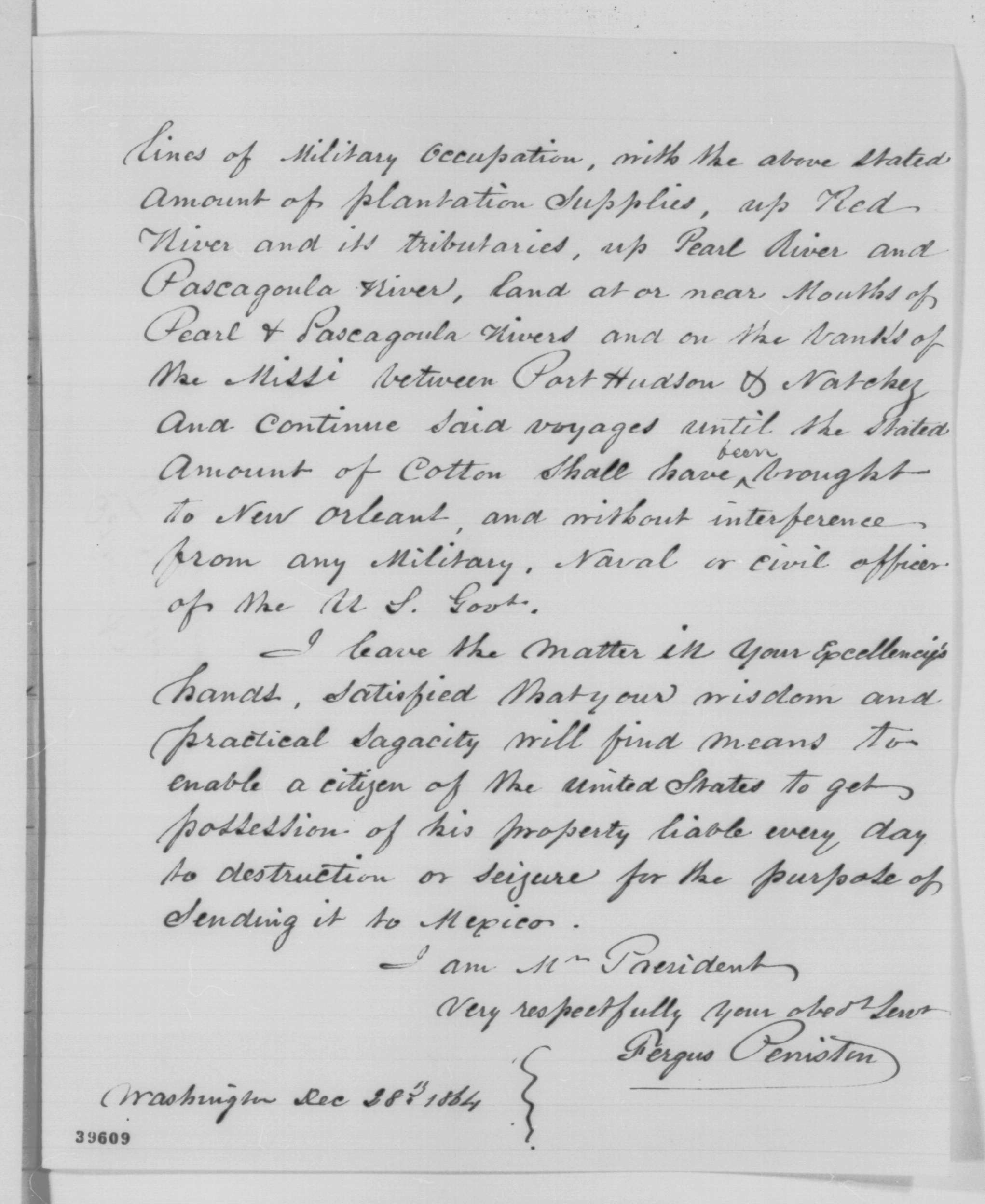
Should you Mr President, see fit to grant my request, I respectfully suggest, that I be provided by you, with a document stating your intentions and granting me permission to proceed with one or more small steamboats & barges, beyond the lines of Military Occupation, with the above stated amount of plantation supplies, up Red River and its tributaries, up Pearl River and Pascagoula River, land at or near Mouths of Pearl & Pascagoula Rivers and on the banks of the Missi between Port Hudson & Natchez and continue said voyages until the stated amount of Cotton shall have been brought to New Orleans, and without interference from any Military, Naval or civil officer of the U S. Govt.
I leave the matter in your Excellency's hands, satisfied that your wisdom and practical sagacity will find means to enable a citizen of the United States to get possession of his property liable every day to destruction or seizure for the purpose of sending it to Mexico.
I am Mr President
Very respectfully Your obedt Servt
Fergus Peniston
Washington Dec 28th 1864
I beg leave respectfully to represent that I am the owner of a large amount of cotton located in Western Louisiana & Southern Mississippi acquired long since in payment of debts & by purchase, as I can show by the proper documents, and as a citizen of the United States loyal to the Govt, I ask, that I be allowed the privilege of bringing my property under my control and disposing of it in such manner as shall be most advantageous to me, after payment of the Internal Rev and other taxes fixed by law.
I respectfully request that I be exempted from the 25% tax, inasmuch as this cotton was and has been my property long before the passage of the act that imposed that tax and circumstances beyond my Control have until this time prevented me from bringing it to market.
This cotton is the produce of very many plantations & in order to prevent my meeting with opposition from the people and to secure their friendly co-operation, I ask that I be allowed to take outside the lines of military occupation, plantation supplies to the extent of 33% of the value of the Cotton brought in by me.
The tide of trade; now flows from Western La, through to Texas, into Mexico and immense amount of supplies of every description and munitions of war are obtained in exchange of Cotton. Allow me Mr President to ask, if it would not be good policy to induce that cotton to go to New Orleans?
Should you Mr President, see fit to grant my request, I respectfully suggest, that I be provided by you, with a document stating your intentions and granting me permission to proceed with one or more small steamboats & barges, beyond the lines of Military Occupation, with the above stated amount of plantation supplies, up Red River and its tributaries, up Pearl River and Pascagoula River, land at or near Mouths of Pearl & Pascagoula Rivers and on the banks of the Missi between Port Hudson & Natchez and continue said voyages until the stated amount of Cotton shall have been brought to New Orleans, and without interference from any Military, Naval or civil officer of the U S. Govt.
I leave the matter in your Excellency's hands, satisfied that your wisdom and practical sagacity will find means to enable a citizen of the United States to get possession of his property liable every day to destruction or seizure for the purpose of sending it to Mexico.
I am Mr President
Very respectfully Your obedt Servt
Fergus Peniston
Washington Dec 28th 1864
Citation
Peniston, Fergus. Fergus Peniston to Abraham Lincoln, Wednesday, December 28, 1864 (Requests tax exemption). Letter. Library of Congress. http://memory.loc.gov/cgi-bin/ampage?collId=mal&fileName=mal1/396/3960800/malpage.db&recNum=0. Accessed December 17, 2016.
Files
Citation
Fergus Peniston, “Fergus Peniston to Abraham Lincoln, Wednesday, December 28, 1864 (Requests tax exemption),” Creating Digital History @ NYU, accessed September 17, 2026, https://aphnyu.org/creatingdigitalhistory/fall2016/items/show/80.
Embed
Copy the code below into your web page