Draft of Play About Sylvester Manor
Dublin Core
Title
Draft of Play About Sylvester Manor
Subject
United States—History—Late 18th century, United States—History—19th century, Shelter Island (N.Y.)—History, Sylvester Manor (Shelter Island, N.Y.), Plantation life—New York—Shelter Island, Slavery, Colonialism, Horsford family, Manuscripts—New York—Shelter Island, Drafts (Manuscripts)—Plays
Description
Patience L’Hommedieu (née Sylvester) (1664-1719)
Patience was the second daughter and fifth child of Grizzell and Nathaniel Sylvester. As is the case with her mother, surviving documentation of her life is scarce. However, we can assume that their lives would’ve been similar in many ways. Perhaps the most significant difference is that Patience did not move away from the place of her birth, and did not need to participate in setting up a new home in a foreign land the way her mother would have. She was also much older (around 30) when she married Benjamin L’Hommedieu in 1694. Together, they had five children, and she the matriarch of the latter descendants of the family who lived at the Manor.
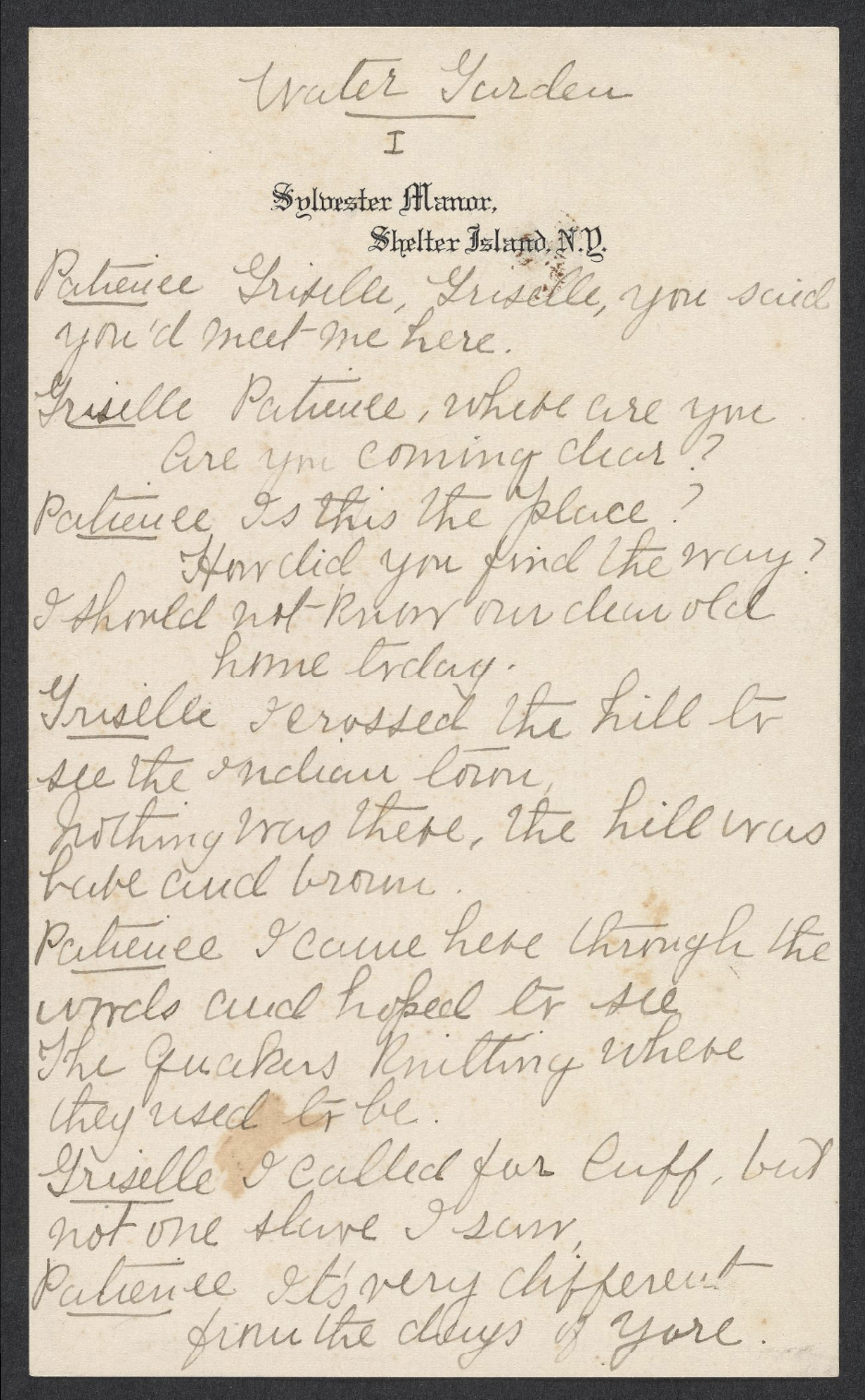
The document which we have selected to accompany Patience’s entry into the family tree is not contemporary to it. Though undated, it has been traced to c. 1870-1930s, and is the first page of a draft of a play about Sylvester Manor which imagines a conversation between Patience and her sister Grizzell (here spelled Griselle) as they return to a barely-recognizable Manor, presumably in the present day. To us, it reads as simultaneously comedic and nostalgic, and it has been included to demonstrate the ways in which the history of the Manor lived continuously in the imaginations of later generations and, more specifically, how the character of Patience was immortalized despite (or perhaps because of) the relative dearth of information about her. Unlike the enslaved women of the Manor – the memory of whom was intentionally erased by later generations of the Sylvester family – the memory of Patience and her sister was consciously preserved, though perhaps poked fun of in this case. Thus, the duality of subject-positions of white women in the 17th and 18th century, who occupied the status of both oppressed and oppressor, is made manifest in this piece of ephemera. The mention of there no longer being enslaved or Indigenous people on the property is particularly noteworthy.
Transcript:
Water Garden
Patience: Griselle, Griselle, you said you’d meet me here
Griselle: Patience, where are you / Are you coming dear?
Patience: Is this the place? / How did you find the way? / I should not know our dear old / home today
Griselle: I crossed the hill to / see the Indian town, / nothing was there, the hill was / bare and brown
Patience: I came here through the / woods and hoped to see / The Quakers knitting where they used to be
Griselle: I called for [Cuff?], but / not one slave I saw
Patience: It’s very different / from the days of yore.
Patience was the second daughter and fifth child of Grizzell and Nathaniel Sylvester. As is the case with her mother, surviving documentation of her life is scarce. However, we can assume that their lives would’ve been similar in many ways. Perhaps the most significant difference is that Patience did not move away from the place of her birth, and did not need to participate in setting up a new home in a foreign land the way her mother would have. She was also much older (around 30) when she married Benjamin L’Hommedieu in 1694. Together, they had five children, and she the matriarch of the latter descendants of the family who lived at the Manor.
The document which we have selected to accompany Patience’s entry into the family tree is not contemporary to it. Though undated, it has been traced to c. 1870-1930s, and is the first page of a draft of a play about Sylvester Manor which imagines a conversation between Patience and her sister Grizzell (here spelled Griselle) as they return to a barely-recognizable Manor, presumably in the present day. To us, it reads as simultaneously comedic and nostalgic, and it has been included to demonstrate the ways in which the history of the Manor lived continuously in the imaginations of later generations and, more specifically, how the character of Patience was immortalized despite (or perhaps because of) the relative dearth of information about her. Unlike the enslaved women of the Manor – the memory of whom was intentionally erased by later generations of the Sylvester family – the memory of Patience and her sister was consciously preserved, though perhaps poked fun of in this case. Thus, the duality of subject-positions of white women in the 17th and 18th century, who occupied the status of both oppressed and oppressor, is made manifest in this piece of ephemera. The mention of there no longer being enslaved or Indigenous people on the property is particularly noteworthy.
Transcript:
Water Garden
Patience: Griselle, Griselle, you said you’d meet me here
Griselle: Patience, where are you / Are you coming dear?
Patience: Is this the place? / How did you find the way? / I should not know our dear old / home today
Griselle: I crossed the hill to / see the Indian town, / nothing was there, the hill was / bare and brown
Patience: I came here through the / woods and hoped to see / The Quakers knitting where they used to be
Griselle: I called for [Cuff?], but / not one slave I saw
Patience: It’s very different / from the days of yore.
Creator
Unknown member of the Horsford family
Source
Sylvester Manor Archive, MSS 208, Fales Library and Special Collections, New York University Libraries
Publisher
Fales Library and Special Collections, New York University Libraries
Date
Undated, circa 1870-1930s
Rights
Permission to use materials must be secured from the copyright holder. Please contact the Fales Library and Special Collections, fales.library@nyu.edu, 212-998-2596.
Type
Manuscript
Files
Citation
Unknown member of the Horsford family, “Draft of Play About Sylvester Manor,” Sylvester Manor, accessed September 17, 2026, https://aphnyu.org/creatingdigitalhistory/2024/sylvestermanor/items/show/5.